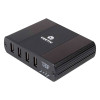
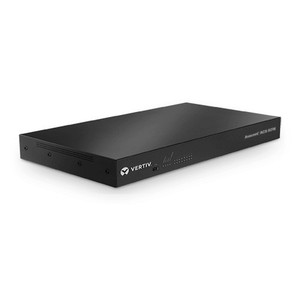
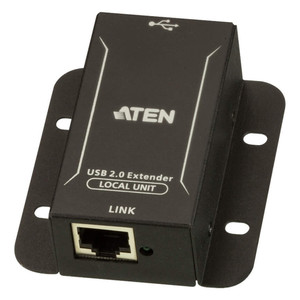
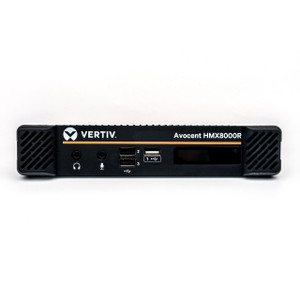
Vertiv USB6000RX LAN USB 2.0 Extender Receiver
Overview
The Vertiv USB6000RX is the receiver unit of the USB6000 LAN USB 2.0 extender system, designed to place USB 2.0 peripherals up to 100 meters from the host computer by transmitting USB signals over a standard GbE LAN infrastructure. Where running individual USB cables is impractical — server rooms, broadcast installations, industrial workstations, or distributed security console setups — this system eliminates the 5-meter USB distance ceiling without specialized cabling. The USB6000RX pairs exclusively with the USB6000TX transmitter unit; together they extend USB device connectivity across existing Ethernet runs.
For integrators working in KVM and USB extension deployments or building out distributed control infrastructure, the USB6000 system leverages the GbE LAN backbone already present in most facilities — no dedicated fiber, no proprietary cable runs, no additional conduit costs. Browse the full Vertiv product line for complementary switching and extension solutions.
Key Features
- 100-Meter USB Extension over GbE LAN: USB 2.0 signals travel up to 100m on standard Cat5e/Cat6 — far beyond the 5m USB specification limit. This means a security workstation, industrial controller, or broadcast console can sit in a secured equipment room while its USB peripherals (cameras, scanners, dongles, storage) operate at the remote end. No repeaters, no active intermediate hardware.
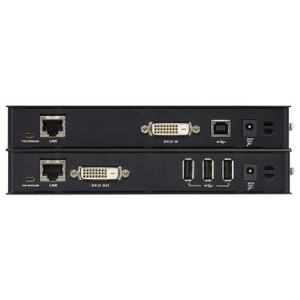
- Four USB 2.0 Ports on the Receiver: The USB6000RX provides four local USB 2.0 ports at the peripheral end. That's enough to connect a keyboard, mouse, USB dongle, and one additional device simultaneously — useful in kiosk builds or operator consoles where multiple input devices must live together at the remote point.
- Single RJ-45 GbE Interface: One RJ-45 port connects the receiver to the LAN, meaning the entire USB extension path runs over the network switch infrastructure already deployed. No dedicated point-to-point cable between transmitter and receiver is required — the two units can exist on opposite ends of a structured cabling system as long as they share L2 connectivity.
- Universal AC Power Input (100–240V, 50–60Hz): The 24V AC adapter accepts any mains voltage worldwide, so this unit deploys in North American, European, or Asian facilities without a transformer or voltage converter. Input current draw is 0.7A — a negligible load on any standard circuit.
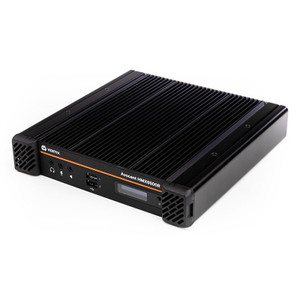
- Metal Enclosure: The black metal chassis provides mechanical durability in rack-adjacent or under-desk installations where plastic housings risk cracking under cable tension or incidental contact. At 100mm × 76mm × 26mm, the receiver is compact enough to mount behind a monitor or inside a shallow equipment enclosure.
- Plug-and-Play Operation: No driver installation is required on the host system. The USB6000 pair enumerates connected USB devices transparently to the operating system — relevant in locked-down enterprise environments where driver installation requires IT approval cycles.
- CE and FCC Certified: Both certifications confirm the unit meets electromagnetic emissions and interference standards for commercial deployment in the EU and US markets — a procurement requirement for many enterprise and government facilities.
Integration & Compatibility
The USB6000RX is the receiver-only component of the USB extender system; it requires the companion USB6000TX transmitter at the host end. The two units communicate over GbE LAN — verify that your network switches support the traffic path between transmitter and receiver, particularly in VLAN-segmented environments where USB multicast or broadcast traffic may be filtered.
USB 2.0 compatibility means the system supports devices operating at High Speed (480 Mbps), Full Speed (12 Mbps), and Low Speed (1.5 Mbps) — covering the vast majority of HID, storage, and dongle devices. USB 3.x devices are not supported; if your peripheral requires USB 3.0 bandwidth, this system is not the correct fit.
Power supplies and structured cabling accessories for your broader installation are available in the power and infrastructure category. For installations requiring simultaneous KVM switching alongside USB extension, review the full KVM switching lineup for integrated solutions.
Frequently Asked Questions
Q: Does the USB6000RX include the transmitter unit?
A: No. The USB6000RX is the receiver unit only. The companion transmitter is the USB6000TX, sold separately. Both units are required to complete the USB extension link.
Q: What is the maximum extension distance for the USB6000RX?
A: The USB6000 system supports a maximum transfer distance of 100 meters over GbE LAN — well beyond the 5-meter native USB 2.0 cable limit.
Q: Does the USB6000RX require driver installation?
A: No. The USB6000RX is plug-and-play — no driver installation is needed on the host computer. Connected USB devices enumerate transparently through the extension link.
Q: What USB version does the USB6000RX support?
A: The USB6000RX supports USB 2.0 (High Speed 480 Mbps, Full Speed 12 Mbps, Low Speed 1.5 Mbps). USB 3.x is not supported.
Q: What power supply does the USB6000RX use?
A: The USB6000RX uses an included AC adapter with a 24V output. The adapter accepts universal AC input from 100–240V at 50–60Hz, drawing 0.7A — compatible with standard mains power globally.
Q: What certifications does the USB6000RX carry?
A: The USB6000RX carries CE and FCC certifications, confirming compliance with electromagnetic emissions standards for commercial deployment in the EU and US.
The USB6000RX handles one specific problem that comes up constantly in distributed security and AV installs: you need a USB peripheral — a hardware dongle, biometric reader, or USB-connected camera — to live 30, 50, or 80 meters from the host machine, and you have GbE LAN already in the walls. Rather than pulling new USB active-extension cables or switching to a different interface entirely, the USB6000RX drops onto the existing network infrastructure and gives you four USB 2.0 ports at the far end. That 100-meter ceiling covers most in-building scenarios without a second hop.
Technical Highlights:
- 100m over GbE LAN: Structured Cat5e/Cat6 runs already present in nearly every commercial building become the USB transport path — no additional cable pulls, no specialized media converters beyond the USB6000TX/RX pair.
- Four USB 2.0 ports at the receiver: Covers the typical remote console load (keyboard + mouse + dongle + one additional device) without a hub. Reduces point-of-failure count at the peripheral end.
- Universal 100–240V AC input: The 24V adapter works on any mains voltage — relevant for multi-region deployments or installations in facilities with non-standard supply voltage.
Deployment Considerations:
- The USB6000RX must be paired with the USB6000TX transmitter — verify the TX unit is on the same order. The receiver is non-functional without it, and the two are not interchangeable with third-party USB-over-LAN units.
- USB 3.x devices will not work through this system. If any peripheral at the remote end requires SuperSpeed USB bandwidth (external SSDs, high-frame-rate capture cards), this extender is the wrong tool — plan for a USB 3.0-capable extension solution instead.
The USB6000RX is well-suited to security operations centers and access control head-end rooms where the computing hardware is locked in a server closet but operators or enrollment stations need USB connectivity at a desk or checkpoint up to 100 meters away — the GbE LAN path means the extension infrastructure is already in place.