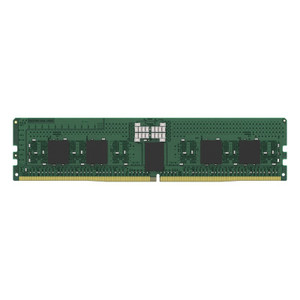
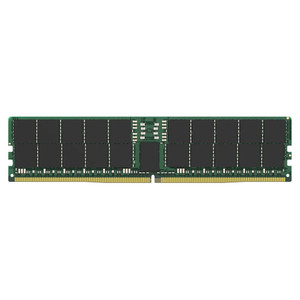
Kingston KSM64R52BD8-32MH 32GB DDR5-6400 ECC Registered DIMM
The Kingston KSM64R52BD8-32MH is a 32GB DDR5 ECC Registered DIMM running at 6400 MT/s — the right stick when you're provisioning a server platform that demands validated memory bandwidth and error correction without compromise. Built on a dual-rank, x8 organization with Micron H-die ICs, this module slots into 288-pin DDR5 RDIMM slots on Intel Xeon Scalable and AMD EPYC platforms where memory stability under sustained load is non-negotiable. If you've ever chased a correctable ECC event log storm on a surveillance NVR or database server, this is the tier of memory that stops those calls at 2 AM.
Overview
At 6400 MT/s, the KSM64R52BD8-32MH sits at the current DDR5 RDIMM performance ceiling for production server workloads. The 2Rx8 (dual rank, x8) configuration keeps signal integrity manageable on multi-DIMM channels while delivering the full 32GB capacity per slot — useful when populating a 16-DIMM platform and needing to maximize memory without stepping up to 64GB sticks. The Micron H-die substrate is not incidental: server OEMs qualify memory at the die level, and H-die RDIMMs clear the QVL hurdles on major platforms more cleanly than generic alternatives.
Key Features
- DDR5-6400 at CAS 52: 6400 MT/s with a row cycle time of 48 ns and CL52 latency. For workloads that stream large sequential datasets — video analytics buffers, large NVR frame caches, AI inference pipelines — the raw bandwidth matters more than absolute latency. You get both in the same module.
- ECC with On-Die ECC (ODECC): Two layers of error correction running simultaneously. On-Die ECC corrects single-bit errors within the DRAM die before they hit the memory bus; the registered ECC channel layer then handles any errors the bus introduces. Sustained 24/7 server operation — common in surveillance back-ends — accumulates far more bit-flip exposure than desktop use. This architecture is built for exactly that.
- Registered (Buffered) Architecture: The register buffer on this RDIMM re-drives command and address signals, allowing the memory controller to drive more DIMMs per channel without signal degradation. On platforms with 4–8 DIMM slots per channel, unbuffered DIMMs simply cannot maintain signal integrity at 6400 MT/s — registered DIMMs are the only viable option.
- 1.1V Operating Voltage with 1.8V VPP: DDR5's lower core voltage (1.1V vs DDR4's 1.2V) reduces per-module power draw. On a fully populated 8-DIMM server that runs continuously, this is a measurable reduction in PSU load and heat output — relevant when you're calculating rack power budgets for a surveillance server room.
- 288-Pin DIMM Form Factor: Standard DDR5 server slot footprint. Pairs with DDR5-capable server motherboards on Intel Sapphire Rapids, Emerald Rapids, and AMD Genoa/Bergamo platforms. Not backward-compatible with DDR4 slots — verify your platform's memory generation before ordering.
- Operating Temperature 0–95°C: The 95°C upper limit reflects JEDEC DDR5 junction temperature tolerance, not ambient. In a properly ventilated 1U or 2U chassis, this gives adequate thermal headroom, but do not run this module without adequate airflow — DDR5 at 6400 MT/s generates more heat per stick than DDR4 predecessors.
- Storage Temperature Range -55–100°C: Broad storage tolerance means modules can be staged in warehouse environments without special climate control — practical for integrators holding inventory across a project lifecycle.
- Row Active Time (tRAS) 32 ns, Row Precharge Time (tRP) 16 ns: These secondary timings define how quickly the DRAM array can cycle between row activations. At 6400 MT/s, tightened secondary timings translate to higher effective bandwidth on random-access workloads — relevant for database-backed VMS platforms and AI inference servers pulling from large frame buffers.
Integration and Compatibility
The KSM64R52BD8-32MH (often searched as KSM64R52BD8 32MH) is designed for DDR5 RDIMM slots on server-grade platforms. DDR5 RDIMMs require a compatible memory controller — consumer DDR5 platforms use unbuffered DIMMs (UDIMMs) and will not accept registered modules. Always cross-reference against your motherboard's QVL before deploying. The Micron H-die specification is relevant when platform QVLs call out specific DRAM component vendors. For server memory deployments mixing capacities, Kingston publishes channel population rules — follow them; mixing 1Rx8 and 2Rx8 modules on the same channel will typically force the controller into a lower-performance mode. For high-availability configurations, pair with a UPS solution to protect against dirty power events that can trigger uncorrectable ECC errors even on registered DIMMs. If you're sizing memory for a network video recorder or AI-assisted analytics server, consult the platform's memory bandwidth requirements against the channel count you're populating — DDR5-6400 on a 4-channel platform delivers substantially more aggregate throughput than a 2-channel configuration at the same per-DIMM spec.
Frequently Asked Questions
Q: Is the KSM64R52BD8-32MH compatible with consumer desktop motherboards?
A: No. This is a Registered (Buffered) DIMM (RDIMM), which requires a server-grade memory controller. Consumer desktop platforms use unbuffered DIMMs (UDIMMs). Installing an RDIMM in a UDIMM slot will result in the system not posting. Verify your platform uses DDR5 RDIMM slots before ordering.
Q: What does the Micron H-die designation mean for compatibility?
A: The Micron H-die refers to the specific DRAM die vendor and silicon revision used in this module. Some server OEM qualified vendor lists (QVLs) specify memory at the die level, not just the module vendor. If your platform QVL explicitly lists Micron H-die DDR5-6400 RDIMMs, this module satisfies that requirement.
Q: Can I mix the KSM64R52BD8-32MH with other capacity DDR5 RDIMMs on the same server?
A: Mixing DIMM capacities is technically possible on many platforms but often forces the memory controller into a compatibility mode that reduces effective bandwidth. For optimal performance at 6400 MT/s, populate all slots in a channel with matched modules. Check your motherboard's memory population rules before mixing.
Q: What is the operating voltage and does it affect power supply sizing?
A: This module operates at 1.1V core voltage with a 1.8V VPP (programming power). DDR5's lower core voltage compared to DDR4 (1.2V) reduces per-DIMM power draw, which is meaningful when calculating PSU headroom on a fully populated server chassis running 24/7.
Q: Does this module support On-Die ECC in addition to standard ECC?
A: Yes. The KSM64R52BD8-32MH includes On-Die ECC (ODECC), which corrects single-bit errors within the DRAM die before they reach the memory bus, in addition to the standard registered ECC that operates at the channel level. This dual-layer error correction is a DDR5 architectural feature and is particularly valuable in continuous-operation server environments.
Q: What is the refresh row cycle time and why does it matter for server workloads?
A: The refresh row cycle time (tRFC) for this module is 295 ns. DRAM must periodically refresh all rows to retain data integrity. A longer tRFC means more time spent refreshing rather than serving data requests. At 6400 MT/s, the controller is optimized to schedule refresh operations to minimize impact on memory bandwidth — but tRFC is a fixed hardware parameter that affects maximum sustainable throughput under mixed read/write workloads.
The KSM64R52BD8-32MH is one of those modules I specifically reach for when a client is building a surveillance analytics server or a multi-channel NVR back-end on a DDR5 platform and can't afford memory-related instability. The dual-layer ECC story — On-Die ECC at the silicon level combined with registered ECC at the channel — is genuinely meaningful for 24/7 operation, not a marketing footnote. The 295 ns refresh row cycle time tells me this module was binned for server workloads where the memory controller needs predictable scheduling behavior.
Technical Highlights:
- 6400 MT/s with CL52 / tRAS 32 ns: At 6400 MT/s and a row active time of 32 ns, you're getting DDR5's current production ceiling for RDIMMs. This translates directly to higher aggregate memory bandwidth on multi-channel platforms — relevant when feeding multiple AI inference threads or large video decode pipelines simultaneously.
- On-Die ECC + Registered ECC: Two independent error correction layers. ODECC catches bit flips within the die; channel-level ECC catches anything introduced on the bus. Running surveillance servers in environments with power quality variation or elevated temperatures, this combination keeps your ECC log clean rather than flooding it with correctable events.
- 1.1V Core / 1.8V VPP: Lower operating voltage than DDR4 means measurably less heat per module. On a 16-DIMM server chassis, the cumulative thermal reduction affects fan duty cycle and long-term component stress — a real factor in sealed or space-constrained deployments.
Deployment Considerations:
- Verify your motherboard QVL explicitly supports DDR5-6400 RDIMMs with Micron H-die before ordering — some platforms support 6400 MT/s only with specific die vendors or require a BIOS update to enable XMP/EXPO profiles at rated speed.
- Watch out for mixed-rank deployments: combining this 2Rx8 module with 1Rx8 sticks on the same channel will typically force the memory controller to its lowest common denominator speed, negating the 6400 MT/s spec entirely.
This module is the right call for a purpose-built DDR5 surveillance analytics server or AI inference appliance where you're running Milestone, Genetec, or a custom frame-processing stack 24/7 and need both the bandwidth ceiling and the error correction to keep the platform stable across years of continuous operation.