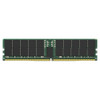
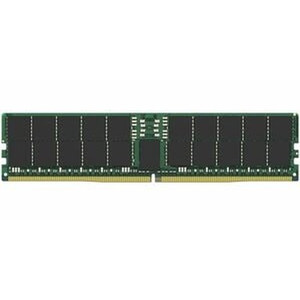
Kingston KSM64R52BD4-64MH 64GB DDR5-6400 ECC Registered Server DIMM
Overview
The Kingston KSM64R52BD4-64MH is a 64GB DDR5 ECC Registered DIMM running at 6400 MT/s — a high-density, high-bandwidth module built for workloads that demand memory reliability and throughput in equal measure. Populated on a 288-pin DIMM form factor with a 2Rx4 dual-rank organization and Micron H-die ICs, this module slots into DDR5 RDIMM-capable server and workstation platforms where mission-critical uptime is non-negotiable. At 1.1V operating voltage, it draws less power than equivalent DDR4 configurations while delivering nearly double the peak bandwidth, a meaningful efficiency gain across multi-socket compute nodes running 24/7.
Key Features
- 64GB per DIMM at 6400 MT/s: A single module delivers 51.2 GB/s of peak theoretical bandwidth — enough headroom for in-memory databases, virtualization hypervisors, and AI inference workloads that would otherwise hit a memory wall at DDR4 speeds. Fewer DIMMs needed per channel to reach target capacity, which simplifies thermal management in dense 1U and 2U chassis.
- ECC (Error-Correcting Code): Hardware-level single-bit error correction and multi-bit error detection run continuously in the background without software overhead. For production database servers or surveillance NVR platforms recording from dozens of concurrent streams, silent data corruption from cosmic ray bit-flips is a real risk — ECC eliminates it without a performance penalty.
- On-Die ECC (ODECC): DDR5's native on-die ECC operates inside each DRAM die before data ever reaches the memory controller. This is separate from, and additive to, the system-level ECC — providing a first layer of correction at the cell level. The result is measurable improvement in effective MTBF for long-running server deployments.
- Registered (Buffered) DIMM architecture: The register on the DIMM buffers the command and address signals between the memory controller and the DRAM ICs. This is what allows high-capacity configurations — 8-DIMM and 16-DIMM fully loaded systems — without signal integrity degradation. Unregistered (UDIMM) modules cannot scale to these densities.
- CAS Latency 52 (CL52) at 6400 MT/s: The absolute latency in nanoseconds is what matters for latency-sensitive workloads. At 6400 MT/s with CL52, actual CAS latency computes to approximately 16.25 ns — competitive with DDR4-3200 CL22 (13.75 ns) in absolute terms while providing far greater bandwidth. For throughput-bound workloads (streaming, encoding, bulk inference), the bandwidth advantage dominates.
- 1.1V operating voltage: DDR5 runs at 1.1V versus DDR4's 1.2V. Across a 16-DIMM fully loaded server, that differential adds up to measurable rack-level power savings — relevant when calculating PUE in large-scale deployments or when power budgets are tight in edge compute enclosures.
- 2Rx4 dual-rank organization: Two independent ranks per DIMM allow the memory controller to interleave accesses across ranks, improving effective throughput in read-heavy workloads. The x4 device width also provides more granular ECC coverage per chip compared to x8 configurations — a design choice that strengthens data integrity for enterprise use.
- Micron H die: The KSM64R52BD4-64MH uses Micron H-die DRAM components. Die vendor and revision matter for system qualification lists (QVL) — many server platform vendors qualify specific die revisions for stable operation at rated speeds. Micron H is a current production die with broad platform support across major server OEM QVLs.
- Operating temperature 0–95°C: Rated for the full thermal range of air-cooled server environments, including high-ambient edge deployments where rack inlet temperatures may exceed typical data center norms. The 95°C upper limit reflects JEDEC compliance for server-class modules.
- Row cycle time 48 ns / Refresh row cycle time 295 ns: These timing parameters define the underlying DRAM array performance characteristics. The 295 ns tRFC is within DDR5 JEDEC specification for 16Gb die density, ensuring compatibility with standard memory controller refresh scheduling without requiring custom BIOS tuning.
Integration and Compatibility
The KSM64R52BD4-64MH (often searched as KSM64R52BD4 64MH) requires a DDR5 RDIMM-compatible server or workstation motherboard. DDR5 RDIMMs are not backward compatible with DDR4 slots — verify your platform supports DDR5 RDIMM before ordering. Check your motherboard or server OEM's QVL for this specific MPN and die revision to confirm rated-speed operation; platforms that do not explicitly list this module may default it to a lower validated speed. The 288-pin DIMM form factor is standard for desktop and server DDR5, but RDIMM specifically targets server platforms — consumer Z-series and HEDT motherboards typically require UDIMMs, not RDIMMs. For server memory deployments, confirm whether your platform supports 2DPC (two DIMMs per channel) at 6400 MT/s, as many DDR5 platforms down-clock to 5600 or 4800 MT/s when both DIMM slots per channel are populated. Single-DIMM-per-channel configurations are most likely to sustain rated 6400 MT/s speeds.
Frequently Asked Questions
Q: What server platforms is the KSM64R52BD4-64MH compatible with?
A: This module requires a DDR5 RDIMM-compatible server or workstation platform. It uses a 288-pin DIMM form factor with Registered (buffered) architecture. Verify your platform's QVL for this specific MPN and Micron H die revision. Consumer motherboards with DDR5 slots typically require UDIMMs, not RDIMMs.
Q: Does the KSM64R52BD4-64MH support ECC?
A: Yes — it supports both system-level ECC (hardware error correction and detection via the memory controller) and DDR5 On-Die ECC (ODECC), which corrects single-bit errors within each DRAM die before data reaches the controller. These two layers operate independently and additively.
Q: Will this module run at 6400 MT/s in a dual-DIMM-per-channel configuration?
A: Potentially not. Many DDR5 server platforms reduce maximum supported speed when both DIMM slots per channel are populated (2DPC). Single DIMM per channel (1DPC) configurations are most likely to sustain the rated 6400 MT/s. Consult your motherboard or server OEM documentation for 2DPC speed limits.
Q: What is the operating voltage of the KSM64R52BD4-64MH?
A: 1.1V operating voltage, with a VPP (programming power voltage) of 1.8V. These are standard DDR5 RDIMM voltage levels per JEDEC specification.
Q: What are the operating and storage temperature ranges?
A: Operating temperature is 0–95°C. Storage temperature range is -55°C to 100°C. These ratings cover standard server room and edge compute environments.
Q: Is this a registered (buffered) or unbuffered DIMM?
A: Registered (buffered). The RDIMM architecture buffers command and address signals, enabling high-density multi-DIMM configurations that unbuffered modules cannot support at scale. This module is not suitable for platforms that require UDIMMs.
When customers ask me about the KSM64R52BD4-64MH, the first thing I flag is the dual-layer ECC story — on-die ECC at the DRAM cell level plus system-level ECC through the memory controller. That combination is not marketing language; it reflects how DDR5 RDIMM architecture actually works, and it matters if you are running a platform where unplanned reboots from uncorrected memory errors carry real cost. At 6400 MT/s with a 2Rx4 organization, this module is built for server environments, not workstations or prosumer builds.
Technical Highlights:
- 6400 MT/s bandwidth: Peak theoretical throughput of approximately 51.2 GB/s per channel — roughly double DDR4-3200 bandwidth. For analytics servers or video management platforms processing high-frame-rate streams from large camera counts, this bandwidth headroom reduces the risk of memory becoming the bottleneck under burst load.
- 1.1V operating voltage with VPP 1.8V: Standard DDR5 RDIMM voltage envelope. In a fully loaded 16-DIMM server configuration, the per-DIMM voltage reduction versus DDR4 compounds across the system — worth factoring into power budget calculations for edge or branch deployments with constrained UPS capacity.
- CL52 / tRCD 52 / tRP 16 / tRC 48 ns: The timing profile is consistent with JEDEC-spec DDR5-6400 for server-class modules. Row precharge time of 16 cycles and row cycle time of 48 ns are parameters your BIOS will read from the SPD — no manual tuning expected on a properly validated platform.
Deployment Considerations:
- Confirm RDIMM support on your specific motherboard revision before ordering — not all DDR5 platforms support RDIMMs. Some platforms support both RDIMM and UDIMM, but they cannot be mixed in the same system. Check the OEM QVL for Micron H die specifically, as die revision affects qualification at rated speed.
- The 95°C operating temperature ceiling is the JEDEC limit for the module, but your system's thermal management must keep DIMM temperatures below that threshold. In dense 2U servers with inadequate airflow, sustained operation near thermal limits accelerates DRAM wear — validate inlet air temperature and fan curve before full deployment.
This module is the right call for high-density DDR5 server builds — particularly platforms running virtualization hypervisors or in-memory data services where 64GB per slot density minimizes slot consumption and the Micron H die provides solid QVL coverage across current-generation Intel Xeon and AMD EPYC platforms.