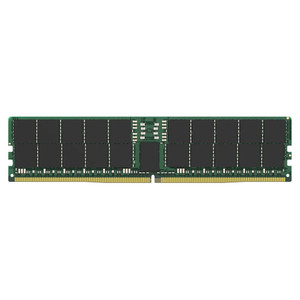
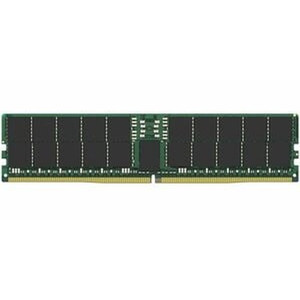
Kingston KSM64R52BD4-96MC 96GB DDR5-6400 ECC Registered Server DIMM
Overview
The Kingston KSM64R52BD4-96MC is a 96GB DDR5-6400 ECC Registered DIMM engineered for enterprise servers where memory capacity, data integrity, and sustained throughput are non-negotiable. Running at 6400 MT/s with a 2Rx4 dual-rank configuration and Micron C-die, this module targets high-core-count platforms — AI inference nodes, database servers, and virtualization hosts — where filling out memory channels with high-density DIMMs is the primary path to maximizing available bandwidth. If your server spec sheet calls for RDIMM DDR5 at 6400 MT/s, this is the part to evaluate first.
Key Features
- 96GB Single-Module Density: At 96GB per stick in a 1x96GB configuration, you can reach multi-terabyte memory populations without exhausting every DIMM slot — critical on platforms where channel saturation degrades bandwidth. Fewer DIMMs also means less signal loading on the memory bus, which matters at 6400 MT/s.
- DDR5-6400 Transfer Rate: 6400 MT/s is at the high end of the DDR5 JEDEC-defined speed grades. For memory-bound workloads — in-memory analytics, large language model inference, columnar database scans — the bandwidth uplift over DDR5-4800 or DDR5-5600 base specs translates directly to reduced query and inference latency.
- CAS Latency 52 (CL52): CL52 at 6400 MT/s works out to an absolute latency of roughly 16.25ns — competitive for DDR5 at this speed grade. For workloads that are latency-sensitive rather than bandwidth-sensitive (OLTP, key-value stores), verify your platform's memory controller supports CL52 optimization at this speed bin.
- ECC with On-Die ECC: Two layers of error correction are active simultaneously. On-Die ECC (ODEC) corrects single-bit errors within the DRAM die itself before data ever leaves the chip; the Registered DIMM's standard ECC layer then covers the DIMM-to-controller path. This stacked approach is especially relevant for high-density DDR5 modules where the raw bit-error rate per gigabit is higher than DDR4.
- Registered (Buffered) Architecture: The register on an RDIMM re-drives command and address signals, allowing the memory controller to support higher DIMM counts and densities than an unbuffered DIMM could sustain. If your server is a validated RDIMM platform, this module fits the spec; LRDIMMs and UDIMMs are electrically incompatible — don't mix.
- 2Rx4 Dual-Rank Organization: Two ranks per module give the memory controller more rows to interleave across, improving effective bandwidth utilization on multi-channel platforms. The x4 device width is the widest DDR5 SDRAM configuration, contributing to the per-die ODEC coverage and the full 96GB capacity in a standard 288-pin footprint.
- 1.1V Operating Voltage: DDR5's native 1.1V supply (down from DDR4's 1.2V) reduces per-module power draw. In a fully-populated server with 16 or 24 DIMM slots, that delta adds up across the power budget and the cooling infrastructure required to remove the heat.
- JEDEC Standard Compliance: This module conforms to JEDEC DDR5 RDIMM specifications, which means it will operate at its rated speed on any server platform whose QVL (Qualified Vendor List) or BIOS has validated DDR5-6400 RDIMMs — no proprietary XMP/EXPO profiles required, no manual overclocking needed.
- 0–95°C Operating Temperature Range: The wide thermal envelope (0–95°C case temperature) covers standard server inlet conditions through extended workloads without triggering thermal throttling, provided chassis airflow meets the server OEM's specifications for high-density DIMMs.
- Precise Timing Parameters: Row cycle time of 48ns, row active time (tRAS) of 32ns, row precharge time (tRP) of 16ns, and refresh row cycle time of 410ns are JEDEC-standard values for DDR5-6400. These are not tunable on a registered platform — the BIOS loads them from the SPD — but matching these to your workload's access pattern confirms the module is correctly binned for your speed grade.
Integration and Compatibility
The KSM64R52BD4-96MC (often searched as KSM64R52BD4 96MC) is built for enterprise server platforms — generation 4 and 5 Intel Xeon Scalable and AMD EPYC 9004/9005-series systems are the primary targets for DDR5-6400 RDIMMs. Before purchasing, cross-reference your server OEM's QVL: DIMM slot count, rank mixing rules, and per-channel DIMM count each affect whether a given platform will POST at the rated 6400 MT/s or fall back to a lower speed bin. Mixing this module with DIMMs of different density, rank count, or speed grade in the same channel is generally unsupported and may cause the system to train to the lowest common denominator. Kingston's server memory line is engineered and tested to JEDEC tolerances; consult your platform's server memory QVL documentation before committing to a bulk order. For systems running demanding virtualization or AI workloads, pairing high-density DDR5 registered memory with a properly sized NVMe storage tier prevents memory-swap bottlenecks from masking the bandwidth gains. If you are planning a multi-socket or high-DIMM-count deployment, reviewing a memory capacity planning guide before finalizing your BOM will help avoid costly rank-mixing or channel-imbalance issues. Kingston's broader Kingston server memory catalog covers additional DDR5 speed grades and densities if this specific bin doesn't match your platform's QVL.
Frequently Asked Questions
Q: Is the KSM64R52BD4-96MC compatible with unbuffered (UDIMM) or load-reduced (LRDIMM) server platforms?
A: No. This is a Registered DIMM (RDIMM). RDIMM, UDIMM, and LRDIMM are electrically incompatible — your server's memory controller must specifically support RDIMMs. Check your server OEM's QVL before ordering.
Q: What does On-Die ECC add over standard ECC on this module?
A: On-Die ECC corrects single-bit errors within the DRAM die itself before the data leaves the chip. Standard ECC then covers the DIMM-to-controller bus. The KSM64R52BD4-96MC implements both layers, which is particularly valuable at 96GB densities where per-die bit error exposure is higher than on lower-density DDR4 modules.
Q: Will this DIMM run at 6400 MT/s out of the box, or does it require XMP/EXPO profile activation?
A: This module is JEDEC-standard at DDR5-6400. No XMP or EXPO profile is needed — the speed and timings (CL52, tRAS 32ns, tRP 16ns, tRC 48ns) are encoded in the SPD and loaded automatically by a compatible server BIOS. Confirm your platform's QVL supports DDR5-6400 RDIMMs.
Q: Can I mix the KSM64R52BD4-96MC with other DDR5 RDIMM densities or speeds in the same server?
A: Mixing is generally not recommended and often unsupported. Different densities, ranks, or speed grades in the same channel typically force the memory controller to train to the lowest common denominator, negating the 6400 MT/s advantage. Populate channels with matched DIMMs for best results.
Q: What is the operating voltage, and does this module require special power delivery from the server?
A: The KSM64R52BD4-96MC operates at 1.1V, which is the standard DDR5 supply voltage. No special power delivery is required beyond what any DDR5-capable server platform already provides. The 0–95°C operating temperature range requires adequate chassis airflow per your server OEM's thermal spec for high-density DIMMs.
Q: What server generations is this module designed for?
A: DDR5-6400 RDIMMs target 4th/5th-generation Intel Xeon Scalable and AMD EPYC 9004/9005-series platforms (and successors) with DDR5-capable memory controllers. Always verify against your specific server model's QVL — not every DDR5 platform validates at 6400 MT/s with 96GB 2Rx4 modules.
The KSM64R52BD4-96MC is one of the denser single-slot DDR5 options available for enterprise platforms right now — 96GB at 6400 MT/s in a 2Rx4 RDIMM footprint. The Micron C-die spec matters here: die quality and bin consistency directly affect whether a platform trains reliably at full 6400 MT/s speed across all populated channels, especially once you move beyond four DIMMs per processor. That dual-layer ECC story — On-Die ECC plus registered-path ECC — is not just a checkbox; at 96GB of DRAM per module, the raw bit-cell count per die is high enough that ODEC provides meaningful protection that standard path-level ECC alone would miss.
Technical Highlights:
- Dual-Layer ECC (ODEC + RDIMM ECC): On-Die ECC handles intra-die single-bit errors before they reach the bus; the RDIMM register layer covers the command/address path. Both operate simultaneously — relevant for always-on workloads where silent data corruption is a harder risk to accept than a correctable ECC event.
- CL52 at 6400 MT/s = ~16.25ns absolute latency: For reference, DDR5-4800 CL40 is roughly 16.67ns — so this module trades a modest CAS increment for a 33% bandwidth increase. For throughput-bound workloads that is a straightforward win; for sub-microsecond OLTP you will want to validate actual platform latency via memory benchmark before committing to a large deployment.
- 1.1V, 0–95°C thermal envelope: 1.1V is standard DDR5, but at 96GB and 6400 MT/s, per-module dissipation is higher than a 32GB DDR5-4800 stick. Factor airflow requirements into rack density planning — a fully-populated 24-DIMM tray of these will draw and dissipate meaningfully more than a sparser lower-speed configuration.
Deployment Considerations:
- QVL verification is non-negotiable before ordering at this density and speed grade. Not every DDR5 server platform has validated 96GB 2Rx4 modules at 6400 MT/s — a BIOS fallback to 5600 MT/s or 4800 MT/s will silently cost you the bandwidth you paid for.
- Rank mixing across channels is the most common deployment mistake with high-density RDIMMs. If any channel in the system contains a mismatched rank count or density relative to other channels, expect either a POST failure or a forced speed downgrade to the lowest validated configuration.
This module is the right pick for AI inference and in-memory analytics deployments where you are trying to maximize per-socket memory bandwidth with the fewest DIMMs possible — not for general-purpose virtualization hosts where 32GB or 48GB DDR5-4800 modules are often the more cost-effective fill strategy.