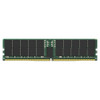
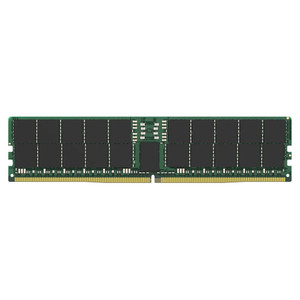
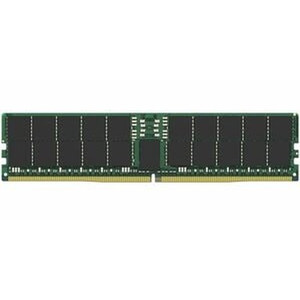
Kingston KSM64R52BD4-64MD 64GB DDR5-6400 ECC Registered Server DIMM
Overview
The Kingston KSM64R52BD4-64MD is a 64GB DDR5 ECC Registered DIMM running at 6400 MT/s — a high-density, high-speed module engineered for enterprise servers and workstations that demand both throughput and data integrity. Built around a 2Rx4 dual-rank topology with Micron D-die, this module delivers the bandwidth headroom that memory-intensive workloads — database engines, virtualization hosts, AI inference stacks — actually need. If your platform supports DDR5 RDIMM at 6400 MT/s, the KSM64R52BD4-64MD is a straightforward answer for populating capacity without sacrificing error correction.
Key Features
- 64GB Single-Module Density: A single DIMM delivers 64GB in a 1x64GB configuration, meaning you can reach high total capacities with fewer slots occupied — useful in servers where slot count is limited or you need to leave headroom for future expansion without a full memory replacement cycle.
- DDR5-6400 MT/s Transfer Rate: At 6400 MT/s, this module sits at the upper end of current DDR5 server speeds. Compared to DDR5-4800 common in first-gen platforms, the bandwidth increase directly benefits latency-sensitive workloads like in-memory databases and real-time analytics pipelines.
- ECC Registered (RDIMM) Architecture: The registered buffer on this DIMM offloads signal integrity management from the memory controller, allowing large-capacity, multi-DIMM configurations that unbuffered DIMMs cannot support at scale. Required for most server-class platforms — do not attempt to use this in a consumer desktop motherboard.
- On-Die ECC (ODECC): In addition to the system-level ECC correction handled by the host controller, this module includes on-die ECC within the DRAM itself. ODECC catches single-bit errors before they even reach the memory bus — a second layer of protection relevant in environments where uptime and data integrity are non-negotiable.
- CAS Latency 52 (CL52): At DDR5-6400, CL52 represents a competitive absolute latency figure. The row cycle time of 48 ns and row active time of 32 ns reflect a timing profile tuned for throughput-oriented server access patterns rather than tight gaming-style latencies.
- 1.1V Operating Voltage: Running at 1.1V, this module is within the standard DDR5 server voltage spec. Compared to DDR4 at 1.2V, the lower per-module power draw becomes meaningful across densely populated 8- or 16-DIMM configurations where aggregate memory power is a rack thermal factor.
- 288-Pin DIMM Form Factor: Standard 288-pin DDR5 DIMM physical interface — compatible with server platforms and workstations using DDR5 RDIMM slots. The module configuration is 8192M x 80, reflecting the 64GB capacity with the additional ECC data width bits included.
- SPD Profile Present: An SPD (Serial Presence Detect) profile is programmed on this module, allowing the host system to correctly identify speed, timings, voltage, and configuration at boot without manual BIOS tuning. In enterprise deployments where modules are swapped or added by field technicians, verified SPD data reduces configuration errors.
- 1.8V VPP (Programming Power Voltage): The module operates at a VPP of 1.8V, the standard for DDR5 DRAM activation voltage. This is a platform-level consideration — confirm your server's VPP rail is within spec before deployment in non-reference platform configurations.
- 2Rx4 Dual-Rank Architecture: The dual-rank layout enables the memory controller to interleave between ranks, improving effective bandwidth utilization. In practice, a 2Rx4 module will often outperform a single-rank (1Rx8) module of equal capacity in multi-threaded server workloads.
Integration & Compatibility
The KSM64R52BD4-64MD is designed for server and workstation platforms with DDR5 RDIMM support at 6400 MT/s. The 2Rx4 configuration requires a memory controller that supports dual-rank DDR5 operation — verify your platform's QVL (Qualified Vendor List) before ordering. This module is built with Micron D-die, which may be a specific compatibility requirement on certain server platforms that distinguish between die vendors for validation purposes. It is not compatible with consumer desktop DDR5 slots, LPDDR5 mobile platforms, or any DDR4 systems. The refresh row cycle time of 295 ns is within JEDEC DDR5 specifications and does not require special controller configuration. For multi-channel configurations, populate slots per your platform's memory population guide to avoid running in degraded single-channel mode.
Frequently Asked Questions
Q: Is the KSM64R52BD4-64MD compatible with consumer desktop DDR5 motherboards?
A: No. This is a Registered (Buffered) DIMM — RDIMMs are not compatible with consumer desktop platforms, which require unbuffered (UDIMM) memory. This module is designed exclusively for server and workstation platforms that explicitly support DDR5 RDIMM.
Q: What does On-Die ECC mean for this module, and how is it different from standard ECC?
A: On-Die ECC (ODECC) is error correction built into the DRAM die itself, operating before data reaches the memory bus. Standard (system-level) ECC is handled by the memory controller and corrects errors across the bus. The KSM64R52BD4-64MD has both: ODECC at the die level and standard ECC via the RDIMM architecture — providing two independent layers of single-bit error protection.
Q: Does the KSM64R52BD4-64MD require a specific die vendor to be compatible with my server?
A: Some server platforms validate memory by die vendor (Micron, Samsung, Hynix) and will only boot or operate at rated speed with specific die configurations. This module uses Micron D-die — check your server's QVL documentation to confirm Micron D-die is on the validated list for your platform and speed bin.
Q: Can this module run at speeds below 6400 MT/s for compatibility with older DDR5 platforms?
A: DDR5 RDIMMs can typically operate at lower speeds if the platform's memory controller supports speed-stepping. However, verified operation at reduced speeds depends on your specific platform — consult your server vendor's QVL and BIOS documentation. The SPD profile on this module provides the rated 6400 MT/s configuration data to the host system automatically.
Q: What is the operating voltage of the KSM64R52BD4-64MD and does it draw more power than DDR4?
A: This module operates at 1.1V VDD, which is lower than typical DDR4 server DIMMs at 1.2V. The VPP (activation voltage) is 1.8V. In aggregate, DDR5 server memory generally offers better performance-per-watt than DDR4, though total system memory power in a fully populated server still requires thermal planning.
The KSM64R52BD4-64MD is one of the more capable DDR5 server DIMMs available at this density point — the combination of 6400 MT/s, dual-rank 2Rx4 topology, and Micron D-die makes it a deliberate spec choice rather than a commodity fill. When I look at this module, the detail that stands out most is the dual-layer ECC story: On-Die ECC at 1.1V working alongside the registered buffer's system-level correction. That's meaningful for deployments where silent data corruption is a real risk, not just a checkbox.
Technical Highlights:
- DDR5-6400 MT/s with CL52: At 48 ns row cycle time, this module delivers bandwidth headroom that benefits multi-threaded workloads — expect meaningful throughput gains over DDR5-4800 in memory-bound server applications like in-memory databases or VM hosting.
- 2Rx4 Dual-Rank: The dual-rank configuration lets the memory controller interleave across ranks, improving effective utilization in parallel workloads. A 2Rx4 module consistently outperforms equivalent-capacity 1Rx8 modules in server-class access patterns.
- On-Die ECC + Registered Architecture: Two independent error-correction layers — ODECC catches intra-die single-bit errors before they hit the bus, while the RDIMM's registered buffer supports the system-level ECC handled by the host controller. The refresh row cycle time of 295 ns stays within JEDEC DDR5 spec, keeping correction overhead predictable.
Deployment Considerations:
- Micron D-die specificity matters on some platforms — AMD EPYC and Intel Xeon Scalable QVLs sometimes distinguish between die vendors at 6400 MT/s. Pull the QVL before provisioning, not after the modules arrive on-site.
- At 1.8V VPP, confirm the server's power delivery rail is within spec — non-reference platform integrations (custom boards, edge compute nodes) occasionally have VPP variance that causes instability at rated speed even when VDD is correct.
This module is the right fit for a high-density AI inference or database server build where you need 64GB per slot, DDR5-6400 bandwidth, and dual-layer ECC without stepping up to proprietary memory configurations — specifically platforms like 4th/5th gen Intel Xeon or AMD EPYC 9004-series that support validated DDR5-6400 RDIMM operation.