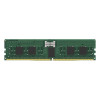
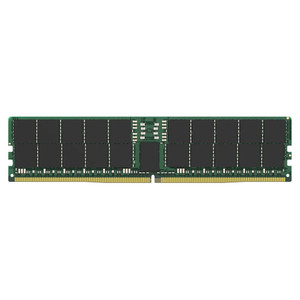
Kingston KSM56R46BS8PMI-24MBI 24GB DDR5-5600 ECC Registered Server DIMM
Overview
The Kingston KSM56R46BS8PMI-24MBI is a 24GB DDR5 Registered ECC DIMM running at 5600 MT/s — a single-rank, 1Rx8 module built around Micron B-die with a Renesas register clock driver. This is purpose-built server memory: the ECC and registered (buffered) design are required by workstation and server platforms that demand data integrity and signal stability across multi-DIMM configurations. If you're populating a DDR5 RDIMM slot on a current-generation Intel Xeon Scalable or AMD EPYC platform, this module is sized and spec'd for that use case.
The 24GB density is a deliberate choice for memory-optimized server builds. In a dual-channel or quad-channel configuration across a full-population board, 24GB per slot adds up to usable capacity tiers (e.g., 96GB on a 4-slot system or 192GB on an 8-slot system) without the cost premium of 32GB or 48GB modules. For server memory upgrades, this density hits a practical sweet spot between cost-per-GB and aggregate capacity.
Key Features
- DDR5-5600 (5600 MT/s) data rate: At 5600 MT/s, this module runs at the high end of the current DDR5 JEDEC mainstream stack. Faster memory bandwidth directly benefits workloads that are memory-throughput limited — databases, in-memory analytics, virtualization hypervisors with many concurrent VMs. It's meaningfully faster than DDR5-4800 baseline and aligns with what current Intel Xeon and AMD EPYC platforms can actually saturate.
- ECC (Error-Correcting Code) with On-Die ECC: Two layers of error correction are in play here. On-Die ECC (ODECC) corrects single-bit errors within the DRAM die itself before they hit the memory bus — a DDR5 architectural requirement. The module-level ECC then provides the SECDED (single-error-correct, double-error-detect) protection that server platforms enforce. For a security recorder, NVR, or edge compute node running 24/7, this means silent memory corruption is caught and corrected rather than silently corrupting data.
- Registered (Buffered) design with Renesas RCD: The Renesas register clock driver re-drives the command and address signals, decoupling the memory controller's electrical load from the DRAM components. This is what makes it possible to run 4–8 DIMMs per channel without signal integrity problems. Unbuffered (UDIMM) memory simply cannot do this reliably at high slot counts — use RDIMMs when your platform and workload require maximum capacity.
- Single-rank, 1Rx8 topology: A 1Rx8 module activates one rank at a time and uses x8-width DRAM chips. Compared to a 2Rx8 of the same capacity, a 1Rx8 has lower rank-switching overhead, which matters for latency-sensitive workloads. It also typically yields better signal integrity margins on crowded memory buses.
- CAS Latency 46 (CL46) at 5600 MT/s: CL46 is the standard JEDEC timing for DDR5-5600. At 5600 MT/s, one clock cycle is approximately 0.357 ns, so CL46 works out to roughly 16.4 ns of true CAS latency — comparable to DDR4-3200 CL22 in absolute terms. The bandwidth gain from DDR5-5600 over DDR4 is where the real-world improvement sits, not in raw nanosecond latency.
- 1.1 V operating voltage: DDR5 runs at 1.1 V, down from DDR4's 1.2 V. In a server with 16 or more DIMMs installed, that per-DIMM voltage reduction meaningfully reduces total memory subsystem power draw — relevant for high-density rack deployments where power and cooling budgets are constrained.
- SPD profile present: The Serial Presence Detect (SPD) EEPROM stores timing, voltage, and configuration parameters. The server's BIOS reads SPD at boot to auto-configure the memory channel correctly. No manual BIOS tuning required — the module self-describes its operating parameters.
- Gold-plated contacts: Gold plating on the 288-pin edge connector resists oxidation and maintains reliable contact resistance over the lifetime of the module, including repeated re-seating cycles during service operations.
- 288-pin DIMM form factor: Standard DDR5 server DIMM footprint — fits any DDR5 RDIMM slot on a motherboard with a standard DIMM socket. DDR5 sockets are not backward-compatible with DDR4; confirm your platform is a DDR5 platform before ordering.
Integration & Compatibility
The KSM56R46BS8PMI-24MBI is positioned for current-generation server and workstation platforms with DDR5 RDIMM support. Kingston maintains a hardware compatibility list (HCL) for this module; verify your specific motherboard or server SKU against Kingston's configurator before deployment. Key platform checkpoints: DDR5 RDIMM slots required (not UDIMM, not DDR4), XMP/EXPO profiles are not relevant here (this is a JEDEC-spec RDIMM, not an enthusiast overclocking module), and the Renesas RCD is compatible with platforms that specify Renesas-based RDIMMs in their QVL. For server and workstation memory upgrades, always match the registered/unbuffered designation to your platform's requirement — mixing RDIMM and UDIMM in the same system is not supported on any platform.
For security-specific deployments — network video recorders, video management servers, or edge analytics nodes — DDR5 ECC memory reduces the risk of silent data corruption in long-running recording processes. A corrupted video frame or index table in an NVR's RAM that goes undetected can result in unplayable footage at exactly the moment it matters. ECC eliminates that failure mode.
Frequently Asked Questions
Q: Is the KSM56R46BS8PMI-24MBI a registered (RDIMM) or unbuffered (UDIMM) module?
A: It is a Registered (buffered) DIMM — RDIMM. It requires a server or workstation motherboard with DDR5 RDIMM slots. It is not compatible with consumer or workstation boards that use unbuffered DDR5 (UDIMM).
Q: What DRAM die and register clock driver does this module use?
A: The KSM56R46BS8PMI-24MBI uses Micron B-die DRAM components and a Renesas register clock driver (RCD). This is relevant for platforms that specify component vendor in their qualified vendor list (QVL).
Q: Does this module support On-Die ECC?
A: Yes. DDR5 architecture mandates On-Die ECC (ODECC) at the DRAM die level, which corrects single-bit errors before they reach the memory bus. This is in addition to the module-level ECC that server platforms use for SECDED protection.
Q: What is the operating voltage for this DIMM?
A: The module operates at 1.1 V (VDD), with a programming power voltage (VPP) of 1.8 V. These are standard DDR5 voltage levels.
Q: Can I mix this 24GB module with other capacities in the same system?
A: Mixing DIMM capacities is platform-dependent. Some platforms support mixed-capacity populations in a degraded mode; others require matched pairs or identical population per channel. Consult your motherboard or server platform's memory population rules before mixing densities.
Q: What is the CAS latency and how does it affect performance?
A: CAS latency is CL46 at 5600 MT/s. True latency in nanoseconds works out to approximately 16.4 ns — comparable to high-performance DDR4. The primary performance advantage of DDR5-5600 over DDR4 is bandwidth, not raw nanosecond latency.
When I spec server memory for video management or edge analytics deployments, the KSM56R46BS8PMI-24MBI stands out specifically because of its dual-layer error correction: On-Die ECC at the DRAM level plus module-level SECDED ECC at the channel level. For a VMS server recording 60+ camera streams around the clock, that combination is not optional — silent bit flips in RAM can corrupt active video buffers or index structures without any system alert, and you only find out when you try to pull footage after an incident.
Technical Highlights:
- 5600 MT/s bandwidth: At this data rate, memory bandwidth stops being the bottleneck for most multi-camera analytics workloads — object detection, license plate recognition, and motion indexing all benefit from high-throughput memory channels.
- 1Rx8 single-rank topology: Single-rank modules reduce rank-switching overhead and maintain cleaner signal margins compared to dual-rank at the same capacity. On platforms where you're populating 4–8 DIMMs, that margin matters for stability.
- Renesas RCD + Micron B-die component spec: Both the register clock driver vendor and DRAM die are identified in the part number — critical for QVL validation on Xeon and EPYC platforms that specify component vendors, not just module capacity and speed.
Deployment Considerations:
- Confirm your platform's QVL explicitly lists Renesas RCD and/or Micron B-die modules. Some BIOS versions on early DDR5 platforms had initialization quirks with specific RCD vendors — a firmware update often resolves this, but verify before bulk deployment.
- Row cycle time is 48 ns and refresh row cycle time is 295 ns — these are standard DDR5 JEDEC values, but if your platform's memory controller has a tight refresh policy (common in high-reliability server configs), confirm timing compatibility in the BIOS memory configuration screen before going live.
For a video analytics server or NVR host running 24/7 in a surveillance operations center — where undetected memory errors are a genuine operational risk — the KSM56R46BS8PMI-24MBI's dual-layer ECC architecture and 5600 MT/s bandwidth make it the right memory spec for the job.