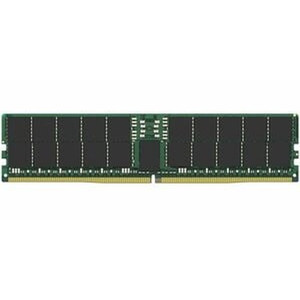
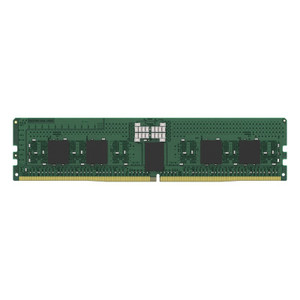
Kingston KSM56R46BD4PMI-64HAI 64GB DDR5-5600 ECC Registered Server DIMM
Overview
The Kingston KSM56R46BD4PMI-64HAI is a 64GB DDR5 ECC Registered DIMM running at 5600 MT/s — a high-density, high-speed module built for server and workstation platforms that demand both capacity and data integrity. This is a dual-rank (2Rx4) module featuring Hynix A-die ICs with a Renesas register component, a combination that matters when you're selecting memory for validated server configurations where component traceability is required for qualification lists.
At 64GB per slot, this module allows platforms with 8 or more DIMM slots to reach multi-terabyte configurations without resorting to lower-density sticks that compromise per-slot efficiency. If your deployment is memory-bandwidth-constrained — think in-memory databases, virtualization hosts running dozens of VMs, or HPC workloads — DDR5-5600 at this density hits a practical sweet spot between cost and throughput.
Key Features
- 64GB Per Module at 5600 MT/s: A single KSM56R46BD4PMI-64HAI delivers 64GB capacity with DDR5's native 5600 MT/s transfer rate. Populating a 8-DIMM platform reaches 512GB total system memory without any module compromise — relevant for large VM footprints or in-memory analytics workloads where you'd otherwise be forced to use slower, lower-density sticks.
- ECC (Error-Correcting Code) with On-Die ECC: Two layers of error correction are active simultaneously — on-die ECC corrects bit errors at the DRAM cell level before data even leaves the chip, while the module-level ECC visible to the host controller handles any remaining errors. For server workloads running 24/7, this significantly reduces the risk of silent data corruption that neither the application nor the OS would detect without it.
- Registered (Buffered) Architecture: The register component (Renesas) electrically isolates the memory controller from the DRAM ICs, enabling high-DIMM-count configurations that unbuffered modules cannot support reliably. If your server motherboard specifies RDIMM, this is the correct module type — using UDIMM in an RDIMM slot, or vice versa, results in non-boot.
- Dual Rank (2Rx4) Configuration: The 2Rx4 layout means the memory controller can interleave across two ranks within a single DIMM. This improves effective bandwidth utilization compared to single-rank modules at the same capacity, which matters on workloads that stress memory subsystem throughput rather than just raw capacity.
- 1.1V Operating Voltage: DDR5's native 1.1V supply (down from DDR4's 1.2V) contributes to lower per-module power draw at the same clock speed. On a dense server with 8–16 DIMMs populated, that differential aggregates into measurable reduction in memory subsystem power consumption and thermal output.
- 288-Pin DIMM Form Factor: Standard DDR5 288-pin footprint for server/workstation platforms. Note that DDR5 288-pin modules are physically keyed differently from DDR4 288-pin DIMMs — they are not interchangeable, and the notch position prevents insertion into a DDR4 slot, eliminating accidental cross-generation installation.
- CAS Latency 46 (CL46), Row Cycle Time 48ns: CL46 is the SPD-programmed default latency at 5600 MT/s. The 48ns row cycle time (tRC) governs how quickly successive row activations can occur — a tighter tRC benefits workloads with high row-activation rates such as transactional databases. These are the latencies the platform will use automatically via SPD without requiring manual BIOS tuning.
- SPD Profile Present: The factory-programmed SPD data means the server platform reads module parameters at POST and configures timing automatically. No XMP/EXPO profiles are expected or needed in a registered server module — the SPD is the authoritative timing source and the memory controller will use it on first boot.
Integration and Compatibility
The KSM56R46BD4PMI-64HAI (often searched as KSM56R46BD4PMI 64HAI) is designed for server and workstation platforms supporting DDR5 RDIMM. Confirm your motherboard or server's qualified vendor list (QVL) specifies DDR5 RDIMM support — mixing RDIMM and UDIMM slots on the same platform is not supported, and some platforms differentiate between RDIMM and LRDIMM (Load-Reduced DIMM), which are not interchangeable. The Hynix A-die with Renesas register component combination is a commonly qualified configuration on major server OEM platforms, but always cross-reference the specific server's memory compatibility list before deploying at scale.
This module operates at 1.1V — verify that your server's memory slots support DDR5 voltage levels. Platforms designed exclusively for DDR4 (1.2V) will not accept DDR5 modules electrically or physically. For server memory deployments requiring validated compatibility, Kingston publishes a system-specific configurator tool on their site that maps this module to supported server platforms.
When building out high-density configurations, populate DIMMs per your platform's channel-filling rules — most DDR5 server platforms prefer symmetric population across memory channels for optimal bandwidth. Refer to the motherboard manual's DIMM population table before inserting modules asymmetrically.
Frequently Asked Questions
Q: What server platforms is the KSM56R46BD4PMI-64HAI compatible with?
A: This module is designed for DDR5 RDIMM-capable server and workstation platforms. Compatibility depends on the specific motherboard or server model — Kingston maintains a system-specific configurator that maps this module to validated platforms. Always check your platform's qualified vendor list (QVL) before deployment.
Q: Is this an ECC module, and what type of ECC does it use?
A: Yes. The KSM56R46BD4PMI-64HAI uses two ECC layers: on-die ECC at the DRAM cell level (corrects errors before data leaves the chip) and standard module-level ECC visible to the host memory controller. Both are active simultaneously, providing stronger error detection and correction than single-layer ECC implementations.
Q: What is the difference between RDIMM and UDIMM, and does this module matter?
A: RDIMM (Registered/Buffered DIMM) includes a register component that electrically buffers the control signals between the CPU memory controller and the DRAM ICs. This allows higher DIMM counts per channel and higher densities than UDIMM. The KSM56R46BD4PMI-64HAI is an RDIMM — it will only work in server/workstation slots designated for RDIMMs. It cannot be used in consumer desktop platforms designed for UDIMM.
Q: What does 2Rx4 mean and why does it matter?
A: 2Rx4 describes the module's rank and chip width configuration: two ranks of x4-wide DRAM ICs. Dual-rank modules allow the memory controller to interleave reads and writes between ranks, improving effective bandwidth compared to single-rank modules of the same capacity. This is relevant on bandwidth-intensive workloads such as databases, virtualization hosts, and scientific computing.
Q: Can I mix this module with DDR4 modules in the same server?
A: No. DDR5 and DDR4 are electrically and physically incompatible. DDR5 operates at 1.1V versus DDR4's 1.2V, and the 288-pin DDR5 DIMM has a different key notch position than DDR4 288-pin modules, preventing accidental cross-generation installation. All memory in a system must match the DDR generation supported by the platform.
Q: Does this module require XMP or manual BIOS tuning to run at 5600 MT/s?
A: No. The SPD profile on this module programs the 5600 MT/s timings and CL46 latency as the default operating parameters. A compatible server platform will read the SPD at POST and configure the memory controller automatically. No XMP/EXPO profile activation or manual BIOS timing entry is required.
The KSM56R46BD4PMI-64HAI is one of the more deliberate component choices in the current DDR5 RDIMM lineup — the specific pairing of Hynix A-die ICs with a Renesas register is not accidental. Server OEMs qualify memory by die and register combination, not just by speed and density, so if you're working from a platform QVL, the Hynix A / Renesas designation on this module is the information you need to match, not just the 64GB and 5600 MT/s headline specs.
Technical Highlights:
- Dual On-Die + Module ECC: The stacked ECC approach — on-die at 1.1V DRAM level plus host-visible module ECC — catches a broader fault spectrum than legacy single-layer implementations. For 24/7 workloads where a correctable error storm can precede an uncorrectable fault, this matters more than raw speed gains.
- 5600 MT/s at CL46, tRC 48ns: The combination of 5600 MT/s bandwidth with a 48ns row cycle time keeps row-activation throughput competitive for transactional workloads. CL46 is tight enough at this speed grade that you won't see meaningful latency penalties versus slower DDR5 bins running lower CL numbers at lower transfer rates.
- 2Rx4 Rank Interleaving: Two-rank interleaving within a single 64GB module means the memory controller keeps both ranks' sense amplifiers active, hiding precharge latency behind concurrent access to the alternate rank. On platforms with limited DIMM slots, this recaptures some of the bandwidth you'd normally only get from fully populated channels.
Deployment Considerations:
- Populate channels symmetrically before adding modules asymmetrically — most DDR5 server platforms enforce or strongly prefer balanced channel fill for rated-speed operation. An asymmetric configuration may drop the entire platform to a lower validated speed bin.
- Watch out for platform-level RDIMM vs. LRDIMM distinctions: some high-capacity server configs explicitly require LRDIMM for 8+ DIMM slots per channel. Confirm the platform's max RDIMM population limit before ordering multiples of this module for a full-capacity build.
This module is the right call for 4th/5th-gen Intel Xeon and AMD EPYC platforms building out dense virtualization hosts or in-memory database nodes where per-slot density directly determines whether you reach your target memory footprint without adding additional servers to the cluster.