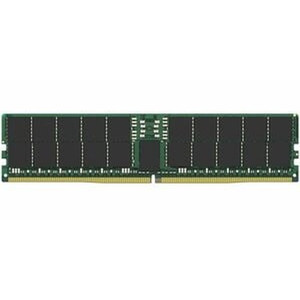
Kingston KSM56R46BD4PMI-96MBI 96GB DDR5-5600 ECC Registered Server DIMM
Overview
The Kingston KSM56R46BD4PMI-96MBI is a 96GB DDR5 ECC Registered DIMM running at 5600 MT/s — a high-density, high-bandwidth module built for workstation and server platforms that demand both capacity and data integrity. Configured as a single 1 x 96GB stick in a dual-rank (2Rx4) arrangement on a 288-pin form factor, it fits standard RDIMM slots on current-generation server motherboards. The module carries a Micron B die paired with a Renesas register clock driver (RCD), a combination widely validated across enterprise server SKUs for stable operation at rated speed.
If you are specifying memory for a multi-socket AI inference node, a virtualization host running dozens of VMs, or a database server where per-core memory bandwidth is a bottleneck, the KSM56R46BD4PMI-96MBI (often searched as KSM56R46BD4PMI 96MBI) gives you a direct path to dense, validated capacity without stepping down to slower DDR4 tiers.
Key Features
- 96GB Single-Module Density: At 96GB per DIMM in a 1 x 96GB configuration, you can fill a 16-slot server to 1.5TB without resorting to 128GB modules — useful when your platform supports 96GB sticks but tops out on per-slot capacity. More capacity per slot also means fewer modules to seat, reducing installation time and potential contact issues.
- DDR5-5600 (5600 MT/s) Data Rate: DDR5-5600 delivers roughly 2.5× the peak bandwidth of DDR4-3200 at comparable density. For memory-bandwidth-sensitive workloads — in-memory databases, large-model inference, real-time analytics — that bandwidth delta translates directly into reduced query latency and higher throughput per socket.
- ECC (Error-Correcting Code) with On-Die ECC: Two layers of error protection are at work here. On-Die ECC operates inside the DRAM die itself, correcting single-bit errors before they reach the memory bus. The Registered DIMM's system-level ECC then catches multi-bit errors at the controller level. In always-on server environments — security management servers, NVR hosts, access control backends — this dual-layer protection directly reduces unplanned downtime from memory-induced crashes.
- Registered (Buffered) Architecture with Renesas RCD: The Renesas register clock driver re-drives command and address signals from the memory controller, allowing high-density dual-rank operation at 5600 MT/s without signal integrity degradation. This is what separates RDIMMs from UDIMMs at high capacity — you get stable operation at rated speed even in fully-loaded configurations.
- Dual Rank (2Rx4) Layout: The 2Rx4 organization — two ranks across a x4 (4-bit wide) DRAM array — gives the memory controller more rank-interleaving opportunities compared to a single-rank module of the same density. Interleaving allows overlapping of read/write cycles across ranks, improving effective bandwidth utilization in bursty workloads.
- CAS Latency 46 (CL46) at 5600 MT/s: CL46 at 5600 MT/s yields an absolute latency of approximately 16.4 ns — competitive for DDR5 at this data rate. Row active time is 32 ns and row cycle time is 48 ns, with a refresh row cycle time of 295 ns. These timings reflect a tightly binned module validated to run at spec without manual XMP/EXPO tuning on compliant server platforms.
- 1.1V Operating Voltage: DDR5's native 1.1V supply (down from DDR4's 1.2V) reduces per-module power draw. Across a fully loaded 16-DIMM server, that 0.1V delta accumulates into measurable wattage savings — relevant in dense rack deployments where power and cooling budgets are constrained.
- SPD Profile: An embedded SPD (Serial Presence Detect) EEPROM stores validated timing and voltage parameters. The server BIOS reads these at POST and configures the memory controller to the correct 5600 MT/s profile automatically — no manual BIOS tuning required for standard deployment.
- 1.8V Programming Power Voltage (VPP): The 1.8V VPP rail powers the DRAM's internal voltage regulators independently of the main 1.1V supply, a DDR5 architectural change that improves on-module voltage stability and allows tighter timing tolerances at high data rates.
Integration and Compatibility
This module targets server and workstation platforms with DDR5 RDIMM slots — Intel Xeon Scalable (Sapphire Rapids / Emerald Rapids) and AMD EPYC (Genoa / Bergamo) are the primary targets for 5600 MT/s registered DDR5. Verify your platform's QVL (Qualified Vendor List) before deploying at 5600 MT/s; some motherboards may train at 4800 MT/s as a conservative default unless the BIOS explicitly validates 5600 MT/s modules. The Micron B die / Renesas RCD pairing is broadly validated across major server OEM QVLs, which reduces the risk of interoperability issues compared to less-documented component combinations. The 288-pin DIMM form factor is the standard for desktop and server DDR5 — not compatible with DDR4 slots, which use the same pin count but a different key position.
Frequently Asked Questions
Q: What server platforms is the KSM56R46BD4PMI-96MBI compatible with?
A: This module targets DDR5 RDIMM-compatible server and workstation platforms, including Intel Xeon Scalable (Sapphire Rapids, Emerald Rapids) and AMD EPYC (Genoa, Bergamo) systems. Always verify against your platform's QVL before deployment to confirm 5600 MT/s support in your specific BIOS revision.
Q: What is the difference between the On-Die ECC and the standard ECC on this module?
A: On-Die ECC is a DDR5 feature built into each DRAM die — it detects and corrects single-bit errors within the die before data reaches the memory bus. The module-level ECC (visible to the server's memory controller) then provides an additional layer of error detection and correction at the system level. Together they offer stronger fault tolerance than single-layer ECC found in DDR4 RDIMMs.
Q: Can this module be used in a desktop or consumer DDR5 motherboard?
A: No. Registered DIMMs (RDIMMs) require a server or workstation memory controller that supports buffered memory. Consumer desktop chipsets do not support RDIMMs and will not POST with this module installed, even though the 288-pin connector is physically compatible.
Q: What does the 2Rx4 ranking mean in practical terms?
A: 2Rx4 means the module has two independently addressable ranks, each built from x4-wide DRAM chips. Dual-rank configuration allows the memory controller to interleave operations across both ranks, improving effective bandwidth utilization in workloads with bursty or random access patterns — beneficial for database and virtualization use cases.
Q: Does the KSM56R46BD4PMI-96MBI require any BIOS configuration to run at 5600 MT/s?
A: The module includes an SPD profile that the BIOS reads automatically at POST. On platforms that validate 5600 MT/s, no manual configuration is needed. Some platforms may default to a lower speed (e.g., 4800 MT/s) until updated to a BIOS revision that explicitly supports DDR5-5600 at this density — check your motherboard vendor's release notes.
Q: Is the KSM56R46BD4PMI-96MBI suitable for 24/7 server operation?
A: Yes. ECC Registered DIMMs are specifically engineered for continuous server operation. The dual-layer ECC (On-Die + system-level), 1.1V DDR5 supply, and validated Micron B / Renesas RCD component pairing are all characteristics of a commercial-grade server memory module designed for always-on environments.
The KSM56R46BD4PMI-96MBI sits in an interesting spot in the DDR5 RDIMM lineup: 96GB is the practical ceiling for single-module density on most current Sapphire Rapids and Genoa platforms before you hit 128GB territory, which not all BIOS revisions handle cleanly at 5600 MT/s. The Micron B / Renesas RCD pairing on this module is one I've seen show up consistently on Intel and AMD server QVLs — that component documentation matters when you're populating 8 or 16 slots and don't want a training failure at 3 AM.
Technical Highlights:
- 5600 MT/s at CL46: The absolute latency works out to roughly 16.4 ns — tight for DDR5 RDIMM at this density. Row cycle time of 48 ns and row active time of 32 ns are within what you'd expect from a well-binned Micron B die, and they hold at rated speed without needing aggressive BIOS tuning.
- Dual-Layer ECC (On-Die + System): On-Die ECC inside the DRAM die scrubs single-bit errors before they hit the bus; system ECC at the controller catches multi-bit faults. For NVR hosts, security management servers, or access control backends running 24/7, this architecture materially reduces the soft-error rate that eventually surfaces as an unexplained reboot.
- 1.1V / 1.8V VPP DDR5 Power Architecture: The split-rail DDR5 design — 1.1V main, 1.8V VPP for internal regulators — is a meaningful improvement over DDR4's single-rail 1.2V. In a 16-DIMM configuration, the per-module power savings aggregate into measurable rack-level efficiency gains.
Deployment Considerations:
- Confirm your platform BIOS supports 5600 MT/s at 96GB density specifically — some server OEMs cap density or speed in early BIOS releases and require a firmware update before the module trains at rated speed rather than falling back to 4800 MT/s.
- RDIMMs are electrically incompatible with UDIMM slots despite sharing the 288-pin DDR5 connector geometry. Mixed RDIMM/UDIMM populations in the same system are not supported — verify slot type before ordering.
This module is a strong fit for high-density virtualization hosts and in-memory database servers where per-slot capacity is the binding constraint and 5600 MT/s bandwidth directly reduces query latency — particularly on AMD EPYC Genoa platforms where memory channels are plentiful and bandwidth scales predictably with validated RDIMM density.