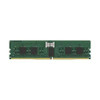
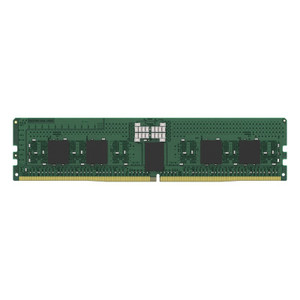
Kingston KSM56R46BS8PMI-16HAI 16GB DDR5-5600 ECC Registered Server DIMM
Overview
The Kingston KSM56R46BS8PMI-16HAI is a 16GB DDR5 ECC Registered DIMM running at 5600 MT/s — purpose-built for server and workstation platforms where memory reliability and bandwidth are non-negotiable. Configured as a single-rank 1Rx8 module using Hynix A-die with a Renesas register component, this module targets system builders and IT architects who need validated, component-traceable server memory for production deployments. If you're speccing a multi-socket or high-density server where memory errors translate directly into downtime, the error-correction and buffered architecture here are the starting point, not a nice-to-have.
Key Features
- DDR5-5600 at CL46 (5600 MT/s transfer rate): Running at 5600 MT/s with a CAS latency of 46, this module delivers peak bandwidth well above DDR4 ceilings — relevant on compute-intensive workloads like database queries, virtualization hosts, and AI inference pipelines where memory bandwidth is a genuine bottleneck. The 46-cycle latency is competitive for registered DDR5 at this speed grade.
- ECC (Error-Correcting Code) with On-Die ECC: Two layers of error correction working together. On-die ECC corrects bit errors within the DRAM die itself before data ever leaves the chip; the module-level ECC then protects data in transit across the memory bus. In a 24/7 server running video management, NVR archiving, or transaction processing, this materially reduces the risk of silent data corruption that wouldn't surface until a critical read.
- Registered (Buffered) Architecture: The Renesas register on this module decouples the memory controller's electrical load from the DRAM chips, enabling higher slot counts and longer trace runs without signal integrity degradation. If your platform supports 8 or more DIMM slots, unbuffered memory won't cut it — registered modules are the correct choice.
- 1Rx8 Single-Rank Configuration: A single-rank layout means the memory controller accesses all chips in one pass — lower rank-switching overhead compared to dual-rank at the cost of per-module capacity. For platforms with many populated slots, single-rank modules often interleave more predictably across channels, which can translate to more consistent latency profiles under load.
- 1.1V Operating Voltage: DDR5 at 1.1V runs cooler than DDR4 at 1.2V — meaningful in high-density chassis with limited airflow. Lower heat per DIMM slot means less thermal throttling risk in dense configurations and reduced long-term stress on the module.
- 16GB Capacity (2048M x 80 module configuration): The x80 module configuration (64-bit data + 8 ECC bits) confirms full ECC width. At 16GB per slot, you can build a 128GB system on an 8-slot board or 256GB on a 16-slot platform without moving to dual-rank or higher-density modules, keeping the BOM straightforward.
- SPD Profile Present: The module carries a programmed SPD profile, allowing the server's BIOS to auto-detect correct timings at boot without manual configuration. Row cycle time is rated at 48 ns, row active time at 32 ns, and row precharge time at 16 cycles — standard validated timings for DDR5-5600 registered operation.
- Hynix A-Die (Component-Traceable): The Hynix A-die designation is explicitly specified in the part number and product description — not inferred. For system integrators qualifying memory against a vendor's Hardware Compatibility List (HCL), knowing the exact die source matters: different die revisions can behave differently under sustained ECC stress or specific firmware revisions.
Integration & Compatibility
The KSM56R46BS8PMI-16HAI (often searched as KSM56R46BS8PMI 16HAI) requires a DDR5-compatible server motherboard with registered DIMM support — consumer and workstation platforms that only accept UDIMM will not POST with this module installed. Verify your platform's QVL (Qualified Vendor List) against Kingston's server memory compatibility tool before ordering. DDR5 ECC Registered DIMMs are not backward-compatible with DDR4 slots; the 288-pin connector is keyed differently to prevent physical misinstallation, but always confirm socket type in your server's specification sheet. Mixed-rank populations (pairing 1Rx8 with 2Rx8 modules in the same channel) are generally supported but should be validated against your specific platform's memory population rules, as some controllers enforce rank-matching per channel for maximum stability.
This module operates at 1.1V, consistent with JEDEC DDR5 specifications, and does not require XMP or custom voltage profiles to run at its rated 5600 MT/s — the SPD profile programs the correct timings automatically on a compliant platform.
Frequently Asked Questions
Q: What does the Hynix A Renesas designation mean on the KSM56R46BS8PMI-16HAI?
A: It identifies the specific DRAM die (Hynix A-die) and the register component manufacturer (Renesas) used on this module. Kingston includes these component designators in the part number so system integrators can qualify the exact configuration against server HCLs — particularly important when a platform vendor certifies specific component revisions rather than just the brand and capacity.
Q: Will this module work in a desktop or consumer workstation motherboard?
A: No. The KSM56R46BS8PMI-16HAI is a Registered (Buffered) DIMM, which requires a server or HEDT platform with RDIMM support. Consumer boards designed for UDIMM will not recognize or boot with a registered module installed. Check your motherboard's specification sheet for RDIMM compatibility before ordering.
Q: What is On-Die ECC and how does it differ from standard ECC?
A: Standard (module-level) ECC corrects single-bit errors on the memory bus between the DRAM and the memory controller. On-Die ECC is an additional correction layer built into the DRAM die itself, correcting errors within the chip before data is placed on the bus. This module includes both, providing two independent error-correction stages — relevant for workloads requiring the highest available memory integrity.
Q: Does the 5600 MT/s speed require manual BIOS configuration?
A: Not on a compliant DDR5 server platform. The module includes a programmed SPD profile that communicates correct timings (CAS latency 46, row cycle time 48 ns, row precharge time 16 cycles) to the system BIOS automatically. No XMP activation or manual timing entry should be required on platforms that adhere to JEDEC DDR5 specifications.
Q: Can this module be mixed with dual-rank DDR5 RDIMMs in the same server?
A: Mixed-rank configurations are technically possible on many platforms but must be validated against your specific server's memory population guidelines. Some memory controllers enforce rank-matching within a channel for stability at full speed. Consult your server vendor's memory configuration guide before mixing 1Rx8 and 2Rx8 modules.
Q: What is the operating voltage of the KSM56R46BS8PMI-16HAI?
A: 1.1V, which is the standard JEDEC DDR5 operating voltage. This is lower than DDR4's 1.2V, contributing to reduced heat output per module — a practical advantage in high-density, fully-populated server chassis.
When customers ask me about the KSM56R46BS8PMI-16HAI, the first thing I point to is the dual-layer ECC architecture — on-die ECC inside the Hynix A-die plus module-level ECC across the full 80-bit bus width. For NVR servers or video management hosts running 24/7, that's not a marketing spec — it's the difference between catching a bit flip silently versus an uncorrectable error that drops a recording session or corrupts an index file.
Technical Highlights:
- 5600 MT/s at CL46: DDR5-5600 delivers substantially higher bandwidth than DDR4-3200, with the SPD profile handling timing auto-configuration at boot — no manual tuning required on JEDEC-compliant platforms.
- Registered (Buffered) with Renesas Register: The Renesas register component isolates the memory controller from the DRAM load, enabling dense multi-DIMM configurations without signal integrity compromise — essential on platforms with 8+ slots.
- 1.1V Operating Voltage: Running 0.1V lower than DDR4, thermal output per module is reduced — meaningful when all 16 or 24 DIMM slots are populated in a 2U chassis with constrained airflow.
Deployment Considerations:
- Verify RDIMM support on your target platform before ordering — the 288-pin DDR5 connector physically differs from DDR4, but some DDR5 platforms are UDIMM-only and will not POST with this registered module.
- The 1Rx8 single-rank configuration offers lower per-module capacity than 2Rx8 equivalents; if you're trying to reach 512GB+ on a 16-slot board, you'll need 32GB or 64GB RDIMMs — this module tops out at 256GB in a fully-populated 16-slot configuration.
This module is the right call for 1U and 2U rack servers deployed as dedicated NVR hosts or edge compute nodes where component traceability (Hynix A-die, Renesas register) matters for platform qualification and the registered architecture supports the slot density those deployments typically demand.