Kingston KSM56R46BD8PMI-48HMI 48GB DDR5-5600 ECC Registered Server DIMM
Overview
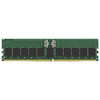
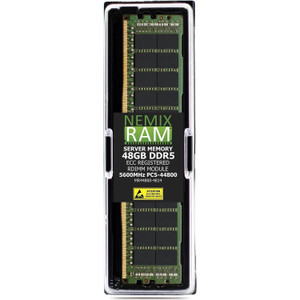
The Kingston KSM56R46BD8PMI-48HMI is a 48GB DDR5-5600 ECC Registered (RDIMM) module engineered for server and workstation platforms that demand high-density, high-speed memory with hardware-level error correction. Built on a 2Rx8 dual-rank layout using Hynix M DRAM components paired with a Renesas register, this module targets production server deployments — AI inference nodes, virtualization hosts, and memory-intensive database platforms — where validated component provenance and ECC protection are non-negotiable. The KSM56R46BD8PMI-48HMI occupies a single 288-pin DIMM slot and delivers 48GB of usable capacity, giving architects a practical path to dense per-slot memory population without moving to 64GB or 128GB modules that carry a significant price premium.
Key Features
- 48GB Single-Slot Density: A 1×48GB configuration means a dual-socket server with 16 DIMM slots can reach 768GB total RAM — enough to fully memory-reside large in-memory databases or multi-tenant VM workloads without filling every slot. This matters for platforms that will be expanded later: you leave headroom for additional DIMMs rather than filling the board on day one.
- DDR5-5600 Transfer Rate: At 5600 MT/s, this module delivers roughly 44.8 GB/s of peak bandwidth per channel — a meaningful step up over DDR4-3200 (25.6 GB/s). For AI inference workloads feeding large tensor operations or HPC codes with high memory-bandwidth demand, the generational uplift translates directly into reduced pipeline stall cycles.
- ECC with On-Die ECC (ODECC): The module carries both traditional RDIMM ECC (single-bit correction, multi-bit detection across the 72-bit wide channel) and On-Die ECC, which corrects single-bit errors within each DRAM die before they ever reach the memory controller. In practice, ODECC reduces the raw error rate that the system ECC engine must handle — extending effective MTBF in high-density DDR5 deployments where higher cell density increases raw bit-error rates compared to DDR4.
- Registered (Buffered) Architecture: The Renesas register isolates the address and command bus from the memory controller, allowing stable operation across higher DIMM counts per channel. Without buffering, DDR5 at 5600 MT/s would struggle to maintain signal integrity beyond one DIMM per channel at full speed. Registered architecture is the correct choice for any platform supporting 2+ DIMMs per channel.
- CAS Latency 46 (CL46) at 5600 MT/s: CL46 at 5600 MT/s yields an absolute latency of approximately 16.4 ns — comparable in real terms to DDR4-3200 CL22 (13.75 ns). Throughput-oriented server workloads benefit more from the bandwidth increase; latency-sensitive single-threaded paths should verify that the target CPU and platform support tighter sub-timings if absolute latency is the constraint.
- 2Rx8 Dual-Rank Layout: Two ranks per DIMM allows the memory controller to interleave between ranks, hiding row cycle time latency (tRC of 48 ns per the SPD profile). For workloads that stride through large memory regions sequentially — like video transcoding pipelines, security analytics, or forensic video review platforms — dual-rank interleaving reduces effective memory access latency under sustained load.
- 1.1V Operating Voltage: DDR5 drops operating voltage to 1.1V versus DDR4's 1.2V. Across a fully populated 16-DIMM server chassis, that difference compounds to meaningful per-rack power savings — relevant for high-density deployments where power and cooling are the limiting factors, not raw compute.
- SPD Profile and VPP 1.8V: The module ships with a factory-programmed SPD profile (including XMP/EXPO if supported by the platform), so it trains at rated speed without manual BIOS configuration. The 1.8V VPP (programming power) supply is drawn from the platform's DDR5 power delivery rail — no separate provisioning required.
- Hynix M DRAM + Renesas Register: Component vendor transparency matters for server qualification. Many OEM server QVLs (qualified vendor lists) specify not just the module PN but the DRAM and register vendor. Knowing this is Hynix M / Renesas allows you to cross-reference against your platform QVL before procurement rather than discovering an incompatibility during deployment.
Integration and Compatibility
The KSM56R46BD8PMI-48HMI is designed for server platforms running Intel Xeon Scalable (Sapphire Rapids and later) or AMD EPYC (Genoa and later) processors that support DDR5 RDIMM at 5600 MT/s. Before ordering, confirm your platform's QVL explicitly lists DDR5-5600 RDIMM at CL46 with 48GB capacity — some platforms qualify 32GB and 64GB densities but not 48GB at 5600 MT/s on day-one BIOS releases. A BIOS update may be required to enable 5600 MT/s training on earlier firmware revisions. For server memory compatibility planning, always validate against the motherboard or server vendor's memory configurator, not just the DDR generation. This module is not compatible with consumer desktop or laptop platforms — those use unbuffered (non-ECC or ECC UDIMM) configurations. If you are populating a workstation that supports RDIMM, verify the platform explicitly calls out registered DDR5 support, as some prosumer boards support only UDIMM DDR5. See the full Kingston memory catalog for additional capacity and speed grade options in the ValueRAM and Server Premier families. For builds pairing high-density memory with storage, NAS and server storage options complement this module in multi-role server deployments. For server components including processors and expansion cards, check platform compatibility before finalizing memory population maps.
Frequently Asked Questions
Q: What server platforms is the KSM56R46BD8PMI-48HMI compatible with?
A: This is a DDR5-5600 RDIMM designed for servers and workstations supporting registered DDR5. Compatible platforms include Intel Xeon Scalable (Sapphire Rapids and newer) and AMD EPYC (Genoa and newer) systems. Always verify your specific motherboard's QVL for 48GB DDR5-5600 RDIMM support before ordering, as BIOS revision requirements vary by vendor.
Q: Does the KSM56R46BD8PMI-48HMI support ECC?
A: Yes — this module is both ECC Registered (RDIMM) and includes On-Die ECC (ODECC). Traditional RDIMM ECC corrects single-bit errors at the channel level; On-Die ECC adds an additional correction layer within each DRAM die, reducing raw error rates before they reach the memory controller. This dual-layer approach is particularly relevant for high-density DDR5 deployments.
Q: Can I mix the KSM56R46BD8PMI-48HMI with other DDR5 RDIMMs in the same server?
A: Mixing DIMM capacities or speeds within a channel is generally unsupported and may cause instability or force the system to train at the slower module's speed. Mixing across channels (not within the same channel) may function in some platforms but is rarely validated by server OEMs. For production environments, populate matched pairs or sets of identical modules for maximum stability.
Q: What does the 2Rx8 ranking mean for memory performance?
A: 2Rx8 means dual-rank, with each rank built from ×8-width DRAM chips. Dual-rank allows the memory controller to interleave between ranks, effectively hiding row-cycle latency (tRC is 48 ns per the SPD profile on this module). Under sustained sequential workloads, dual-rank typically outperforms single-rank DIMMs at the same capacity and speed grade.
Q: Is the KSM56R46BD8PMI-48HMI compatible with consumer desktop motherboards?
A: No. This is a Registered DIMM (RDIMM) requiring a server or workstation platform with registered DDR5 support. Consumer Intel Core and AMD Ryzen desktop platforms use unbuffered DIMM (UDIMM) slots and are not compatible with registered modules. Attempting to install an RDIMM in a UDIMM slot will either physically not seat or will not POST.
Q: What DRAM and register components are used in this module?
A: The KSM56R46BD8PMI-48HMI uses Hynix M DRAM dies with a Renesas register. Component identification is included in the part number suffix and is relevant when cross-referencing server OEM qualified vendor lists (QVLs), which often specify acceptable DRAM and register combinations by component vendor code.
The KSM56R46BD8PMI-48HMI is one of the more practical DDR5 RDIMM options I've come across for mid-density server builds — specifically because the 48GB capacity at 5600 MT/s hits a sweet spot that 32GB misses on memory-intensive workloads and 64GB overprovisioned in cost-sensitive configs. The On-Die ECC on top of channel-level ECC is the spec I'd call out first; at DDR5 cell densities, ODECC isn't a checkbox feature — it measurably reduces the correctable error rate the BMC has to log and the platform ECC engine has to handle.
Technical Highlights:
- Dual-Layer ECC (ODECC + RDIMM ECC): On-Die ECC corrects single-bit errors within each Hynix M DRAM die before they surface at the channel; the RDIMM ECC layer then handles any residual errors across the 72-bit channel. In a fully populated 16-DIMM chassis, this substantially reduces the correctable error event rate logged in the BMC SEL.
- 5600 MT/s / CL46 Timing Profile: The SPD-programmed profile trains automatically at 5600 MT/s on supporting platforms — no manual BIOS timing entry. The row cycle time of 48 ns and row active time of 32 ns per the SPD are tighter than what many competing 5600 MT/s modules publish, which matters under sustained random-access workloads like database buffer pools.
- Renesas Register: The Renesas RCD (Registering Clock Driver) is a widely QVL-listed component on both Intel and AMD server platforms. Modules using off-brand or less common register ICs sometimes fail QVL checks even when the DRAM is identical — this combination reduces that risk on Sapphire Rapids and Genoa platforms specifically.
Deployment Considerations:
- Verify your platform's current BIOS supports 48GB RDIMM at DDR5-5600. Several Xeon and EPYC server vendors shipped initial BIOS releases qualifying only 16GB, 32GB, and 64GB at 5600 MT/s — 48GB population support often arrived in a subsequent microcode update. Check the QVL date alongside the part number entry.
- The 1.8V VPP rail is not independently configurable on most platforms — it's derived automatically from the DDR5 PMIC (Power Management IC) on each DIMM. If your platform reports VPP out-of-spec warnings during POST, verify BIOS is current; this is almost always a firmware recognition issue with newer DIMM densities rather than a hardware fault.
This module fits best in security operations center (SOC) servers running AI-assisted video analytics or forensic review platforms — workloads that hold large frame buffers and model weights in memory and benefit from both the 5600 MT/s bandwidth and the reduced error rate from dual-layer ECC. It's less compelling for pure transactional database workloads where absolute latency per operation is the bottleneck and tighter CL timings would matter more.