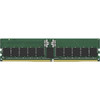
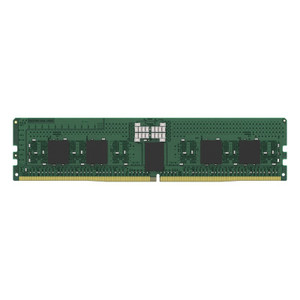
Kingston KSM56R46BD8PMI-32HAI 32GB DDR5-5600 ECC Registered Server DIMM
Overview
The Kingston KSM56R46BD8PMI-32HAI is a 32GB DDR5-5600 ECC Registered (RDIMM) module engineered for server and workstation platforms that demand both high bandwidth and memory integrity. Running at 5600 MT/s with CAS latency 46 at 1.1V, this 288-pin DIMM delivers the throughput modern multi-core Xeon and EPYC platforms require without the power overhead of earlier DDR4 generations. The dual-rank, 2Rx8 organization paired with a verified Hynix A die and Renesas register means you get a module that has been qualified against known-good silicon — not a lottery on die revision.
Key Features
- DDR5-5600 at 5600 MT/s: Compared to DDR4-3200, this module moves data at 75% higher raw bandwidth — directly relevant when feeding cores in analytics-heavy or virtualization-dense deployments where memory bus saturation shows up in profiling.
- ECC with On-Die ECC (ODECC): Two layers of error correction operate here. On-Die ECC corrects single-bit errors within each DRAM die before data even reaches the memory bus. The module-level ECC then handles bus-level errors. For 24/7 server workloads — NVR backends, database servers, surveillance management appliances — this dual-correction architecture reduces uncorrectable error rates compared to standard ECC alone.
- Registered (Buffered) Architecture: The Renesas register buffers command and address signals, allowing the memory controller to drive a larger number of DIMMs per channel without signal integrity degradation. If you are populating a multi-slot server and need to go beyond one DIMM per channel, registered memory is the prerequisite, not an option.
- 2Rx8 Dual-Rank Organization: Dual-rank modules allow the memory controller to interleave between ranks, effectively hiding refresh latency and improving sustained throughput versus single-rank modules at the same capacity. On a lightly-loaded channel, the difference is modest; under sustained random-access workloads it is measurable.
- 1.1V Operating Voltage: DDR5 operates at 1.1V versus DDR4's 1.2V. At scale — a chassis with 8 to 16 DIMMs — this translates directly into lower steady-state power draw and reduced thermal load on the memory subsystem.
- 32GB Capacity in a Single Module: A single KSM56R46BD8PMI-32HAI provides 32GB, meaning a dual-socket server with 8 DIMM slots per CPU can reach 512GB total without resorting to higher-cost 64GB or 128GB modules. This makes it a practical density step for servers that need substantial RAM but are not yet at LRDIMM territory.
- SPD Profile Present: The module ships with a programmed SPD (Serial Presence Detect) profile. The platform BIOS reads this at POST to configure timings automatically — no manual XMP/EXPO profile selection required, and no risk of running unsupported timings on server-class hardware that often disables overclocking profiles entirely.
- Row Cycle Time 48ns / Row Active Time 32ns / TRP 16: These timing parameters describe how quickly the DRAM array can complete a full access cycle. A 48ns tRC means the array recycles quickly enough to sustain the 5600 MT/s data rate without artificial stalls — the timings are internally consistent with the speed grade, which is not guaranteed across all DIMM vendors.
Integration and Compatibility
The KSM56R46BD8PMI-32HAI (often searched as KSM56R46BD8PMI 32HAI) targets server platforms with DDR5 RDIMM slots — Intel Xeon Scalable 4th/5th generation (Sapphire Rapids, Emerald Rapids) and AMD EPYC Genoa/Bergamo platforms both support DDR5-5600 RDIMMs, though per-platform qualification should be confirmed against the server vendor's memory QVL before purchasing. This module is not compatible with consumer motherboards or platforms requiring UDIMMs or LRDIMMs. The 288-pin DDR5 form factor is physically distinct from DDR4 — the notch position is different, and the modules are not interchangeable. Verify your platform's DIMM type requirement before ordering.
Frequently Asked Questions
Q: What is the difference between the On-Die ECC and the module-level ECC on this DIMM?
A: On-Die ECC (ODECC) is a correction mechanism built into each individual DRAM die. It detects and corrects single-bit errors within the die itself before data is placed on the memory bus. The module-level ECC (the traditional ECC most server admins are familiar with) then provides an additional error-detection and correction layer on the bus between the DIMM and the memory controller. Together they provide more comprehensive error coverage than module-level ECC alone.
Q: Is this a registered (buffered) DIMM or an unbuffered DIMM?
A: The KSM56R46BD8PMI-32HAI is a Registered (Buffered) DIMM — RDIMM. It requires a server motherboard with a memory controller that supports registered DDR5. It will not work in consumer platforms or servers that only support UDIMM.
Q: What speed does this module actually run at, and does it require any BIOS configuration?
A: The module is rated at 5600 MT/s with CAS latency 46. It ships with a programmed SPD profile, so a compatible platform will read and apply the correct timings automatically at POST. No manual profile activation is needed.
Q: Can this DIMM be mixed with other Kingston DDR5 RDIMMs in the same server?
A: Mixing DIMMs of different speeds, ranks, or capacities is governed by the server platform's memory population rules, not by Kingston directly. In general, mixing ranks or speeds causes the entire channel to downclock to the slower module's speed. For best performance and stability, populate channels with matched pairs of identical modules.
Q: What does the 2Rx8 designation mean and why does it matter?
A: 2Rx8 means the module is dual-rank, with x8 (8-bit wide) DRAM chips. Dual-rank allows the memory controller to interleave between ranks, which improves sustained throughput and helps hide DRAM refresh latency compared to single-rank modules at the same capacity. The x8 chip width also means more chips per module, which can affect ECC coverage granularity on some platforms.
Q: What is the operating voltage and does it affect compatibility with older DDR4 systems?
A: This module operates at 1.1V, which is the standard DDR5 voltage. DDR4 systems operate at 1.2V and use a physically different 288-pin connector with a different notch position. DDR5 and DDR4 are not physically or electrically compatible — this module requires a DDR5-capable platform.
The KSM56R46BD8PMI-32HAI is one of the cleaner DDR5 RDIMM choices I have seen for server refreshes where you need density without paying LRDIMM premiums. The combination of Hynix A die and Renesas register is a known-stable pairing — both components have long qualification histories with major server OEMs, and the 5600 MT/s speed grade at CL46 is achievable without pushing marginal silicon.
Technical Highlights:
- Dual-Layer ECC (ODECC + Module ECC): The 48ns row cycle time and on-die correction working in tandem means uncorrectable errors are substantially rarer than single-layer ECC — important for any workload where a memory error translates directly into data corruption rather than just a logged correctable event.
- 5600 MT/s at 1.1V: Relative to DDR4-3200 at 1.2V, you get 75% more bandwidth at lower voltage. In a chassis with 8+ DIMMs, the aggregate power reduction is meaningful for data center thermal budgets.
- SPD-programmed, no profile required: Server BIOS environments disable XMP/EXPO by design. The programmed SPD means this module runs its rated speed on first boot without any manual intervention — important when provisioning at scale.
Deployment Considerations:
- Confirm DDR5 RDIMM support on your specific server QVL before purchasing — Intel Sapphire/Emerald Rapids and AMD EPYC Genoa are the primary targets, but BIOS revisions matter; an early firmware may cap DDR5 at 4800 MT/s regardless of module speed rating.
- The 2Rx8 organization means this module draws slightly more power per slot than a hypothetical 1Rx8 at the same capacity — factor this into per-slot power budgets on high-density configurations where every watt counts.
This module is the right fit for NVR backend servers, surveillance management appliances, and mid-density virtualization hosts running 4th/5th gen Xeon or EPYC Genoa where you need 256–512GB per node without stepping up to LRDIMM complexity or cost.