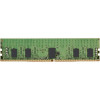
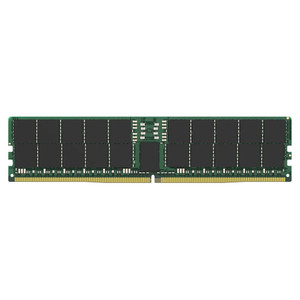
Kingston KSM32RD4/64MFR 64GB DDR4-3200 ECC Registered Server Memory Module
The Kingston KSM32RD4/64MFR is a 64GB DDR4 ECC Registered DIMM running at 3200 MT/s — a high-density, dual-rank module built for rack servers and workstations where memory capacity and reliability are non-negotiable. Built on Micron F Rambus die and certified to the JEDEC DDR4 standard, this module drops into validated server platforms without surprises. If you are populating a multi-socket server, scaling a virtualization host, or expanding memory on a database appliance, this is the module to evaluate first.
Key Features
- 64GB Single-Module Density: A single KSM32RD4/64MFR delivers 64GB of capacity in one DIMM slot — critical when slots are already at a premium on dense 1U/2U platforms. Fewer DIMMs means fewer potential failure points and more headroom for future expansion without a forklift swap.
- DDR4-3200 (3200 MT/s) Speed: At 3200 MT/s, this module operates at the top of the mainstream DDR4 speed range. For memory-bandwidth-intensive workloads — video transcoding servers, database query engines, analytics platforms — that throughput translates directly to job completion time and concurrency headroom.
- ECC (Error Correcting Code) Protection: ECC silently detects and corrects single-bit memory errors in real time. On long-running server workloads — NVR recording servers, 24/7 surveillance infrastructure, financial transaction systems — uncorrected bit errors cause silent data corruption or crashes. ECC eliminates that failure mode.
- Registered (Buffered) Architecture: The register between the memory controller and DRAM chips reduces electrical load on the CPU memory bus. In practice this means you can fully populate all DIMM slots on a multi-channel server without sacrificing signal integrity or being forced to run at a reduced speed tier — important when maximizing memory capacity per server node.
- Dual Rank (2Rx4) Organization: The 2Rx4 configuration gives the memory controller two ranks to interleave, improving effective throughput versus a single-rank module at the same speed rating. For workloads that stress memory subsystems — VM sprawl, in-memory databases, video management server (VMS) frame buffers — dual-rank interleaving delivers measurable throughput gains.
- CL22 Latency at 3200 MT/s: CAS latency of 22 at 3200 MT/s is the standard JEDEC SPD profile for this speed grade — validated and predictable across all supported platforms. The SPD profile is programmed on-module, so the server BIOS reads and applies correct timings automatically with no manual configuration required.
- 1.2V Operating Voltage: DDR4's 1.2V standard voltage runs roughly 20% lower than DDR3's 1.5V. In a fully-loaded server with 16+ DIMMs, that voltage delta compounds into meaningful power and cooling savings — relevant in colocation environments billing on power draw or in edge deployments running on constrained UPS capacity.
- 288-Pin DIMM Form Factor: Standard DDR4 LRDIMM/RDIMM 288-pin connector ensures physical compatibility with all DDR4-capable server motherboard slots. The 8192M x 72 module configuration (72-bit bus width including ECC bits) is the standard architecture for ECC-registered DDR4.
- Micron F Die (Rambus): The Micron F Rambus die designation matters for server qualification lists. Many enterprise server OEMs publish approved DIMM lists (QVL/HVL) by die vendor and revision. Specifying Micron F die ensures you are matching the exact component variant validated by the platform manufacturer — reducing the risk of qualification mismatches on strict server platforms.
- Gold Lead Plating: Gold-plated contacts resist oxidation and provide stable electrical contact over the module's service life — relevant in environments with variable humidity or where modules are reseated periodically during maintenance cycles.
- 2.5V VPP (Programming Power Voltage): The 2.5V VPP rail powers the RCD (Registered Clock Driver) on the DIMM. All modern DDR4-capable server platforms supply VPP natively — no adapter or converter required. Confirm your platform's VPP rail is active if installing into an older transitional board.
Integration and Compatibility
The KSM32RD4/64MFR is engineered for server and workstation platforms with DDR4 RDIMM slots operating at DDR4-3200. Registered DIMMs require a motherboard with a memory controller that supports buffered modules — this module will not function in consumer desktop or laptop platforms, which use unbuffered (UDIMM) memory. Verify your platform's QVL or server memory support matrix before ordering: confirm DDR4 RDIMM support, 3200 MT/s speed tier support, and 64GB per-slot density support. Row cycle time of 45.75 ns and refresh row cycle time of 350 ns conform to JEDEC standards and are handled automatically by the SPD profile. The row active time of 32 ns is within DDR4 specification for this speed grade.
Typical target platforms include dual-socket Intel Xeon Scalable (Ice Lake / Sapphire Rapids) and AMD EPYC servers, high-density virtualization hosts running VMware ESXi or Proxmox, NVR recording servers managing large multi-camera deployments, and AI inference appliances requiring large memory pools for model loading. Check your specific platform's memory population rules — some platforms restrict which slots can run 64GB RDIMMs or require matched pairs for optimal channel interleaving.
Frequently Asked Questions
Q: Will the KSM32RD4/64MFR work in a desktop or workstation motherboard that uses unbuffered DDR4?
A: No. This is a Registered (buffered) DIMM. It requires a server or workstation platform with a memory controller that explicitly supports RDIMMs. Consumer desktop motherboards and most prosumer workstation boards use unbuffered (UDIMM) slots — the KSM32RD4/64MFR is physically incompatible with those platforms. Check your motherboard's memory support page for RDIMM compatibility before ordering.
Q: What does the 'Micron F Rambus' die designation mean and why does it matter?
A: The die designation identifies the specific DRAM component manufacturer and revision used inside the module. Enterprise server OEMs often publish Hardware/Vendor Qualification Lists (HVL/QVL) that specify approved modules by die vendor. Specifying Micron F Rambus ensures you are ordering the exact component variant the platform vendor qualified, reducing the risk of compatibility issues on strict enterprise server platforms.
Q: Can I mix this 2Rx4 module with 1Rx4 or 1Rx8 modules in the same server?
A: Mixing module ranks is technically possible on some platforms but is generally not recommended. Most server OEMs require matched rank configurations per memory channel for validated operation. Consult your server platform's memory population guide — mismatched ranks can result in reduced operating speed or instability under load.
Q: Does the SPD profile on this module handle timing configuration automatically?
A: Yes. The module includes a programmed SPD (Serial Presence Detect) profile that stores the correct timings — including CL22, row cycle time (45.75 ns), refresh row cycle time (350 ns), and row active time (32 ns) — for DDR4-3200. The server BIOS reads these values at POST and configures the memory controller automatically. No manual BIOS timing entry is required under normal operation.
Q: Is a 64GB RDIMM like this appropriate for a surveillance VMS recording server?
A: High-density memory modules like the KSM32RD4/64MFR are well suited for VMS servers managing large camera counts, where the VMS software, OS, and database processes compete for RAM. ECC protection is particularly valuable in always-on recording environments where silent memory corruption could compromise recorded footage integrity. Verify your VMS server platform supports DDR4 RDIMMs at this density before specifying.
Q: What is the operating voltage for this module and does it require special power rail support?
A: The module operates at 1.2V (standard DDR4) for the DRAM array and requires a 2.5V VPP rail for the Registered Clock Driver. All current-generation DDR4 server platforms supply both voltage rails natively. If installing into a transitional or older DDR4-capable board, confirm VPP rail availability in the platform documentation.
When I spec server memory for surveillance infrastructure builds, the KSM32RD4/64MFR sits in a specific sweet spot: 64GB of ECC-protected capacity at DDR4-3200 in a single RDIMM, with Micron F die that satisfies most enterprise server QVL requirements without chasing premium LRDIMM pricing. The 2Rx4 dual-rank architecture gives the memory controller interleaving headroom that single-rank 64GB alternatives don't, which matters when the VMS process, OS kernel, and recording database are all competing for bandwidth simultaneously.
Technical Highlights:
- ECC at 64GB density: Single-bit error correction is active across the full 8192M x 72-bit module width — all 64GB of capacity is protected, not just a subset. On 24/7 recording servers this eliminates the silent corruption risk that accumulates over months of continuous operation.
- CL22 SPD auto-configuration: Timings — CL22, tRC 45.75 ns, tRFC 350 ns, tRAS 32 ns — are programmed in the SPD profile and applied by the server BIOS at POST without manual intervention. One less variable to get wrong during a late-night rack build.
- 1.2V / 2.5V VPP dual-rail: Standard DDR4 voltage rails mean no compatibility concerns on current-generation Intel Xeon or AMD EPYC platforms. The 1.2V operating voltage across a fully-loaded 16-DIMM chassis represents a meaningful reduction in memory subsystem power draw versus DDR3-era deployments at comparable capacity.
Deployment Considerations:
- Validate your server platform's QVL specifically for 64GB RDIMM support at DDR4-3200 — some Xeon Scalable platforms cap per-slot density at 32GB when all channels are populated, requiring a speed or capacity trade-off.
- Registered DIMMs are not interchangeable with LRDIMMs or UDIMMs at the slot level — confirm RDIMM support explicitly in the motherboard or server documentation before ordering, particularly on repurposed or refurbished server hardware where BIOS revisions may limit maximum supported density.
This module is the right call for VMS recording servers running 64+ camera channels on Milestone, Genetec, or Avigilon where the per-server memory requirement exceeds 256GB and high-density RDIMMs are the only path to full population without moving to a larger chassis footprint.