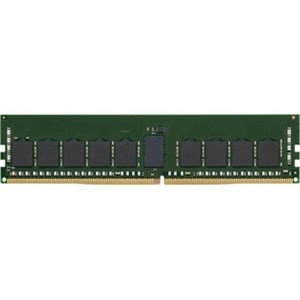
Kingston KSM32RD4/64HCR 64GB DDR4-3200 ECC Registered Server Memory
Overview
The Kingston KSM32RD4/64HCR is a 64GB DDR4-3200 ECC Registered DIMM engineered for enterprise servers and workstations that demand both high memory density and data integrity. Built on a 288-pin DIMM form factor with dual-rank (2Rx4) architecture and Hynix C die with Rambus register, this module slots into platforms where validated, error-correcting memory is non-negotiable — think database servers, virtualization hosts, and storage appliances running 24/7. At 3200 MT/s with a CAS latency of CL22, it delivers predictable throughput without voltage headroom concerns at 1.2V. If you're specifying memory for a rack build or memory upgrade on a certified server platform, this module covers the density, speed, and reliability tier that most modern Intel Xeon or AMD EPYC platforms require.
Key Features
- 64GB Single-Module Density: At 64GB per DIMM in a 1x64GB configuration (8192M x 72 module layout), you get maximum memory density per slot — critical on platforms with limited DIMM slots where you need to reach 512GB, 1TB, or higher total system memory without buying additional modules or risking compatibility gaps from mixing densities.
- DDR4-3200 (3200 MT/s) Speed: Running at 3200 MT/s matches the native rated speed of most current-generation server platforms based on Intel Ice Lake or AMD Milan CPUs. You won't be underclocking a faster module or artificially capping memory bandwidth — the module runs at its rated speed on compatible CPUs and chipsets natively.
- ECC (Error-Correcting Code): ECC continuously monitors memory for single-bit errors and corrects them in real time, preventing silent data corruption. On a 64GB module handling large in-memory datasets — SQL buffers, VM RAM allocations, containerized workloads — uncorrected bit flips cause application crashes or data corruption that's extremely hard to diagnose without ECC. This module eliminates that exposure.
- Registered (Buffered) Design: The register (RCD) between the memory controller and DRAM chips reduces the electrical load on the memory bus, making it possible to populate multiple DIMMs per channel without signal integrity issues. RDIMM is the standard for any server platform with more than two DIMM slots per channel — unbuffered modules simply won't work reliably in those configurations.
- CL22 Latency at 3200 MT/s: CAS latency of 22 at 3200 MT/s is the JEDEC standard timing for DDR4-3200 server modules. This means the module will initialize and be recognized correctly on any platform that follows JEDEC SPD — no manual timing adjustments, no XMP profiles needed, just plug-in and boot.
- 1.2V Operating Voltage: Standard DDR4 voltage at 1.2V keeps power consumption and thermal output in line with server TDP budgets. In a fully populated 24-DIMM chassis, the difference between 1.2V and 1.35V modules adds up — staying at 1.2V avoids unexpected thermal throttling on the memory bus.
- 2Rx4 Dual-Rank Architecture: Dual-rank organization allows the memory controller to interleave between ranks, improving effective memory bandwidth under workloads that hammer the bus continuously. On database and analytics workloads, dual-rank modules typically outperform single-rank at the same speed because the controller can pipeline rank switches.
- JEDEC Standard Compliance: Full JEDEC compliance means the SPD (Serial Presence Detect) data is correctly programmed and the module will be recognized and initialized correctly by server BMCs and UEFI firmware without requiring custom BIOS settings or platform-specific workarounds.
- Gold Lead Plating: Gold-plated contacts resist oxidation and provide consistent electrical contact even in environments with temperature cycling or moderate humidity — relevant in any server room without perfectly controlled environmental conditions.
- 2.5V VPP (Programming Power Voltage): The 2.5V VPP rail is the standard for DDR4 RDIMMs and confirms this module meets the full DDR4 RDIMM electrical specification for the VPP supply required by the register and DRAM.
Integration and Compatibility
The KSM32RD4/64HCR targets server platforms with DDR4 RDIMM support running at 3200 MT/s. Verify your specific server's QVL (Qualified Vendor List) before deploying — Intel Xeon Scalable (Ice Lake, Cascade Lake) and AMD EPYC (Milan, Rome) platforms supporting DDR4-3200 RDIMMs are the primary targets. The 2Rx4 rank configuration is compatible with most multi-DIMM-per-channel server motherboards. Confirm your platform's maximum supported module density (some older Cascade Lake platforms cap per-DIMM density below 64GB) before ordering. This module is not compatible with consumer desktop platforms, LGA1200/AM4 systems, or platforms requiring LRDIMM (Load-Reduced DIMM) instead of RDIMM.
Frequently Asked Questions
Q: What server platforms is the KSM32RD4/64HCR compatible with?
A: This module is designed for servers supporting DDR4-3200 ECC Registered (RDIMM) memory, including platforms built around Intel Xeon Scalable (Ice Lake, Cascade Lake) and AMD EPYC (Milan, Rome) processors. Always verify against your specific server's QVL (Qualified Vendor List) before purchasing — compatibility varies by platform, BIOS version, and population configuration.
Q: Can the KSM32RD4/64HCR be used in a desktop or workstation PC?
A: No. This is a Registered (Buffered) ECC DIMM designed exclusively for server motherboards with registered memory support. Desktop and mainstream workstation platforms use unbuffered DIMMs (UDIMM) and will not recognize or operate this module.
Q: What does the '2Rx4' designation mean for this module?
A: 2Rx4 means the module is dual-rank with x4-wide DRAM chips. Dual-rank allows the memory controller to interleave access between ranks for improved bandwidth. This is relevant when populating multiple DIMMs per channel — confirm your server's rank mixing rules before mixing 2Rx4 and 1Rx4 modules in the same system.
Q: Does the KSM32RD4/64HCR require any special BIOS configuration?
A: No special BIOS configuration should be required. The module is JEDEC-compliant with standard DDR4-3200 CL22 timings programmed in SPD. It will initialize at its rated speed on compatible platforms without XMP or custom timing profiles.
Q: What is the operating voltage and does it affect server power budgets?
A: The module operates at 1.2V (standard DDR4 voltage), keeping per-module power draw within the standard DDR4 TDP envelope. In fully populated server configurations, operating at the standard 1.2V avoids the additional thermal and power load associated with higher-voltage non-standard modules.
Q: Is ECC error correction active by default on this module?
A: ECC is a hardware feature of the DRAM and module design — it is always active as long as the server platform and memory controller have ECC enabled (which is the default on all server-grade platforms that support ECC RDIMMs). No software configuration is required to activate ECC on compatible platforms.
When I spec memory for high-density server builds, the KSM32RD4/64HCR hits the right combination of density and platform safety for most current-generation workloads. The 64GB capacity at DDR4-3200 with a 2Rx4 dual-rank layout and Hynix C die gives you a module that's qualified against the major server OEM platforms — and the JEDEC-standard CL22 timings mean you're not dealing with SPD negotiation failures at first boot.
Technical Highlights:
- 64GB Density at 1.2V: Reaching 64GB per slot at standard 1.2V keeps the module within the DDR4 power spec even in chassis with 24 DIMMs populated — no special VRM headroom required beyond what any DDR4 server platform already provides.
- Row Cycle Time 45.75 ns / Row Active Time 32 ns: These JEDEC timing parameters confirm the module's SPD is programmed to full DDR4-3200 specification, which matters when validating against platform QVLs that check SPD contents against expected timing tables.
- 2.5V VPP Rail: The 2.5V VPP is the correct programming power voltage for DDR4 RDIMM registers (Rambus RCD) — if your server platform's VPP rail is misconfigured or failing, this module will exhibit register initialization errors. Worth checking VPP rail health in any troubleshooting scenario.
Deployment Considerations:
- The 2Rx4 rank configuration affects population rules on some platforms — Intel Ice Lake Xeon in particular has specific guidance on mixing 2Rx4 and 1Rx4 modules across channels. Follow the platform's memory population guide precisely to avoid operating at reduced speed or sub-optimal interleaving.
- Refresh row cycle time of 350 ns is the standard DDR4 tRFC parameter — if you're deploying on older Cascade Lake platforms that have known SPD compatibility issues with 16Gb-component 64GB RDIMMs, confirm a BIOS version that supports the 16Gb DRAM component density before deploying at scale.
For a virtualization host running VMware vSphere or a Linux KVM cluster where you need 512GB to 1.5TB of system RAM in a 2U chassis, the KSM32RD4/64HCR gives you the per-slot density to reach those totals without resorting to LRDIMMs or non-standard voltages — a straightforward memory spec for builds where stability and OEM validation matter more than chasing the lowest latency numbers.