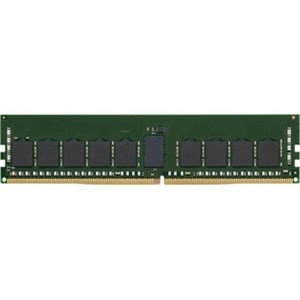
Kingston KSM26RD8/32HCR 32GB DDR4-2666 ECC Registered Server DIMM
Overview
The Kingston KSM26RD8/32HCR is a 32GB DDR4-2666 ECC Registered DIMM engineered for server and workstation platforms that demand error-correcting memory with validated stability. Built on a dual-rank, x8 architecture using Hynix C die with Rambus register components, this module targets rack-mounted servers, storage appliances, and compute nodes where memory reliability directly affects uptime. If you are specifying memory for a production server build or a surveillance NVR platform requiring large-capacity, fault-tolerant RAM, this is the correct class of module to evaluate.
Key Features
- 32GB Capacity per DIMM: A single module delivers 32GB at a 4096M x 72 configuration, meaning you can achieve high-density memory populations without filling every slot — leaving headroom for future expansion without a full memory overhaul.
- DDR4-2666 Speed (CL19): Operating at 2666MHz with CAS latency 19 keeps memory bandwidth aligned with mainstream server CPU specifications. This is the sweet spot for Intel Xeon Scalable and AMD EPYC platforms that commonly validate at this frequency, reducing the risk of compatibility mismatches during commissioning.
- ECC (Error-Correcting Code): ECC detects and corrects single-bit memory errors in real time — a non-negotiable requirement for servers running databases, video management software, or any workload where a silent data corruption event could compromise recorded evidence or transaction integrity. Non-ECC RAM has no equivalent protection.
- Registered (Buffered) Design: The register between the memory controller and DRAM chips reduces electrical load on the memory bus, allowing higher DIMM counts per channel. For multi-processor servers or dense 2U platforms with 16+ DIMM slots, registered DIMMs are the only viable path to full population.
- Dual-Rank (2Rx8) Layout: Two ranks per module give the memory controller more flexibility in scheduling row accesses, which translates to better sustained throughput under concurrent read/write workloads — relevant in NVR servers continuously writing multiple high-bitrate camera streams while simultaneously serving playback requests.
- 1.2V Operating Voltage: Running at the JEDEC-standard 1.2V keeps thermal output in check inside high-density chassis. Lower voltage also means the module stays within the power envelope validated by server OEMs, avoiding thermal throttling in tightly cooled rack environments.
- Wide Operating Temperature Range (0–85°C): Rated to operate up to 85°C junction temperature, this module can handle the elevated ambient conditions inside densely populated rack servers without derate — relevant for edge deployments or server rooms with marginal cooling.
- JEDEC-Standard Compliant: Full JEDEC compliance means the module will initialize correctly under standard SPD negotiation without requiring custom BIOS profiles or XMP overrides — critical for servers where memory stability at boot is a hard requirement, not an option.
- Gold-Plated Lead Contacts: Gold contacts resist oxidation over the module's service life, maintaining reliable electrical contact in the DIMM slot — a practical durability detail in installations that may not be revisited for years.
- Row Cycle Time of 46.25ns, Refresh Row Cycle Time of 350ns: These JEDEC timing parameters define the minimum cycle overhead per row access and DRAM refresh interval. They confirm the module is spec-compliant for standard DDR4 server controllers and will not introduce timing violations under validated server configurations.
Integration and Compatibility
The KSM26RD8/32HCR is designed for server platforms that explicitly support DDR4-2666 ECC Registered DIMMs in a 288-pin DIMM socket. Verify your server's Qualified Vendor List (QVL) or memory compatibility list before ordering — registered DIMMs are not interchangeable with unbuffered (UDIMM) or load-reduced (LRDIMM) modules, and mixing types within a server is not supported. The 2Rx8 organization is distinct from 2Rx4 modules of the same capacity; some platforms specify one over the other for maximum channel density. This module's Hynix C die with Rambus register component (as indicated by the HCR suffix) is a validated combination for Kingston's server memory line and is appropriate for platforms that list Kingston ValueRAM or Kingston Server Premier compatibility.
For surveillance deployments specifically, this module suits NVR servers built on platforms such as Intel Xeon E or Xeon Scalable families where ECC is required by the OEM warranty terms. Pairing with a purpose-built network video recorder platform that exposes full ECC reporting through IPMI or the OS memory subsystem lets you catch developing DIMM issues before they become outages.
When planning memory capacity for a video surveillance server, consult a security camera system sizing guide to confirm how many concurrent streams and retention days your chosen NVR software (such as Milestone, Genetec, or Avigilon) requires at your target resolution. Higher-megapixel IP cameras writing continuous H.265 streams increase both storage I/O and system RAM demands substantially compared to legacy analog-equivalent streams.
For rackmount server builds, review your network switch and infrastructure stack alongside memory selection — the memory tier is only one element of a validated server BOM for production surveillance or compute workloads.
Frequently Asked Questions
Q: Is the KSM26RD8/32HCR compatible with desktop or workstation motherboards that use standard DDR4?
A: No. This is a Registered (Buffered) ECC DIMM intended for server platforms. Consumer and most workstation motherboards require unbuffered (UDIMM) DDR4 and will not POST with registered DIMMs installed. Confirm your platform's memory type support before ordering.
Q: What does the 'HCR' suffix in KSM26RD8/32HCR indicate?
A: The suffix indicates the DRAM component manufacturer and register type used on this specific module revision — Hynix C die with a Rambus register. Kingston uses component-specific suffixes to allow buyers to identify the exact DRAM and register combination, which can matter for platforms with strict QVL requirements.
Q: Can this module be mixed with other 32GB DDR4-2666 RDIMMs from different manufacturers in the same server?
A: Mixing DIMM brands or component revisions is generally discouraged in server environments and may void OEM support. For best results, populate with matched modules from the same part number. Consult your server's memory compatibility documentation before mixing.
Q: What voltage does the KSM26RD8/32HCR require?
A: It operates at 1.2V (standard DDR4 voltage) with a programming power voltage (VPP) of 2.5V, both of which are standard for server DDR4 platforms. No non-standard voltage configuration is required.
Q: Is ECC memory required for surveillance NVR servers?
A: ECC is not universally mandated, but it is strongly recommended for any server running continuous-write workloads like NVR recording. Silent memory errors in a non-ECC system can corrupt video index files or database entries, causing playback failures that may only be discovered when footage is needed most. Many enterprise NVR platforms and server OEMs require ECC for warranty support on server-class builds.
Q: What is the operating temperature range of the KSM26RD8/32HCR?
A: The module is rated for 0°C to 85°C operating temperature, which covers standard data center and edge server environments. This range aligns with JEDEC standards for server DIMMs.
The KSM26RD8/32HCR sits squarely in the server memory tier most integrators reach for when building out a production NVR or compute node — 32GB of DDR4-2666 registered ECC at 1.2V with JEDEC-validated timings. The 2Rx8 dual-rank layout is worth paying attention to here: it is architecturally different from 2Rx4 modules at the same 32GB capacity, and some server platforms specify one rank width over the other when populating all slots, so pulling the server's QVL before ordering saves a return trip.
Technical Highlights:
- ECC Protection: Single-bit error detection and correction in real time — on a 24/7 NVR writing dozens of simultaneous streams, a memory error without ECC correction can silently corrupt the video index or ring-buffer pointers, producing gaps in recorded footage that surface only during an investigation.
- CL19 at DDR4-2666: The 46.25ns row cycle time and CL19 latency are fully within JEDEC DDR4-2666 spec, meaning no custom BIOS tuning or XMP profiles needed — the server memory controller negotiates correct timings from SPD on first boot.
- 1.2V / 2.5V VPP: Standard voltage rails mean no power delivery anomalies in validated server platforms. The 0–85°C operating range gives this module room to perform in edge or lightly cooled environments without thermal derating.
Deployment Considerations:
- Registered DIMMs require a server-class platform with a registered memory channel — installing this in a UDIMM-only motherboard will result in a no-POST condition. Always verify the server's memory compatibility list (QVL) lists this specific part number or the Kingston KSM26RD8 family before deployment.
- The HCR component suffix (Hynix C / Rambus register) is not interchangeable with HCI or other suffix variants for platforms that enumerate component revisions in their QVL. If the QVL specifies a different suffix, order accordingly.
This module is the right fit for a mid-density rack server build — a 2U or 4U NVR chassis running 64–128 cameras at 4K H.265 where the platform OEM mandates ECC registered memory and DDR4-2666 is the validated speed grade. It is not the correct choice for any UDIMM or LRDIMM slot, nor for consumer platforms regardless of socket compatibility.