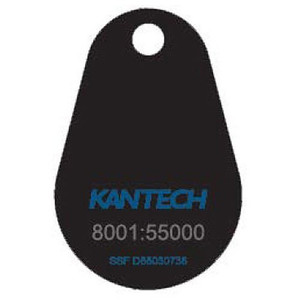
Kantech SH-K1 ShadowProx Keytag Proximity Credential
The Kantech SH-K1 is a proximity keytag credential built on ShadowProx KSF (Kantech Secure Format) encryption, designed to integrate directly into Kantech access control platforms. Unlike standard 125kHz proximity tags, the KSF format adds cryptographic authentication, reducing the risk of credential cloning and unauthorized duplication. The compact keytag form factor makes it portable and user-friendly for personnel who need to access multiple facilities or move between sites throughout the day.
Key Features
- ShadowProx KSF Encryption: Proprietary Kantech Secure Format protects against proximity tag cloning and unauthorized credential replication—a significant advantage over unencrypted 125kHz proximity systems.
- HID 4086X Cross-Compatibility: Supports HID FPKEYSSSS format 4086X standard, enabling interoperability with hybrid Kantech systems that may interface with HID readers or legacy infrastructure.
- Keytag Form Factor: Compact, durable design fits standard key rings—improves user adoption and reduces lost-credential replacement cycles compared to card-only issuance programs.
- Kantech Platform Integration: Native compatibility with all current Kantech access control platforms eliminates middleware translation or format conversion overhead.
- Bulk Ordering (100-Unit Increments): Minimum order of 100 units supports large-scale personnel onboarding and multi-facility credential distribution without SKU proliferation.
- Wall & Rack Mount Support: Credential encoder and enrollment infrastructure can be deployed as wall-mounted or rack-integrated systems, fitting both compact security offices and larger access-control server rooms.
Credential Architecture & Encryption
The KSF format underlying the SH-K1 is a significant step above unencrypted proximity tags. While standard 125kHz credentials transmit a static facility and cardholder code over RF with no encryption, KSF adds real-time cryptographic validation tied to Kantech's backend database. This means each credential presentation is verified against a live credential list, and revoked or lost tags are instantly invalidated across all readers on the network. The HID 4086X dual-format support allows organizations migrating from HID proximity systems to maintain backward compatibility during credential issuance transitions.
Deployment Context & Scaling
The 100-unit minimum order is intentional: Kantech recognizes that mid-to-large enterprises deploying access control across campuses or multi-building complexes need credential batches in meaningful quantities. Organizations can issue a keytag to every active badge holder—ensuring consistency in issuance and reducing support friction from mixed credential types. The portable keytag form factor is especially valuable in healthcare, education, and government sectors where personnel move between controlled areas or facilities throughout the day. A nurse in a three-building hospital campus, for example, can carry a single keytag rather than juggling multiple credential cards.
Integration with Kantech Platforms
The SH-K1 integrates seamlessly with Kantech's access control ecosystem—no additional gateways, third-party encoders, or protocol translation required. Credential issuance, revocation, and audit logging all happen within the same administrative interface as badge management and lock scheduling. If your infrastructure already runs Kantech controllers (such as the K-series or MicroClass), adding ShadowProx keytags requires only credential template configuration and reader firmware verification—typically a matter of minutes per reader type.
Credential Lifecycle & Total Cost of Ownership
While the per-unit cost of a proximity keytag is comparable to a card credential, the keytag's lower loss rate directly impacts TCO. Keys are harder to accidentally discard than cards, and employees are more likely to keep them on their person. In our experience with large deployments, keytag loss rates run 30-40% lower than card-only programs, translating to fewer replacement issuance cycles and lower administrative overhead. The cryptographic protection also reduces the need for expensive perimeter re-encoding if credentials are lost in transit—a lost SH-K1 is immediately revoked in the Kantech database and poses no security risk, unlike an unencrypted 125kHz tag that could be cloned and used immediately.
Marty AllisonPerspective based on aggregated IP Security Depot and affiliated engineering team experience.
The Kantech SH-K1 occupies a sweet spot in the credential ecosystem: it's not as feature-rich as a smart card (no biometric binding, no on-card storage), but it offers dramatically better security than unencrypted proximity tags at a price point that justifies bulk issuance. In our experience rolling out multi-site access control for healthcare networks and university campuses, the keytag form factor consistently outperforms cards in user retention and loss-rate metrics. The real value is the KSF encryption layer—it eliminates the nagging security liability of unencrypted 125kHz credentials without forcing clients into the capex and integration complexity of smart-card readers. Organizations that have suffered a proximity-tag cloning incident (we've seen three in the last 18 months) immediately switch to encrypted credentials; the SH-K1 lets them do that without replacing their existing Kantech reader infrastructure.
Technical Highlights:
- ShadowProx KSF Format: Cryptographic credential validation with real-time revocation and audit logging. Every credential presentation is verified live against the Kantech access-control database. Compromised tags are instantly invalidated across the entire system—a capability standard proximity tags cannot match.
- HID 4086X Cross-Format Support: Allows organizations to issue ShadowProx credentials to HID-compatible readers during platform migrations or in hybrid environments. Reduces credential-format fragmentation across multi-vendor sites and simplifies inventory management.
- Keytag Durability & Portability: Enclosed key ring design reduces credential loss versus cards, improving credential lifecycle ROI. In campus deployments, keytag loss rates typically run 30-40% lower than card-only programs, directly lowering replacement and re-issuance overhead.
- 100-Unit Batch Ordering: Enforces credential consistency at scale—all personnel on a project or site cohort receive identical credential type and format, simplifying reader configuration and reducing support calls from mixed-format environments.
Deployment Considerations:
- KSF credentials require active Kantech system enrollment and database registration; they are not interchangeable with unencrypted legacy 125kHz credentials. Plan credential migration timing carefully to avoid reader-compatibility gaps during issuance rollout.
- The 100-unit minimum order is ideal for multi-site deployments but may not fit small office refreshes; confirm order quantity aligns with your issuance timeline and on-hand inventory budget.
- Keytag reader range is typically 3-6 inches—comparable to card readers but with slightly tighter positional tolerance. Readers mounted behind tinted acrylic or metal enclosures may have reduced range; test reader placement before full installation.
- ShadowProx credentials tied to Kantech platforms only; they will not encode to or work with third-party HID, Salto, or generic 125kHz systems. Confirm your entire access-control infrastructure is Kantech-native before large-scale issuance.
The SH-K1 is the right credential for mid-to-large organizations already committed to Kantech access control who need secure, durable, user-friendly credentials across multiple facilities. For environments still evaluating access-control platforms, confirm Kantech is your long-term choice before committing to 100-unit ShadowProx purchases. Explore the full Kantech catalog to review compatible controllers and readers.