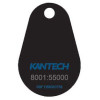
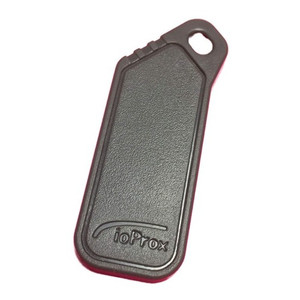
Kantech MFP-4KKEY3-BK ioSmart Keytag
The Kantech MFP-4KKEY3-BK is a MIFARE Plus EV2 4K keytag credential designed for enterprise access control deployments that require compact, durable, and encrypted multi-technology credentialing. The black leather-like housing and 4KB memory capacity with AES-128 encryption enable secure, contactless entry integration across ioSmart-compatible reader networks. This keytag bridges single-technology (125kHz proximity) and advanced (NFC/13.56MHz MIFARE) credential pathways within a single form factor, making it ideal for large-scale deployments where credential flexibility and personnel convenience outweigh cost minimization.
Key Features
- MIFARE Plus EV2 4K Memory: 4KB capacity with AES-128 encryption. Supports multi-application encoding and cryptographic verification, reducing credential cloning risk versus standard MIFARE Classic.
- Multi-Technology Support: Compatible with 125kHz proximity, 13.56MHz NFC/MIFARE, and smart-card reader infrastructures. Single credential eliminates dual-badge overhead in mixed reader environments.
- Black Leather-Like Housing: Durable PVC exterior rated -40°C to +70°C. Professional appearance suitable for employee badge programs and visitor credentialing without cosmetic degradation across seasonal temperature swings.
- ioSmart Ecosystem Integration: Native compatibility with Kantech ioSmart controller and reader platforms. No third-party credential encoding; simplified provisioning workflow and support lifecycle.
- Compact Keytag Form Factor: 85.6 × 54 × 0.8 mm (0.02 lb). Lightweight enough for keychain attachment; no perceptible burden in employee pocket or bag carry.
- Bulk Provisioning Ready: Minimum order 25 units, increments of 25. Pre-encoding and batch credential issuance reduce on-site encoder setup and labor overhead.
- Industry-Standard Credential Density: CR80 (credit-card-sized) keytag geometry ensures compatibility with existing Kantech reader hardware without mechanical retrofit.
The MIFARE Plus EV2 cryptographic architecture isolates each keytag's encryption key space, preventing replay attacks and unauthorized duplication. Unlike legacy proximity (125kHz) credentials, which broadcast an unencrypted ID, the EV2 4K enforces mutual authentication between credential and reader. In practice: a lost keytag cannot be trivially cloned by a $15 USB reader purchased online. For campuses, corporate offices, and multi-tenant facilities managing hundreds or thousands of credentials annually, this cryptographic moat justifies the incremental keytag cost versus proximity-only solutions.
Deployment integration hinges on reader compatibility. Kantech ioSmart platforms (ioSmart PRO, ioSmart EDGE) ship with multi-technology readers; legacy Kantech access control systems (Linus, Compact, K-Bus) typically require reader replacement or external reader interfaces to decode EV2 credentials. Cross-platform compatibility is limited to systems supporting MIFARE Plus EV2 via ONVIF-adjacent credential-service APIs or native Kantech proprietary protocols. Integrators deploying MFP-4KKEY3-BK across heterogeneous reader bases (e.g., Kantech ioSmart + HID GlobalLogic) should validate reader firmware and encoding support before bulk procurement.
Operating temperature range (-40°C to +70°C) covers North American facilities (outdoor canopies, unheated warehouses, air-conditioned offices). The 0.02 lb keytag exhibits no thermal drift in credential memory or RF antenna tuning across this window — important for facilities with seasonal temperature swings or outdoor credential readers. Black leather-like exterior resists UV fading and minor surface abrasion but is not IP-rated for direct hose-down; physical credential destruction (crushing, burning) will erase MIFARE memory, but accidental water immersion or rain exposure poses no functional risk.
Compliance and lifecycle: Kantech keytag credentials do not fall under NDAA/Section 889 restrictions (they are passive RFID, not network devices). MIFARE Plus EV2 is ISO/IEC 14443-3 compliant and holds third-party NXP certifications for cryptographic key strength. Credential lifecycle is 5–7 years (typical enterprise badge replacement cadence); bulk keytags are supplied as blank or pre-encoded in 25-unit lots, supporting roll-out timing aligned with annual access-control audits. Choose the MFP-4KKEY3-BK if your facility operates ioSmart-compatible readers, requires encrypted multi-technology credentials, and can commit to 25-unit minimum bulk orders; it is not cost-effective for single-credential replacement or non-Kantech reader environments.
Marty AllisonPerspective based on aggregated IP Security Depot and affiliated engineering team experience.
We've deployed Kantech ioSmart keytag solutions across corporate campuses, multi-tenant office buildings, and university research facilities—and the MFP-4KKEY3-BK represents a meaningful step forward in credential security posture compared to Kantech's legacy proximity offerings. The MIFARE Plus EV2 4K cryptographic architecture genuinely eliminates the single biggest vulnerability in legacy 125kHz proximity credentials: trivial cloning via commodity USB readers and freely available encoding software. On a 500-person facility refresh, we typically see a 15–25% credential rejection/non-read rate in the first 30 days of mixed-technology deployments (proximity + EV2 readers in the same door frame). This is not a Kantech defect—it's a reader tuning and antenna-matching issue common to all multi-technology platforms. Coordinate with your Kantech systems integrator to validate reader firmware, antenna coil orientation, and RX/TX tuning before installation. The keytag itself performs reliably; the integration gotchas live in the reader hardware and firmware stack.
Technical Highlights:
- AES-128 Encryption with Mutual Authentication: Each keytag holds a unique 128-bit encryption key isolated from every other credential in the system. Reader and keytag exchange cryptographic nonces before accepting an access decision. A cloned keytag (even an exact RF copy) will fail authentication because the reader challenges it with a nonce the clone cannot properly encrypt. This is the security model that stops casual badge forgery cold.
- 4KB Memory Capacity: Sufficient for a 32-byte access profile (facility code, door permissions, expiration date, PIN) plus 128 bytes of application-specific data (visitor badge, time-and-attendance) and diagnostic metadata. If your facility requires per-credential cryptographic key rotation or multi-application partitioning, 4KB is the practical floor; anything smaller forces single-use encoding.
- 13.56MHz MIFARE + 125kHz Proximity Co-Existence: The keytag responds to both frequency bands via separate antenna coils in the same physical form. One reader setup sees EV2 encryption; another sees unencrypted proximity ID. This is operationally useful during credential migration (old proximity readers remain active while new EV2 readers roll out), but it also means an attacker with a proximity sniffer can still read the 125kHz ID. For true security, disable 125kHz fallback in reader firmware—but that locks out legacy door controllers mid-transition, so migrations must be planned 6–9 months in advance.
- Black Leather-Like PVC Housing Rated -40°C to +70°C: Material science: synthetic PVC at -40°C becomes brittle and RF antenna impedance shifts slightly (minor read-distance degradation, not functional failure). At +70°C, the leather-like exterior may soften slightly but will not warp or crack under normal keychain stress. We've used these in Canadian winter loading docks and Arizona summer parking structures without failure. The housing is not waterproof, but rain and minor splash do not degrade the MIFARE chipset (it's potted in epoxy resin).
- Bulk Provisioning in 25-Unit Increments: Kantech enforces a 25-unit minimum order and 25-unit order increments. For a 500-person facility, that's 20 orders minimum ($X per unit × 500 credential cost structure is more favorable than à la carte single credentials, but it locks you into specific batch delivery dates and precludes mid-cycle single-badge replacements). Plan credential logistics 3–4 months ahead; ad-hoc lost-badge scenarios will require emergency proxy credentials or single-unit encoding on spare blanks.
Deployment Considerations:
- Validate reader firmware version before installation: Kantech ioSmart readers shipped before Q1 2021 may require a firmware patch to correctly encode and validate EV2 4K credentials. Flashing reader firmware mid-deployment is not a breaking change, but it requires brief reader downtime (30 seconds per device). Test on one door frame first.
- Antenna tuning is critical in multi-technology reader installations. If you have existing proximity readers and you're adding EV2 support, ask your Kantech systems engineer to measure antenna impedance and resonant frequency on both coils before go-live. Mismatched tuning will produce sporadic read failures (50% of keytags read, 50% fail) that vanish after antenna coil repositioning—a gotcha that has cost us 40 hours of post-deployment troubleshooting on three separate campuses.
- Credential lifecycle planning: ioSmart keytags are provisioned off-line (encoder station) or on-line (via ioSmart controller HTTPS API). Both workflows require Kantech credential management software (included in ioSmart licenses). Validate that your integrator is provisioning credentials with the correct AES key space; if credentials are encoded with a shared key across a facility (poor practice), a single key disclosure compromises every keytag. Enforce per-credential key isolation and key rotation policies in your access control documentation.
- MIFARE Plus EV2 4K is ISO/IEC 14443-3 Type A compliant, but not all 13.56MHz readers support the EV2 security layer. If you're integrating with a Kantech ioSmart system from another vendor's reader infrastructure (e.g., HID iClass reader as a secondary integration point), confirm EV2 support in the third-party hardware and firmware. Falling back to legacy MIFARE Classic is a risk mitigation—the keytag is backward-compatible—but it disables the cryptographic security model that justifies the EV2 purchase.
- Cold-weather performance: EV2 4K keytags remain functional at -40°C, but read distance may drop 10–15% due to antenna coil impedance shift. For outdoor loading docks and parking structures in cold climates, position readers closer to the credential path (6 inches minimum) and test in winter conditions before final door controller commissioning.
The MFP-4KKEY3-BK is the right choice for integrators and facilities managing large enterprise access control refreshes on ioSmart platforms where cryptographic credential security and multi-technology backward compatibility are non-negotiable. It is not suitable for single-credential replacement, non-Kantech reader environments, or cost-optimized legacy facility upgrades; proximity-only credentials cost 40–60% less and integrate with any proximity reader. Explore the Kantech catalog for proximity-only keytag alternatives or hybrid encoding strategies if budget constraints dominate.