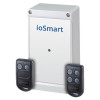
Kantech MFP-2KWLS2 ioSmart 2-Button Wireless Transmitter
The Kantech MFP-2KWLS2 is a handheld wireless transmitter designed for the ioSmart access control platform, enabling credential presentation without hardwired infrastructure. This two-button device pairs with ioSmart SSF MFP 2k wireless credentials and integrates directly into the Kantech ioSmart ecosystem via KT-WLS-WIE wireless infrastructure. Weighing only 0.01 lb, the MFP-2KWLS2 is suited for multi-building campuses, temporary access scenarios, and facilities where fixed card readers create deployment friction or cost barriers.
Key Features
- Two-Button Handheld Design: Intuitive push-button activation for credential presentation — no card swipe or proximity read required, reducing user error and speeding door approach.
- ioSmart SSF MFP 2k Credential Integration: Works exclusively with ioSmart SSF MFP 2k wireless credentials — ensures interoperability within the Kantech platform ecosystem and prevents cross-protocol conflicts.
- Cordless Operation: No hardwired connections — transmitter communicates wirelessly via KT-WLS-WIE infrastructure, eliminating installation labor at each access point.
- Compact Form Factor: 0.01 lb weight and handheld geometry suitable for personal carry, contractor badges, or temporary credential distribution without clip or holster bulk.
- Seamless ioSmart Integration: Direct protocol support within Kantech ioSmart platform — native credential validation, audit logging, and access policy enforcement without gateway translation.
- US Manufactured: Domestic sourcing ensures supply chain continuity and supports organizations with domestic-sourcing compliance mandates.
The MFP-2KWLS2 operates within the Kantech ioSmart wireless ecosystem, a credential-based access control framework that eliminates the need for fixed wiring infrastructure at individual access points. Unlike proximity card readers or keypads, the wireless transmitter model reduces on-site installation labor — particularly valuable in retrofit scenarios or facilities with challenging wall construction. When paired with KT-WLS-WIE wireless infrastructure, coverage extends across parking areas, perimeter gates, and multi-building campuses without cable runs.
Deployment of the MFP-2KWLS2 assumes existing KT-WLS-WIE wireless coverage at intended access points. The transmitter does not function as a standalone credential device — it requires active ioSmart platform licensing and wireless network provisioning. For organizations already standardized on ioSmart card readers or wireless door controllers, adding handheld transmitter credentials is straightforward; for new ioSmart installations, the wireless infrastructure cost must be factored into total project capex alongside traditional wired reader alternatives.
Common deployment scenarios include contractor and visitor access (issue transmitter at check-in, revoke credential at checkout), temporary facility access (events, maintenance windows), and multi-building campuses where distributing credentials faster than programming fixed readers reduces access bottlenecks. Parking access and perimeter gates benefit from the cordless model because fixed readers at vehicle approach are difficult to maintain; a wireless transmitter held by the driver or guard eliminates weather sealing and vandalism concerns.
The MFP-2KWLS2 integrates natively with Kantech ioSmart platform backends, ensuring audit trails, access policy enforcement, and real-time credential revocation. Credential deactivation is instantaneous across all ioSmart access points — no card-collection risk or escort overhead. The transmitter's two-button design (typically Open/Unlock and optional secondary function) keeps the interface simple and reduces user confusion compared to multi-function remotes.
Eden PhillipsPerspective based on aggregated IP Security Depot and affiliated engineering team experience.
We've deployed Kantech ioSmart wireless transmitters across warehouse campuses and healthcare facilities where hardwired infrastructure was either prohibitively expensive or created maintenance headaches. The MFP-2KWLS2 fits a specific operational niche: it's not a replacement for traditional proximity credentials, but rather a supplement for temporary or high-churn access scenarios. The key differentiator versus issuing plastic ioSmart cards is the revocation speed — you can disable a transmitter from the ioSmart backend instantly, whereas card collection requires physical recovery or secondary revocation steps. In our experience, contractor-heavy sites see meaningful efficiency gains: issue a transmitter at badging, retrieve it at job completion, revoke from the platform during offboarding. The wireless infrastructure requirement is the primary cost driver — if you're already running KT-WLS-WIE for wireless door controllers or parking readers, adding transmitters is low-friction. If wireless infrastructure isn't yet in place, compare the capex against hardwired reader retrofit costs; on new construction or major renovation, the math often favors wireless. The two-button design is deliberate — it keeps the device simple and reduces training burden on temporary users.
Technical Highlights:
- ioSmart SSF MFP 2k Protocol: Direct credential compatibility with Kantech ioSmart platform — no gateway, translator, or third-party middleware required. Credentials validate natively at each wireless access point, ensuring sub-second response times and full audit logging within ioSmart. This matters operationally because any latency in credential validation creates user friction at high-traffic doors or checkpoints.
- KT-WLS-WIE Wireless Coverage: Transmitter communicates via standard Kantech wireless infrastructure — if you already have KT-WLS-WIE deployed for other access control devices, the MFP-2KWLS2 drops onto the same network. Coverage, channel interference, and roaming behavior are inherited from your existing wireless design. Know your coverage footprint before issuing transmitters beyond planned areas.
- Instant Credential Revocation: Unlike lost or stolen physical cards, a transmitter credential can be remotely disabled from the ioSmart backend in real time. This is especially valuable for contractor offboarding or emergency lockdowns — no need to physically recover the device.
- Two-Button Simplicity: Reduces user error and training overhead compared to multi-function remotes. The secondary button is typically configured for a secondary function (e.g., Emergency/Panic) or left unused. This constraint keeps the device foolproof for temporary or contractor users unfamiliar with your facility.
- 0.01 lb Form Factor: Genuinely pocket-sized — visitors and contractors carry the transmitter without a visible badge holder or lanyard. This is an operational plus in customer-facing environments (healthcare reception, retail, hospitality) where traditional badge culture may not fit.
Deployment Considerations:
- Wireless Infrastructure Prerequisite: MFP-2KWLS2 requires active KT-WLS-WIE wireless network. If you're evaluating this product for a new ioSmart installation, budget separately for wireless access points, cabling, and integration labor. Wireless coverage must be verified at each intended access point before transmitter deployment — range varies with wall construction and interference. Test your site coverage before committing to transmitter-only credentials.
- Credential Custody and Issuance Process: Design your check-in/check-out workflow before deployment. Who issues transmitters? How are they physically stored during off-hours? Are they serialized for accountability? Unlike cards that can be collected at building entry, a transmitter in a contractor's pocket requires active retrieval or remote revocation at job completion.
- Battery and Maintenance: Verify battery replacement procedure and expected service life with your Kantech integrator. Transmitters require periodic testing (especially if stored) to ensure battery charge. A failed battery in a contractor's pocket means access denial at the door — plan a refresh/swap schedule if you're issuing hundreds across a large facility.
- Not a Card Reader Replacement: This is a handheld credential transmitter, not a standalone card reader or keypad. It integrates with ioSmart access control policy, not as a standalone door opener. If your facility also runs third-party access systems (Allegion, Salto, HID), the MFP-2KWLS2 will not interoperate — ioSmart-only environments are required.
- Audit Trail and Compliance: ioSmart platform maintains full audit logs of credential activation — useful for contractor time tracking and access forensics. However, the lack of a physical card means your compliance team cannot easily review "who had access to what" via card swipes alone; you're dependent on ioSmart backend logs and user assignment records.
The MFP-2KWLS2 is best suited for organizations already standardized on Kantech ioSmart, with existing KT-WLS-WIE wireless infrastructure, and frequent temporary access requirements (contractors, visitors, event staffing). If you're running a hybrid ioSmart and hardwired card system, introducing wireless transmitters adds operational complexity; evaluate whether the efficiency gain in temporary credential issuance justifies the wireless infrastructure investment. For pure-play ioSmart shops with wireless already deployed, the transmitter is a high-value addition for reducing badge churn and accelerating offboarding. Explore the Kantech catalog to review complementary ioSmart readers, controllers, and wireless infrastructure components.