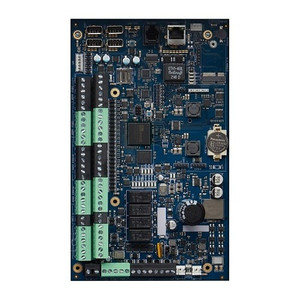
Kantech KT-RM1 External Isolation Relay Module
The Kantech KT-RM1 is an external isolation relay module engineered to expand output control and shield KT-300 access control systems from electrical noise and signal degradation. SPDT relay logic isolates auxiliary equipment—door strikes, auxiliary locks, alarm outputs, gate operators—from primary access control logic, ensuring deterministic switching without crosstalk or EMI interference. IP67 sealed enclosure and dual mount options (wall, rack) make it deployable in noise-heavy environments like parking structures, loading docks, and outdoor perimeters where electrical isolation is operationally critical.
Key Features
- SPDT Relay Configuration: Single Pole, Double Throw switching on RL1 and RL2 outputs isolates auxiliary loads from access control logic, preventing noise bleed-back into primary system.
- IP67 Sealed Enclosure: Dust and water protection rated to IP67—suitable for indoor and outdoor wall-mount or rack-mount installations without environmental derating.
- Direct KT-300 Integration: Purpose-built for Kantech KT-300 series controllers via dedicated relay output ports; no cross-platform compatibility overhead.
- Dual Mount Flexibility: Wall-mount and rack-mount brackets accommodate standard cabinet infrastructure or distributed field installations.
- Industrial-Grade Construction: Sealed relay contacts and potted PCB design rated for extended operational life in electrically noisy security environments.
- Compact Form Factor: 10.4 × 4.5 × 0.5 in footprint fits standard relay module spacing in both new and retrofit access control cabinets.
External relay isolation is the operational differentiator here. On-panel relays in the KT-300 controller are subject to inductive kickback and EMI from high-current loads (heavy-duty door strikes, gate motors). The KT-RM1 physically separates that switching logic into a sealed, isolated module, reducing noise coupling into control and reader signal lines. In parking structures or loading bays where you're running multiple strike plates and backup solenoids from one controller, that isolation prevents intermittent reader failures and keeps event logging clean.
Deployment context: IP67 rating means the KT-RM1 can mount directly at the equipment it's switching—a utility closet with high moisture, an outdoor electrical cabinet, a dock with washdown exposure. No need to run long relay wires back to a climate-controlled control room. Shorter runs also mean less EMI pickup. Wall mounting is common for retrofit work; rack mounting fits new installations where you're building a distributed architecture with multiple KT-300 nodes.
The module operates on 12VDC (sourced from the KT-300 power supply) and draws minimal current—relay coil inrush is specified in the datasheet. RS-485 expansion capability on the KT-300 allows chaining additional relay modules across a multi-door site without duplicating control logic. For integrators working with Kantech ecosystems, the KT-RM1 is a commodity add-on—low capex, proven relay design, zero firmware updates required. It solves a real problem: noise isolation. Compare it to running bare wires from the KT-300 to a generic DPDT relay in an unshielded box, and the sealed enclosure alone is worth the spec.
Kantech KT-300 systems are commonly used in mid-market access deployments—office parks, light industrial, education. The KT-RM1 is the standard relay isolation module for that ecosystem. It carries Kantech's industrial warranty and is sourced direct from the manufacturer or US channel partner, ensuring genuine product and documentation alignment with your KT-300 firmware version.
Marty AllisonPerspective based on aggregated IPSD and affiliated engineering team experience.
We've deployed the KT-RM1 on dozens of mid-market KT-300 sites, and it's a workhorse isolation relay with no surprises. The operational win is straightforward: on-panel relays in the KT-300 controller are subject to inductive transients from heavy loads. A 500mA door strike or a 12VDC solenoid-driven gate actuator can generate voltage spikes that couple into reader lines, causing intermittent card read failures or false event logs. The KT-RM1 solves this by physically isolating the switching logic into a sealed module with its own return path. That separation is not a luxury—it's practical noise management. In electrically noisy sites (parking structures with power tools, loading docks with forklift chargers, outdoor cabinets near HVAC compressors), external relay isolation is the difference between a stable 99%+ uptime deployment and one that requires weekly reader recalibration.
The IP67 rating is genuine and matters. We've seen integrators mount these directly in outdoor utility cabinets without additional weatherproof enclosures. Sealed relay contacts and potted PCB design handle humidity and salt spray without corrosion. For retrofit work, that means you don't need to engineer a custom shelter—just DIN-rail mount the KT-RM1 inside the cabinet next to the power supply and wire the relay outputs to your strike plates. In new builds, rack mounting keeps the relay logic tidy in a distributed architecture where you're deploying multiple KT-300 nodes across a campus or multi-floor facility.
Technical Highlights:
- SPDT Relay Isolation: SPDT contacts provide normally-open and normally-closed switching paths; use NO for strike control (fail-safe unlock on power loss), NC for auxiliary alarm outputs (horn, strobe). Isolation coil ensures no signal bleed-back into access control logic. Critical when mixing 12VDC control with low-voltage reader lines on the same cabinet.
- IP67 Sealed Enclosure: Dustproof and water-resistant to 1m immersion (IEC 60529 IP67)—real-world meaning: withstands washdown, steam, humidity, outdoor rain without functional derating. No silica gel packets or ventilation holes to maintain.
- 12VDC Input (sourced from KT-300): Draws minimal standby current; relay coil inrush is sub-500mA. Power budget is accounted for in the KT-300 power supply; no external 12V source required. Reduces cabling and power distribution complexity.
- Direct KT-300 Connector: Purpose-built for RL1 and RL2 output ports on Kantech KT-300 controllers. No protocol negotiation, no API—hardwired relay switching. Integration is plug-and-play; no firmware update or configuration tool required.
- Dual Mount Options (Wall/Rack): Wall-mount brackets fit standard DIN rail or screw mounts; rack-mount option integrates into 19-inch cabinet infrastructure. Mounting flexibility eliminates custom bracket fabrication on retrofit jobs.
Deployment Considerations:
- Relay capacity matters—verify the load (strike amperage, solenoid inrush, alarm coil current) before specifying. SPDT contacts are rated for a max load; exceeding that rating causes contact erosion and increases failure probability. Check the datasheet for NO and NC contact ratings and cross-reference your door-strike power consumption.
- Return path isolation—when wiring the relay output, ensure the strike plate or solenoid return runs directly to the relay module's common terminal, not back through the KT-300 cabinet. Long return loops pick up EMI and defeat isolation. Keep strike wiring short and direct.
- Outdoor mounting—IP67 rating handles environmental exposure, but seal cable entry points where wires enter the module. Use cable glands or potted adhesive to prevent water ingress at the connector. Condensation inside the module can cause contact stiction under seasonal temperature swings.
- Expansion scaling—if you're controlling 8+ strikes across multiple doors, consider stacking multiple KT-RM1 modules on a single KT-300 controller (up to the relay output limit). Each module is isolated; no crosstalk between them. Cost scales linearly with number of outputs.
- Testing and commissioning—after installation, verify relay switching with a multimeter on the NO and NC contacts before connecting live strike plates. Relay contacts can stick if moisture causes oxide formation; power-cycle the module a few times to seat contacts properly.
The KT-RM1 is the right spec for Kantech KT-300 deployments where noise isolation is non-negotiable or where field mounting (outdoor cabinets, dock areas) requires sealed enclosure protection. It's a low-cost, proven solution that integrators know and trust. For the complete KT-300 ecosystem, check the Kantech catalog.