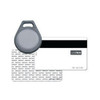
Kantech HID-C1386 ISOProx II 26-bit Proximity Card
The Kantech HID-C1386 is a standard ISOProx II format proximity card engineered for HID-based access control deployments. Built on proven 26-bit Wiegand encoding, it integrates seamlessly into existing reader networks without requiring gateway reconfiguration or system firmware updates. Organizations managing facility badge programs, visitor credential issuance, or large-scale credential replacement across multi-building campuses rely on this card's proven interoperability and field reliability.
Key Features
- 26-bit Wiegand Encoding: Industry-standard format ensures compatibility with HID ISOProx II readers and all legacy Wiegand access control systems without translation layers.
- Dye-Sublimation Printing: Full-color front-surface printing supports custom branding, photo ID, employee numbering, and expiration dates — single-card issuance reduces handling and reprint cycles.
- ISOProx II Form Factor: Standard credit-card dimensions (CR80) fit existing badge holders, lanyards, and magnetic stripe compatible card readers for multi-credential workflows.
- HID Reader Ecosystem Compatibility: Works with HID ProxPro, ProxProII, and RP40 readers — no reader firmware patches required on system upgrades.
- Batch Issuance Ready: Sold in 100-card increments; supports high-volume credential programs where cards are printed and distributed on predictable schedules.
- Dual-Format Support Path: Card format allows future upgrade to iCLASS SE or NFC credentials without physical infrastructure overhaul — legacy Wiegand readers remain operational while new readers are phased in.
Integration and Deployment Context
The HID-C1386 is the refresh card for organizations already running HID access control backbone infrastructure. Unlike higher-cost smart cards or mobile credential pilots, proximity cards impose zero network load, require no battery replacement, and have zero failed authentication due to connectivity issues. A 500-card facility badge renewal takes a single afternoon: print, batch-encode via your access control workstation, and distribute. On-site or third-party printing vendors can apply customization (photo, barcode, security features) during the card production workflow.
Wiegand encoding means the card itself carries no encrypted credential data — the access control system reads the card's hardcoded identifier and looks up permissions in its local database. This design eliminates the need for readers to validate certificates or contact external authentication servers, making it ideal for facilities with isolated or bandwidth-constrained networks. However, card loss or theft requires immediate deactivation at the system level (credential database), not physical card replacement.
Typical deployments pair the HID-C1386 with an HID access control panel (EdgeSoló, ProxPro, or VertX controller) running a credential management application (iLOQ Manager, Kantech KeyScan, or third-party ONVIF-compliant access management platform). Card assignment, expiration scheduling, and zone-level access rules are administered centrally; physical card distribution is handled by your badge office or HR department. Print batches of 100 cards on a schedule that matches employee onboarding and attrition cycles to minimize aging inventory.
Ordering and Batch Specifications
The HID-C1386 is ordered in 100-card minimum quantities with incremental ordering in 100-card multiples. This batch model is standard across the industry and reflects the economics of card manufacturing and personalization workflows. Dye-sublimation printing is typically handled by your card vendor or badge office at the time of encoding; blank cards can be ordered separately and personalized on-site if your facility has in-house printing infrastructure. Lead times vary by vendor and customization complexity — coordinate with your badge office or printing service to confirm turnaround before employee start dates.
Marty AllisonPerspective based on aggregated IP Security Depot and affiliated engineering team experience.
We've installed thousands of HID-based access control systems across healthcare, education, and corporate campuses over the past fifteen years. The HID-C1386 is the workhorse credential — it's not flashy, but it works. The real value comes from Wiegand's simplicity: no cryptographic overhead, no reader firmware bloat, and no dependency on backend authentication servers. In a hospital with five buildings and 800 staff, you can encode a batch of 50 cards on Monday morning and have them in circulation by Wednesday without a single IT ticket. Compare that to NFC or smart-card deployments where each card read triggers a certificate validation check, and the infrastructure cost differential becomes obvious. That said, Wiegand proximity is read-range agnostic — a card is either in the field of the reader or it isn't. If your facility requires multi-range zoning (e.g., « can enter lobby but not server room »), that logic sits in the access control panel, not the card. The card is a dumb identifier; the panel is the brain. For most traditional facilities, that's fine. But if your organization is migrating toward mobile credentials or requiring higher assurance (proof of possession + device binding), proximity cards are a dead-end credential. Plan your refresh cycle accordingly. We've seen too many badge programs where organizations ordered 500 HID-C1386 cards in 2019, only to announce a mobile credential pilot in 2022 — those cards never got issued, and now you're managing dual-credential workflows that complicate operations.
Technical Highlights:
- 26-bit Wiegand Encoding: Eight-byte fixed identifier encoded directly on the card's magnetic microstrip. No cryptography, no key derivation — readers simply extract the ID and match it against the access control system's credential database. Massive operational advantage on system troubleshooting: if a card doesn't authenticate, you can manually query the system using the card's printed ID number without needing special diagnostics hardware.
- Dye-Sublimation Print Quality: Full-color photographic-quality printing on the front surface allows for employee photo, job title, company logo, and security features (hologram, microprinting, barcodes). Quality degrades slightly over 3-5 years of daily use (fading, abrasion), but the card remains readable by readers throughout its lifecycle. Consider reprinting during annual badge refresh cycles if visible ID is a compliance requirement.
- Reader Compatibility Across Generations: The HID-C1386 works with HID readers manufactured in the last 20+ years. If you're integrating into an older facility with ProxPro readers from 2005 and a newer facility with VertX controllers from 2020, both can read the same card format without translation. This cross-generation compatibility is rare and powerful in legacy environments.
- Batch Encoding Efficiency: Cards can be pre-programmed with encoding data in batches via your access control workstation using a desktop encoder (HID MultiClass reader or Kantech encoding module). Encoding a batch of 100 cards takes 5-10 minutes; personalization printing adds another 20-30 minutes depending on your printer model and complexity. No per-card network calls, no cloud API rate-limiting, no certificate provisioning delays.
- Minimal Supply Chain Complexity: Proximity cards are commodity items manufactured by HID, Kantech, and dozens of third-party vendors. If your preferred vendor's lead time extends, you can often source compatible 26-bit Wiegand cards from a competitor and encode them on your existing system without vendor lock-in. Try that with proprietary smart-card or NFC credentials.
Deployment Considerations:
- Wiegand transmission is unencrypted. The card's ID is broadcast in plaintext every time the reader energizes the coil. In high-security environments (DoD, financial sector, healthcare), proximity cards alone don't meet insider threat or regulatory requirements — pair with PIN entry, multi-factor readers, or migrate to encrypted smart-card credentials. Know your compliance posture before committing to a large card order.
- Card cloning is trivial with a $50 reader clone and a writable proximity card blank. If someone steals or photographs the card, a determined attacker can duplicate the credential and gain unauthorized access. Proximity works best in low-threat facilities or as a first-factor with secondary PIN/biometric controls. In higher-assurance deployments, require NFC or smart-card credentials instead.
- Batch ordering in 100-card minimums creates inventory management overhead. Don't order more than 12 months of card stock at one time — storage, expiration dating, and reprint demand fluctuate. Coordinate ordering cycles with your HR onboarding calendar to minimize waste and SKU sprawl in your badge office.
- Dye-sublimation printing quality depends on your printer maintenance and ribbon/ink cartridge freshness. Don't assume your existing badge printer can handle high-quality photo reproduction — test a small batch before committing to a large print run. If in-house printing isn't viable, budget for third-party printing turnaround and coordination with your card vendor.
- Wiegand readers have a maximum transmission distance of 3-6 inches depending on coil size and reader model. If your facility requires long-range reader implementation (10+ feet), you'll need to migrate to active RFID or NFC credentials that support longer read ranges. Proximity cards are fine for standard door-mounted readers but won't work for parking-lot perimeter gates or vehicle-mounted readers.
The HID-C1386 remains the right credential choice for organizations with mature HID access control infrastructure, high-volume badge issuance programs, and low-to-medium security requirements. It's proven, interoperable, and operationally simple — no surprises. For facilities planning a migration to modern smart-card or mobile credential platforms, use proximity cards as a transition vehicle while you phase in new reader infrastructure, but don't build long-term strategy around Wiegand. Explore the Kantech catalog for complementary access control components and credential management solutions.