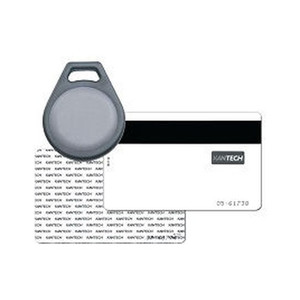
Kantech HID-C1386GGK ISOProx II Proximity Card
The Kantech HID-C1386GGK is a 26-bit Wiegand ISOProx II proximity card designed for personnel access control badge programs. Dye-sublimated printing resists fading through daily use and environmental exposure, maintaining readable card surface for multi-year deployments. The card integrates directly with Kantech HID ISOProx II readers and any access control system or reader supporting standard Wiegand protocol, making it a versatile credential for both new installations and legacy system upgrades.
Key Features
- 26-bit Wiegand Format: Industry-standard protocol ensures compatibility with Kantech HID ISOProx II readers and third-party access control systems supporting Wiegand data format.
- Dye-Sublimated Printing: Photo-quality surface resists fading and wear from daily handling, Badge graphics, employee photos, and facility branding remain legible across multi-year service life.
- ISOProx II Proximity Technology: 125kHz RFID transmission — no contact required, compatible with standard proximity reader hardware.
- Direct Kantech Integration: Works seamlessly with Kantech HID ISOProx II reader hardware and Kantech controllers supporting Wiegand input.
- Bulk Issuance Ready: Minimum order 100 units in 100-unit increments, suited to enterprise badge programs and credential refresh cycles.
- Physical Durability: Rigid PVC construction withstands wallet carry, pocket clips, and ID badge holders without delamination or signal degradation.
ISOProx II cards operate at 125kHz, the legacy proximity standard still widely deployed across North American facilities. Unlike newer waveforms (13.56MHz / NFC), 125kHz readers are inexpensive, power-efficient, and installed in thousands of existing access control systems. Kantech's HID-C1386GGK card leverages this installed base — integrators can issue new credentials without reader replacement.
Wiegand protocol carries the card's 26-bit identity code as a serial digital signal, transmitted over standard two-wire or four-wire Wiegand lines to a controller or reader. This separation of card encoding (proximity RF) from data transport (hardwired Wiegand) is operationally important: it allows badge issuance decisions to remain decoupled from reader firmware versions. A new batch of cards can be issued and provisioned in your access control software or controller database without requiring reader updates or recalibration.
Dye-sublimation printing quality is a downstream operational factor often overlooked. Cards used for photo ID (employee name, photograph, expiration date) must remain readable after 12-24 months of daily handling. Thermal dye-sublimated surfaces outperform inkjet or thermal transfer alternatives in fade resistance and scratch durability. For facilities managing hundreds or thousands of credentials, dye-sublimated cards reduce reissuance costs and administrative overhead tied to faded or illegible badges.
Bulk order requirements (minimum 100 units per transaction) reflect the manufacturing economics of dye-sublimation and personalization. Most enterprise deployments — corporate campuses, hospitals, data centers, manufacturing plants — issue credentials in batches tied to hiring cycles, facility expansions, or quarterly badge refresh programs. Ordering in 100-unit increments aligns card procurement to these operational rhythms.
Marty AllisonPerspective based on aggregated IP Security Depot and affiliated engineering team experience.
We've deployed thousands of Kantech HID ISOProx II reader and card combinations across light-to-medium enterprise sites. The HID-C1386GGK card is the consumable half of that ecosystem — and it's a legitimately reliable choice if your site is already running Kantech readers or if you're building a new access control system and want a card technology with a 20+ year installed base. The 26-bit Wiegand format is old by today's standards, but that's actually an asset. Unlike newer credential types (iCLASS SE, DESFire), 26-bit Wiegand readers are bulletproof: they don't require cryptographic rollover, firmware patches, or complex lifecycle management. A card issued in 2004 still works today. A card issued today will still work in 2030.
The real operational win is dye-sublimated printing. On one-off access cards or temporary credentials, it doesn't matter much. But in a corporate badge program with 500+ active cardholders, where people lose cards monthly and you're reissuing at scale, dye-sublimation eliminates the photo-fading problem that tanks cheaper inkjet or thermal-transfer cards after 12 months of wallet use. Fewer reissues mean fewer data entry errors in your access control system and less staff time managing credential logistics.
Technical Highlights:
- 26-bit Wiegand Encoding: Three-number scheme (facility code + cardholder ID + parity) provides 65,536 possible facility IDs and up to 256 cardholders per facility ID. This is tight for large enterprises but sufficient for most mid-market deployments. If you have 5,000+ cardholders across a single facility, you may need to shard across multiple facility codes or upgrade to iCLASS SE (bit depth and encryption). Know your headcount before ordering.
- 125kHz Proximity Operation: No battery on the card — passive RFID backscatter powered entirely by reader RF field. This means card lifetime is effectively permanent (no degradation path). The trade-off: read range is typically 4-6 inches, compared to 12+ inches on newer 13.56MHz waveforms. Not a problem for card readers mounted on gate posts or door frames, but relevant if you're trying to design a walk-through ADA turnstile that reads cards on a lanyard from 2 feet away.
- Dye-Sublimated Surface: Resists scratches, fading, and minor chemical exposure better than thermal-transfer or inkjet alternatives. In warehouse or outdoor environments with temperature swings, dye-sublimation holds color saturation. Cost per unit is 2-3x inkjet, but replacement cost and administrative overhead for a faded card program over 3 years can exceed the initial dye-sub premium by 5-10x.
- Minimum 100-Unit Order: Reflects production batch size for dye-sublimation and personalization (if you're doing on-site printing, you'll also need compatible HID card printers and ribbon stock, a separate TCO conversation). Pre-plan your badge program — don't order 100 cards for a 50-person site and hold 50 blank cards in a filing cabinet.
- Kantech Controller Integration: If you're using a Kantech K300 or K400 controller, this card works over Wiegand input pins. The controller can read card data and cross-reference it against a local database, an external LDAP server, or a cloud-based identity platform. No special drivers or firmware — Wiegand is a dumb protocol; the controller just counts pulses and decodes the bitstream.
Deployment Considerations:
- 26-bit Wiegand facility code and cardholder ID assignment must be planned before card issuance. Once 100 cards are issued with a given facility code, changing facility codes requires reissuing the entire batch. Coordinate with your access control system administrator to lock in facility codes before ordering.
- If you have existing proximity cards (even from other vendors), test compatibility with your Kantech readers before bulk purchase. Some older or cloned proximity formats can cause reader conflicts. Request a sample HID-C1386GGK card and validate against your reader population.
- Dye-sublimated cards should not be stored in direct sunlight or above 85°F for extended periods. If you're pre-issuing cards for seasonal staff or future hires, store in a cool, dry location and personalize (print employee photo) closer to the activation date.
- Wiegand line length matters for larger facilities. Standard Wiegand transmission is over cat5/cat6 or twisted-pair cable up to 500 feet without signal buffering. Beyond that, you'll need Wiegand repeaters or long-line drivers. Document your reader-to-controller distance during system design to avoid integration surprises.
- Card format is 26-bit Wiegand — this is not backwards-compatible with 37-bit or 48-bit Wiegand variants. If your system has legacy cards in a different Wiegand format, they'll coexist on the same readers, but database lookups must be keyed by format + ID to avoid collisions. Check your access control software manual on multi-format support.
The HID-C1386GGK is the right card if you're running Kantech hardware, already committed to 125kHz proximity, or building a new medium-scale access control system where legacy compatibility and durable personalization are more important than cutting-edge cryptography. For enterprises moving toward iCLASS SE, NFC, or mobile credential (smartphone bearer tokens), this card is an end-of-life technology — don't use it as your primary credential pathway in 2024-2025+. For 95% of traditional facility access control, it's a solid, proven choice. Explore the Kantech catalog for compatible readers, controllers, and integration software.