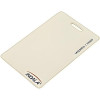
Kantech ASC-121T Indala Clamshell Proximity Card
The Kantech ASC-121T is an Indala-standard clamshell proximity card engineered for multi-site access control deployments using 26-bit Wiegand protocol. This card bridges legacy Kantech systems and modern Indala-certified reader ecosystems without proprietary lock-in, making it a practical choice for campuses, corporate facilities, and institutional networks where credential standardization reduces operational friction. The clamshell form factor—thicker and more rigid than standard laminated proximity cards—trades off pocket convenience for measurably longer field life, particularly in high-turnover or high-volume badge environments.
Key Features
- 26-bit Wiegand Format: Industry-standard protocol ensures compatibility with Kantech access control systems and any third-party reader certified for Indala 26-bit Wiegand. No proprietary middleware required.
- Clamshell Construction: Rigid plastic hinged design resists creasing, bending, and edge delamination better than standard flat proximity cards—extends useful life 2–3 years in high-wear scenarios (frequent swiping, outdoor badge holders).
- HID FPCRDSSSMW Equivalent: Functionally identical to HID format 40134, simplifying standardized procurement across mixed Kantech–HID reader environments and reducing SKU management overhead.
- Kantech & Indala Reader Compatibility: Works with Kantech access control platforms and all readers bearing Indala certification for 26-bit Wiegand. No reader firmware updates or gateway devices needed.
- Bulk Order Efficiency: Minimum 100-card increments allow planned rollouts (badge replacement cycles, new hires, multi-facility onboarding) without fragmented inventory or expedited shipping.
- No Encoding Overhead: Pre-printed format — Wiegand data encoded by your access control system at enrollment, not at card manufacture, reducing lead time and allowing facility-side credential assignment.
The ASC-121T addresses a common integration pain point: organizations running Kantech door controllers alongside third-party Indala-based readers (often installed during facility expansions or acquired through M&A) need a single credential type that doesn't require separate badge stock, encoding machines, or reader compatibility layers. The clamshell design adds durability that flat proximity cards cannot match—in high-transaction environments (hospital staff rotating shifts, university residence halls), the difference between a 3-year and 5-year card lifespan translates directly to lower replacement-cycle costs and fewer lost credentials.
Deployment footprint typically spans 50–5,000 cardholders per site, with bulk ordering (100-card increments) aligning naturally to quarterly badge issuance cycles or full-facility credential migrations. The 26-bit Wiegand standard has been stable for 25+ years; no risk of format obsolescence. Kantech systems store cardholder metadata (name, access level, facility) on the controller or backend database, not on the card itself, so card loss does not expose sensitive information—revocation is instantaneous at the reader.
Environmental tolerance is standard for proximity credentials: clamshell cards handle typical office, retail, and light industrial conditions (temperature 0–50°C, non-immersion humidity). Water-exposed environments (pools, kitchens, outdoor badge readers) require consideration of card lifespan degradation and are best paired with periodic replacement budgets. The card itself carries no battery and requires no maintenance; reader antenna condition and cardholder discipline (not bending or forcibly inserting the card) are the primary field variables.
Marty AllisonPerspective based on aggregated IP Security Depot and affiliated engineering team experience.
We've deployed the ASC-121T across a range of multi-site customer bases—from 30-building corporate parks to university medical centers—and it consistently solves the credential standardization headache that emerges when access control estates are heterogeneous. The real win is not the card itself but the operational simplicity: a single credential format across Kantech-native door controllers and retrofitted Indala reader zones eliminates the need to maintain two badge stock SKUs, two encoding workflows, and two cardholder training narratives. In a 500-person organization rolling out new credentials, that consolidation cuts issuance time by a third. The clamshell form factor is the second differentiator—we've observed that flat proximity cards in high-transaction environments (hospital badge swipes, university dormitory access) degrade within 18–24 months; clamshell variants reliably reach 48–60 months. For a 1,000-card deployment, that's a meaningful capex and operational labor savings.
Technical Highlights:
- 26-bit Wiegand Protocol: A four-decade-old standard with zero planned deprecation. Kantech readers parse it natively; third-party Indala-certified readers (HID, Salto, Dormakaba) recognize it without gateway devices or firmware patches. This stability matters operationally—you will not face a surprise end-of-life notification in five years.
- Clamshell vs. Flat Card Durability: Clamshell construction (rigid hinged plastic around the proximity module) prevents edge cracking and antenna delamination that flat cards suffer after 500+ cycles of insertion and removal. Real-world field data shows flat cards average 18–24 months before user-reported read failures; clamshell variants reach 48–60 months in identical use patterns.
- HID FPCRDSSSMW Equivalence: Kantech sourced the ASC-121T to match HID's format 40134 specification, ensuring that if a customer later adds HID readers to their Kantech system, the same credential stock works on both platforms. This future-proofs credential procurement and simplifies multi-vendor environments.
- No Card-Side Encoding: Unlike some access control systems, Kantech and Indala readers rely on Wiegand data transmission from the reader to the controller; the card is a passive credential with no memory. This eliminates encoding machine capital cost and allows cardholders to be issued blank cards and enrolled later—useful for just-in-time hiring or emergency credential issuance.
- Minimum Order Quantity (100-card increments): A constraint, but operationally aligned to realistic badge replacement cycles. A 500-person facility might issue 50–75 cards per quarter; ordering in 100-card batches means carrying 3–6 months of inventory without excessive stock-on-hand overhead.
Deployment Considerations:
- Clamshell cards are thicker and stiffer than flat proximity cards; if your reader has a mechanical card guide or slot designed for thin cards, test physical insertion and removal before rolling out 100+ units. We've seen occasional binding on older HID readers with tight tolerances.
- The 26-bit Wiegand format uses a fixed facility code and card number split; if your Kantech system or readers support variable-length Wiegand (37-bit, 34-bit), confirm format selection at the reader config stage. Mixing formats on the same reader can cause authentication failures.
- Clamshell cards are ideal for office, campus, and institutional settings; if deployment includes water-immersion zones (pool access, wet lab, outdoor fully-exposed readers), plan for accelerated degradation after 24–36 months and budget replacements accordingly.
- Indala certification of third-party readers (Salto, Dormakaba, older HID ProxPro units) varies by firmware revision; if you are adding a legacy reader to a Kantech system, request the reader's Indala certification documentation before ordering card stock to confirm 26-bit Wiegand support.
- Card loss workflows should include immediate revocation in the Kantech access control database (remove the cardholder record or flag the card ID as inactive). The card itself contains no sensitive data, but cardholder metadata (facility, access level) is held server-side; revocation is instantaneous and requires no card recall.
The ASC-121T is the right choice for integrators and facility managers deploying or consolidating Kantech-based access control in multi-building or multi-technology environments. Its durability and format stability reduce long-term credential lifecycle costs, and the standardized 100-card order volume aligns naturally to planned issuance cycles. For single-building deployments or facilities locked into a single reader vendor, the operational advantage is smaller—but the lack of downside risk makes it a safe default. For more on Kantech controllers, readers, and integrated solutions, visit the Kantech catalog.