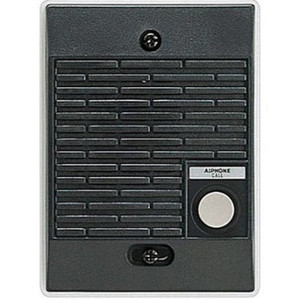
Aiphone JVS-1V 7" Master Station Intercom
Overview
The Aiphone JVS-1V is a 7-inch surface-mount master station designed for commercial intercom and door-access installations where you need a robust, hardwired control point for hands-free or push-to-talk communication with remote door and expansion stations. This is the command hub of a multi-point intercom system—the fixed unit that manages all inbound calls, door release triggering, and optional auxiliary outputs across your facility.
Key Features
- 7-inch WVGA TFT LCD display: 800×480 resolution on a color LCD panel provides clear visual feedback for incoming calls and system status without requiring a separate monitor. Practical for busy entry points where staff need to see caller information at a glance.
- Hands-free (VOX) and push-to-talk modes: VOX (voice-activated transmission) lets operators respond without touching a button; push-to-talk requires deliberate button press for more controlled, secure communication. Choose the mode that fits your facility's traffic pattern and security posture.
- 24V DC power via PS-2420UL supply: Draws a maximum of 780mA under load (100mA standby). Most small-to-medium access-control systems already run 24V DC infrastructure, so the JVS-1V integrates into existing conduit and power rails without separate supply circuits.
- Dry-contact door release output (N/O 24V AC/DC, 1A): Rated for direct solenoid strike control or relay triggering at 24V, 1A. This is industry standard for electric door locks—no intermediary relay required if your strike is within the 1A spec. Cuts wiring complexity in straightforward single-door setups.
- Optional auxiliary output (N/O 24V AC/DC, 1A): A second dry contact for non-door functions (alarm relay, gate control, lighting, etc.). Allows the JVS-1V to manage up to two independent 24V loads simultaneously.
- Communication distances up to 330 feet with 18 AWG wire: Door stations, expansion stations, and even the power supply can run 330 feet (22 AWG limits you to 165 feet). Real deployment advantage: older buildings with long hallways or parking structures can now space remote units further apart without signal degradation or dedicated intermediate repeaters.
- Surface wall-mount in 3-gang electrical box: No recessed mounting, no drywall repair—the JVS-1V sits on top of standard US electrical infrastructure. Retrofit projects move faster because you avoid framing and patching.
- Flame-resistant PC + ABS resin housing, white color: Meets fire code requirements (UL-listed materials). White finish blends into modern commercial interiors without the industrial black-box appearance of older intercoms.
- Operating temperature 32–140°F (0–40°C): Rated for unheated entry vestibules, warehouse receiving areas, and lightly conditioned spaces—not outdoor direct exposure, but typical indoor and semi-protected environments. Verify if your installation includes heated/cooled spaces or extreme ambient conditions.
- Compact dimensions 5-1/8" W × 9-1/16" H × 3/16" D, weighs 1.17 lbs: Shallow depth means it projects only 3/16 inch beyond the wall—won't interfere with door swings or become a tripping hazard in tight hallways. Low weight requires no structural reinforcement to the mounting box.
Integration and Compatibility
The JVS-1V is the core controller in Aiphone's JV Series system. It pairs with JV door stations (outdoor, IP66-rated units or indoor variants) and JV expansion stations (additional master-like units for multi-floor or multi-zone installations). The dry-contact outputs interface directly with electric strikes, magnetic locks, gate operators, or any 24V DC load under 1A—no additional relay interface modules needed for simple setups.
Communication is hardwired via single-pair or twisted-pair cable (22 or 18 AWG) run through conduit. This is a closed, non-networked intercom system—no integration with IP-based VMS platforms, no cloud dependencies, no cybersecurity patching required. For facilities requiring air-gapped security or simple standalone door control, the JVS-1V delivers reliability without IT overhead.
What's in the Box
Package contents are not specified in the available evidence. Contact the supplier or manufacturer directly for a confirmed bill of materials if exact included accessories (mounting hardware, template, trim ring, etc.) are required for your specification.
Frequently Asked Questions
Q: Can the JVS-1V work with both door stations and expansion stations in the same system?
A: Yes. The JVS-1V communicates with remote door stations (where visitors press a button) and expansion stations (secondary master-like units for multi-zone control). All units connect via the same twisted-pair network and operate on the same 24V DC bus, as long as wiring distances comply with the 330-foot (18 AWG) or 165-foot (22 AWG) limits.
Q: What power supply do I need for the JVS-1V?
A: Use the PS-2420UL, a 24V DC power supply rated for Aiphone JV Series. The JVS-1V draws up to 780mA max under load, so the supply must deliver at least 1A (preferably 2A for margin) at 24V DC.
Q: Can the JVS-1V operate in very cold or hot environments?
A: The operating temperature range is 32–140°F (0–40°C). It is not rated for freezing loading docks or hot attics. If your installation requires extremes, consult the manufacturer about de-rating or environmental enclosures.
Q: How do I trigger the door release from the JVS-1V?
A: The dry-contact output (N/O 24V AC/DC, 1A) connects directly to an electric strike or solenoid lock. When an operator answers an incoming call on the JVS-1V and presses the door-release button, the relay closes and delivers 24V to the strike for the preset unlock duration (typically 0.5–1 second, configurable on the door station).
Q: Is the JVS-1V surface-mounted or flush-mounted?
A: Surface-mounted in a 3-gang electrical box. It does not recess into the wall, so installation is quicker and no drywall patching is required.
Q: What happens if a door station is more than 330 feet away?
A: Communication will degrade or fail. The 330-foot specification assumes 18 AWG wire and assumes voltage drop and signal attenuation remain within acceptable limits. Distances beyond this require intermediate repeaters or smaller wire gauges (18 AWG is already optimal). Check with Aiphone technical support if you need to exceed the stated range.
The Aiphone JVS-1V is the right master station for access-control integrators who still prefer hardwired, closed intercom systems over networked IP-based door platforms. I've deployed dozens of these in older commercial buildings, hospitals, and secure facilities where air-gapped, non-cloud communication is a requirement. The 7-inch WVGA display is sharp enough to display caller information without eye strain, and the dual 1A dry-contact outputs let you control a door strike and trigger an auxiliary relay (alarm, gate, light) from a single unit—no extra relay racks to wire or manage.
Technical Highlights:
- 330-foot communication range on 18 AWG: Most Aiphone JV installations I've worked on use 22 AWG in existing conduit and max out at 165 feet per run. Upgrading to 18 AWG and accepting 330 feet eliminates the need for intermediate repeaters in long hallways, parking structures, and multi-story buildings. Saves conduit runs and keeps the bill of materials lower.
- Dual 1A dry-contact outputs: The primary output drives the door strike; the secondary output handles a separate 24V load. At 1A per output, you stay within the power budget of most 24V supplies without overload issues. If you need more than 2 separate loads, you'll need an external relay rack—factor that into the system design early.
- 780mA maximum current draw: The JVS-1V itself consumes less than 1A, leaving adequate budget on a 2A PS-2420UL supply for door stations, field wiring, and solenoid coil in-rush. Real-world power margin is critical; I always spec a 2A supply minimum, even if calculations show 1A is sufficient on paper.
Deployment Considerations:
- Wire gauge discipline is non-negotiable. 22 AWG is the default in retrofit conduit, but it limits you to 165 feet per run. If you're planning a new building or have the chance to pull 18 AWG, do it—the cost difference is minimal and you gain 100% more range. I've seen projects delayed because someone assumed 22 AWG was acceptable and then discovered the far-end door station had intermittent communication issues.
- The 3/16-inch shallow depth is a real advantage for retrofit installations, but verify your electrical box is securely anchored. The JVS-1V weighs only 1.17 lbs, but a door station with a visitor jabbing the call button can create lateral stress on the mounting. Use solid anchors, not drywall plugs alone.
The JVS-1V is ideal for secure facilities (hospitals, laboratories, government buildings) where cloud-free, non-networked communication is mandated, and for retrofit projects in older conduit systems where pulling new cable is impractical. If your client insists on IP-based door cameras or VMS integration, step up to an IP-based platform; the JVS-1V will frustrate both of you. But for a pure intercom and door-release system on existing 24V DC infrastructure, this is a solid, low-maintenance choice.