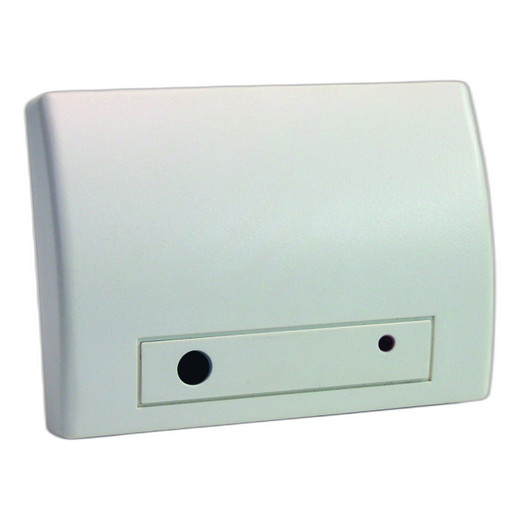
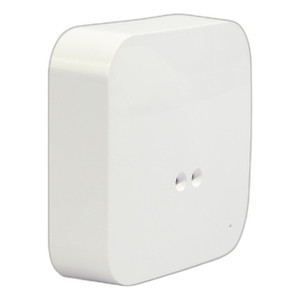
Inovonics EN1247 Wireless Glassbreak Detector
The Inovonics EN1247 is a wireless acoustic glass break detector designed for perimeter intrusion monitoring in commercial and residential security deployments. Operating on the license-free 902–928 MHz frequency band, this sensor eliminates hardwired installation complexity and reduces labor costs on retrofit projects where running low-voltage cable to windows and doors is impractical or prohibitively expensive. The compact form factor (4.2 x 3.1 x 1.7 inches) mounts directly on or near vulnerable glazing points, delivering reliable glass breakage detection without panel wiring.
Overview
Glass break detection provides a critical layer of perimeter security for ground-floor windows, glass doors, storefronts, and any entry point where forced breakage is a realistic attack vector. The EN1247 monitors for the specific acoustic frequency patterns characteristic of impact glass breakage—not background noise, music, or shattering objects—reducing nuisance alarms that plague poorly tuned sensors. Wireless architecture means no hardwired zones, no panel integration headaches, and no need to identify or troubleshoot low-voltage shorts in cable runs. For integrators managing intrusion sensors across multiple facility types, the EN1247 simplifies retrofit deployments significantly.
Key Features
- Wireless 902–928 MHz operation — License-free ISM band eliminates FCC coordination and works cleanly in most commercial and residential RF environments, avoiding the channel congestion common in congested 2.4 GHz Wi-Fi bands. Means no hardwired low-voltage runs, no cable termination labor, and faster commissioning on retrofit jobs.
- Acoustic glass break detection — Responds specifically to the sound signature of forced glass breakage (high-frequency transients typical of impact), not ambient noise or deliberate loud sounds. Reduces false alarm rates that result from poor acoustic discrimination.
- Compact dimensions (4.2 x 3.1 x 1.7 inches) — Low-profile form factor integrates into standard window frames and architectural trim without obvious visual presence. Allows flexible mounting on frames, interior walls, or adjacent surfaces within 10–15 feet of the protected glass.
- Wide operating temperature range (-20° to 60°C) — Operates in climate-controlled interiors and uninsulated entry areas, attics, vestibules, and outdoor-mounted applications. Critical for facilities with inconsistent HVAC coverage or seasonal temperature swings.
- Individual sensor addressing — Deploy multiple EN1247 units across a facility and address each independently, enabling zone-specific alarm reporting through standard security control panels. Avoids lumping all glass breaks into a single zone.
- Inovonics wireless protocol compatibility — Integrates with Inovonics-compatible receiver modules and control panels supporting 902–928 MHz operation. Verify receiver compatibility and frequency allocation during system design to ensure reliable signal propagation across your protected perimeter.
Integration & Compatibility
The EN1247 communicates intrusion-class event signals to compatible Inovonics wireless receivers and security control panels. Integration success depends on confirming that your existing receiver module supports the 902–928 MHz band and Inovonics sensor protocol before deployment. During commissioning, verify wireless signal strength and battery condition at each mounting location; weak RF coverage or low battery states will compromise detection and reporting reliability. Multiple EN1247 units integrate as independent zones, so plan your zone numbering and alarm reporting hierarchy during system design.
Deployment Considerations
Mount the EN1247 on or near windows and glass doors, preferably within 10–15 feet of the protected glass surface to ensure acoustic access to breakage events. Interior wall mounting works if the wall is not heavily insulated or acoustically dampened. Test detection sensitivity at commissioning by simulating glass breakage noise in the protected area—do not assume factory calibration is optimal for your specific glass type, frame construction, or ambient acoustic environment. Plan battery replacement intervals as part of your maintenance schedule; wireless sensor life depends on consistent power availability.
Frequently Asked Questions
Q: Does the EN1247 require hardwired installation?
A: No. The EN1247 operates wirelessly on the 902–928 MHz band and requires no low-voltage wiring. Mounting is mechanical (adhesive or screw fastening); communication with the receiver is wireless. This eliminates cable runs and associated labor on retrofit projects.
Q: How far can the EN1247 detect glass breakage?
A: Acoustic detection range depends on proximity to the protected glass and local ambient noise levels. Optimal performance is achieved within 10–15 feet of the target window or door. Placement on or immediately adjacent to the glass surface provides the best detection sensitivity.
Q: Can I use the EN1247 in unheated or outdoor locations?
A: Yes. The operating temperature range of -20° to 60°C (-4° to 140°F) supports uninsulated entry areas, vestibules, attics, and other non-climate-controlled spaces. Verify that the wireless signal reaches your receiver from the mounted location.
Q: What wireless receiver modules are compatible with the EN1247?
A: The EN1247 works with Inovonics-compatible wireless receiver modules and control panels that support 902–928 MHz operation. Confirm your specific receiver model supports this frequency band and sensor protocol before purchase. Contact your panel manufacturer or integrator for compatibility verification.
Q: Does the EN1247 work with standard security system panels?
A: Yes, provided your system includes a compatible 902–928 MHz wireless receiver that decodes Inovonics sensor transmissions. The receiver reports intrusion-class events to your control panel, enabling standard zoning and alarm reporting. Panel compatibility depends on the receiver module, not the panel itself.
Q: How often must I replace the battery?
A: Battery life depends on sensor activity and wireless transmission frequency. Establish a replacement schedule during commissioning based on battery voltage and activity logs. Include EN1247 battery replacement in your routine security system maintenance cycles.
Ted PerryPerspective based on aggregated IP Security Depot and affiliated engineering team experience.
I've evaluated the Inovonics EN1247 on several retrofit security deployments where hardwired glass break sensors were impractical due to cable routing constraints or renovation costs. The wireless architecture eliminates extended low-voltage runs to windows and doors—a significant labor and material savings on ground-floor perimeter projects. The 902–928 MHz band operates cleanly in most commercial environments with minimal RF interference, and the acoustic detection algorithm filters out everyday noise effectively when properly commissioned.
Technical Highlights:
- 902–928 MHz license-free operation: Avoids regulatory filing and channel coordination. Works well in facilities with mixed wireless systems. No competing demand for spectrum allocation like 2.4 GHz Wi-Fi or cellular bands.
- Acoustic frequency discrimination: The EN1247 responds to high-frequency transients characteristic of forced glass breakage, not sustained loud noise or music. This selective frequency response cuts false alarm rates significantly—a real operational win on facilities with active day shifts or outdoor loading areas.
- Operating temperature -20° to 60°C: Covers uninsulated entry vestibules, loading docks, attics, and seasonal storage areas. Many competitors spec to 0°C or higher, which limits deployment options in northern climates or unheated warehouse spaces.
Deployment Considerations:
- Acoustic mounting is critical. The EN1247 must have clear acoustic access to the protected glass surface. If mounted behind a wall partition, insulation, or heavy drapery, detection performance degrades. Plan placement during site survey—do not assume mounting on the adjacent wall 15 feet away will work if there are acoustic barriers in between.
- Wireless signal coverage must be verified at commissioning. A sensor with a strong acoustic response but weak RF link to the receiver is worse than useless—it'll log events that never reach the panel. Walk every proposed mounting location with a signal meter or test transmission.
- Battery replacement becomes a maintenance item. Unlike hardwired sensors, the EN1247 depends on battery power for transmission. Build a scheduled replacement cycle into your service agreement; missing battery failures will create blind spots in your perimeter coverage.
The EN1247 is a solid choice for retrofit glass break coverage where hardwiring is cost-prohibitive or technically difficult—warehouse loading doors, retail storefronts with tight construction schedules, and multi-tenant facilities where wall penetration requires landlord approval. Pair it with a comprehensive receiver validation during design, and test acoustic performance at commissioning to confirm detection thresholds match your specific glass type and mounting surface.