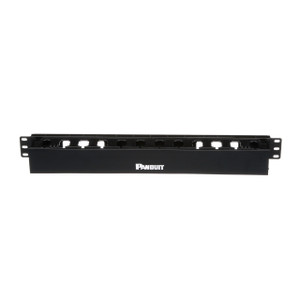
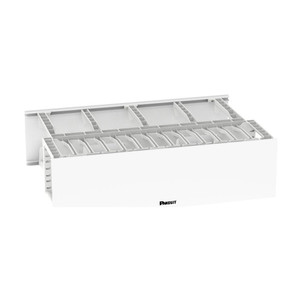
Panduit WMPHF2E PatchLink Horizontal Single-Sided Cable Manager, 2RU
Overview
The Panduit WMPHF2E is a PatchLink™ horizontal single-sided cable manager designed for standard EIA 19-inch (483 mm) racks and cabinets. At 2RU (88.9 mm tall), it provides a dedicated pathway for organizing patch cords between switching gear and patch panels — copper, fiber optic, and coax all route cleanly through a single unit. If your rack currently looks like a spaghetti bowl every time you make a MAC (move, add, or change), this is the product that stops that problem at the source.
The core design philosophy here is access without chaos. The dual-hinging front cover lets you open from either side without pulling adjacent cables out of position, and the flexible finger array inside organizes individual cords into lanes. That means when you need to re-patch port 14 on a 48-port switch, you're touching one cable — not wrestling with a bundle.
Key Features
- 2RU form factor (88.9 mm / 3.5 in. height): occupies exactly two rack units in any standard 19-inch EIA-310 cabinet. Sized to sit between a 1U patch panel and a 1U switch without wasting space — plan two WMPHF2E units per switch if you're running full 48-port density.
- 19-inch (483 mm) width, standard EIA rack-mount: fits any compliant open-frame rack, two-post relay rack, or enclosed cabinet without adapter brackets. No guessing on compatibility.
- 3.7-inch depth: gives enough runway to manage realistic bend radii on patch cords running to deep switching gear. Shallow managers force tight bends on Cat6A and OM4 fiber — this depth avoids that.
- Dual-hinging front cover: opens left or right depending on which side of the rack you're working from. In dense deployments where two racks sit face-to-face, this matters — you're not fighting the cover while trying to trace a cable.
- Flexible finger array: individual polymer fingers separate and hold patch cords in distinct channels. Each cord stays where you put it. When you're doing MACs on a live switch, you identify and pull the right cord the first time rather than the fifth.
- Bend radius clips included: protect Cat6A, OM3/OM4 fiber, and coax from being kinked at the entry/exit points of the manager. Exceeding minimum bend radius is one of the most common causes of intermittent link issues in patched environments — these clips enforce compliance passively.
- Single-sided design: cable entry and management from the front face only. Appropriate for installations where rear access to the cable manager is limited or where rear-exit cables are handled by a separate vertical manager.
- Closed pathway design: the cover and finger array together form an enclosed channel that physically protects cables from accidental snags, airflow deflectors, and neighboring hardware during service. Open-finger-only designs leave cables exposed to whatever else is happening in the rack.
- Compatible with copper, fiber optic, and coax: a single manager handles mixed cable types in hybrid environments — no need for separate fiber-only troughs when your infrastructure mixes media.
- RoHS Compliant, UL 2416, CSA C22.2: meets North American safety standards for cable management raceway components. Required by many facilities management and data center compliance programs; UL 2416 specifically covers wiring duct used in electrical equipment.
- Black finish: standard rack color match. Visually consistent in mixed-vendor rack builds where appearance affects audits and client walk-throughs.
- Package quantity: 1 unit: sold individually, so you can spec exact quantities per rack without over-ordering. Order two per 1U patch panel / 1U switch pair for full top-and-bottom management.
Integration & Compatibility
The WMPHF2E mounts in any EIA-310 compliant 19-inch rack or cabinet — open-frame two-post, four-post, and enclosed cabinets all accept it without modification. It pairs directly with Panduit's PatchLink patch panels and modular furniture systems, but the standard 19-inch form factor means it works alongside gear from any vendor. For network switch deployments running structured cabling, position one unit above and one below each switch to capture both incoming and outgoing patch runs. In rack enclosure and cable management builds, horizontal managers like the WMPHF2E complement vertical cable managers that handle inter-rack trunk runs. For broader Panduit cable management and connectivity products, including patch panels, jacks, and vertical managers, review the full Panduit catalog for components designed to work in the same system. If you're planning a structured cabling layout from scratch, a network infrastructure planning guide can help size manager count to port density before you order.
What's in the Box
- 1x Panduit WMPHF2E PatchLink Horizontal Single-Sided Cable Manager, 2RU
- Bend radius clips (included per product description)
Frequently Asked Questions
Q: What rack size does the WMPHF2E fit?
A: The WMPHF2E is 19 inches (483 mm) wide and mounts in any EIA-310 compliant 19-inch rack or cabinet — open-frame two-post, four-post, or enclosed. No adapter brackets required.
Q: What cable types does the WMPHF2E support?
A: It manages copper (Cat5e, Cat6, Cat6A), fiber optic, and coax patch cords. The flexible finger array accommodates mixed cable types in the same manager.
Q: Is the WMPHF2E single-sided or double-sided?
A: Single-sided. Cable entry and organization is from the front face only. If you need rear-access cable management, pair it with a rear horizontal or vertical manager.
Q: Does the WMPHF2E include bend radius protection?
A: Yes. The unit ships with bend radius clips that protect cables at the entry and exit points of the manager, maintaining minimum bend radius compliance for Cat6A and fiber optic cords.
Q: What certifications does the WMPHF2E carry?
A: The WMPHF2E is RoHS Compliant and meets UL 2416 and CSA C22.2 standards — the North American safety standards for wiring duct and cable management components used in electrical equipment.
Q: How many rack units does the WMPHF2E occupy?
A: Two rack units (2RU), or 88.9 mm / 3.5 inches of vertical rack space.
The thing I keep coming back to on the WMPHF2E is the dual-hinging cover combined with the 3.7-inch depth — that combination is what separates a cable manager you'll actually use correctly from one that becomes a cable-stuffing tube within six months. When you're in a live rack doing a MAC at 2 AM, a cover that only opens one way is a liability.
Technical Highlights:
- 3.7-inch pathway depth: deep enough to maintain proper bend radius on Cat6A (minimum 4x cable diameter, roughly 1 inch) and OM4 fiber (minimum 1.18 inch) without forcing a hard turn at the manager exit. Shallow managers are one of the most common sources of marginal-performing links in patched environments.
- UL 2416 / CSA C22.2 compliance: these aren't marketing certifications — UL 2416 is the specific standard for wiring duct in electrical equipment. If your facility has a third-party electrical inspection or a data center compliance audit, non-listed cable management hardware gets flagged. The WMPHF2E passes.
- Flexible finger array with closed cover design: fingers organize individual cords into lanes, and the cover keeps them there. In a 48-port patched environment, that means you can identify and pull a single cord by tracing the lane — instead of following a cable through a tangled bundle under a switch.
Deployment Considerations:
- The single-sided design means all cable entry and exit is front-face only. If your installation routes cables from the rear of patch panels through to the back of the rack (common in structured cabling builds with rear-exit panels), you'll need a separate rear horizontal or vertical manager for that run — the WMPHF2E doesn't cover it.
- At 2RU, this manager is sized for a 1U patch panel / 1U switch pairing. If you're running 2U switches or dual-stacked patch panels, plan your manager count accordingly — one WMPHF2E above and one below each switch is the standard layout for full-density port management.
The WMPHF2E is the right unit for enterprise IDF closets and MDF builds where structured cabling density is high, MACs happen regularly, and the facility has compliance requirements that demand listed cable management components. It's not the right call for a two-switch closet where you're managing eight cables — in that scenario, the per-unit cost doesn't justify the formality. For 24-port and above patch panel runs in a permanent installation, it pays for itself the first time someone has to trace and re-patch a cable without pulling the wrong one.