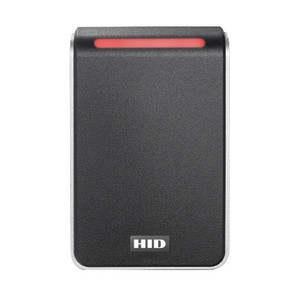
HID 40NKS-02-01EAVP SIGNO 40 Wall-Mount Access Reader
Overview
The HID 40NKS-02-01EAVP is a wall-mounted multi-technology access control reader built around the SIGNO 40 platform for enterprise door access systems. This wired reader supports smart cards, proximity cards, NFC-enabled mobile credentials, and card-less authentication formats — all on a single device. By consolidating multiple credential types into one reader, you reduce hardware sprawl and installation labor across multi-door access control deployments. The unit integrates OSDP v2 protocol, which provides encrypted, standardized communication between the reader and your access control panel. This eliminates the need for proprietary bridging and ensures credential data remains protected during transmission — a critical requirement in regulated environments.
Key Features
- Multi-Technology Credential Support: Handles smart cards, proximity cards, NFC mobile credentials, and card-less formats on a single reader. Reduces the need to deploy separate readers for different employee populations or visitor credential types — one installation point handles multiple authentication methods.
- OSDP v2 Protocol: Industry-standard encrypted communication with access control panels. Ensures interoperability across third-party systems that support OSDP v2, not locked into a single vendor ecosystem. Encrypted credential data prevents man-in-the-middle attacks during reader-to-panel communication.
- Mobile Credential Capability (MOBA6HK compatible): Enables smartphone-based access without requiring a physical card. Reduces issuance overhead and allows remote credential provisioning or revocation. Employees already carry phones; this eliminates credential replacement logistics.
- Wall-Mount Surface Installation: Fixed to standard wall surface — straightforward installation in lobbies, stairwells, and entrance points. No specialized housing required, which simplifies retrofit projects and reduces door-frame modifications.
- LED Status Indication & Flash Memory (Configurable): Default settings disable LED status and flash memory per enterprise security protocols. Configurable via access control panel, allowing you to enable or disable features depending on deployment context (e.g., disable LEDs in high-security areas to avoid advertising reader presence).
- Enterprise-Grade Form Factor: Black and silver casing matches corporate aesthetics. Designed for high-traffic commercial and institutional environments where durability and appearance matter alongside function.
Integration & Compatibility
Compatible with HID access control systems and third-party platforms that support OSDP v2 protocol. Works in single-door and multi-door installations across commercial, institutional, and enterprise environments. The 40NKS-02-01EAVP integrates seamlessly into existing access control reader deployments, provided your access control panel supports OSDP v2. Mobile credential deployment requires compatible mobile credential management software (e.g., HID mobile app infrastructure). Configuration includes factory-default settings optimized for enterprise scenarios; installer can customize LED and flash memory behavior during commissioning.
When planning a multi-reader deployment, evaluate the number of doors, credential types in use, and whether OSDP v2 is already running on your access control infrastructure. If your panel supports only proprietary protocols, you'll need a gateway or bridge — verify this during specification phase.
Frequently Asked Questions
Q: Does the HID 40NKS-02-01EAVP work with non-HID access control panels?
A: Yes, provided the panel supports OSDP v2 protocol. OSDP v2 is an open standard; many third-party panels (Salto, Genetec, Honeywell, etc.) support it. Confirm OSDP v2 support with your panel vendor before specifying the 40NKS-02-01EAVP.
Q: Can I use the 40NKS-02-01EAVP for outdoor installations?
A: This model is a wall-mount reader designed for indoor use. For outdoor entrances, weather-resistant housings or purpose-built outdoor readers are required. Consult a systems integrator for weatherproof options in the HID portfolio.
Q: What mobile credential format does the 40NKS-02-01EAVP support?
A: The reader is compatible with MOBA6HK mobile credential infrastructure. This requires a corresponding mobile credential management system (e.g., HID Mobile Access app). Ensure your access control infrastructure includes the necessary backend to provision and manage mobile credentials.
Q: Is the 40NKS-02-01EAVP NDAA Section 889 compliant?
A: HID is a U.S.-owned manufacturer (owned by Axon Enterprises, a U.S. public company). Verify current NDAA compliance status directly with your systems integrator or HID for the most up-to-date certification details, as compliance designations can change.
Q: What's the typical installation time for the 40NKS-02-01EAVP?
A: Wall-mount installation is straightforward — surface-mount fastening, wired connectivity to the access control panel, and OSDP v2 configuration. Typical installation time per reader is 30–60 minutes, depending on cable routing and pre-existing infrastructure. First reader deployment typically takes longer due to system configuration and testing.
Q: Can the LED status indication be disabled after installation?
A: Yes. LED and flash memory are configurable via your access control panel. Disable LEDs in high-security or sensitive areas to avoid advertising the reader's presence. Enable them in low-security zones for user feedback and troubleshooting.
Ted PerryPerspective based on aggregated IP Security Depot and affiliated engineering team experience.
The HID 40NKS-02-01EAVP delivers genuine flexibility for enterprise environments that need to support mixed credential types without multiplying hardware. OSDP v2 encryption is the real win here — it sidesteps the proprietary communication risk you get with some older readers, and it opens the door to interoperability across vendors. The 40NKS-02-01EAVP (often searched as 40NKS 02 01EAVP) is particularly useful when you're consolidating legacy proximity-card systems with new mobile credential rollouts.
Technical Highlights:
- OSDP v2 Encrypted Protocol: Credential data travels encrypted between reader and panel — no plaintext transmission. This is non-negotiable in healthcare, financial, and government sectors where credential interception is a documented threat vector.
- Multi-Technology on One Reader: Smart cards, proximity, NFC mobile, and card-less formats all on a single reader eliminates the need to stack multiple readers on a single door frame — reduces installation complexity and cost per access point.
- Mobile Credential Support (MOBA6HK compatible): Smartphone-based access shifts credential issuance from physical inventory to app-based provisioning. Faster onboarding, instant revocation (no card collection needed), and reduced replacement cycle.
Deployment Considerations:
- OSDP v2 Requirement: Your access control panel must natively support OSDP v2. If it only supports Wiegand or proprietary protocols, you'll need a gateway or bridge — this adds cost and complexity. Verify panel compatibility before procurement.
- Mobile Credential Backend: Enabling mobile credentials requires HID's credential management infrastructure (app, provisioning server, etc.). This is not just a reader deployment — budget for backend licensing and integration.
- Indoor-Only Form Factor: Wall-mount design is straightforward to install but not weatherproof. Outdoor entrances require separate readers or protective housings.
- Configurable LEDs and Flash Memory: Factory defaults disable LED status and flash memory for security-conscious deployments. If you need user feedback or local logging, you'll need to enable and test these features during commissioning.
Position the 40NKS-02-01EAVP in enterprise office buildings, corporate campuses, or institutional facilities where you need to support multiple credential types and OSDP v2 infrastructure is already in place or planned. It's not the choice for outdoor-only deployments or legacy Wiegand-only systems — that requires a different reader. But if you're consolidating credential types and want encrypted, standards-based communication, this reader eliminates the hardware sprawl and reduces per-door installation overhead significantly.