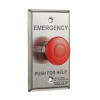
HES PBM-5 Panic Station Momentary SG/302
The HES PBM-5 is a hardwired momentary panic station designed for direct integration into SG/302 access control systems. In controlled-access environments—corporate offices, educational facilities, secured production areas—this device serves as a manual emergency activation point that triggers immediate security response without intermediary software or network dependency. The single normally open (NO) contact closure provides a straightforward, fail-safe mechanism for on-site personnel to summon security or law enforcement in genuine threat scenarios.
Key Features
- Momentary Contact Design: Depressed activation closes the NO contact briefly, triggering panic protocol in the SG/302 system. No latching or sustained signal required.
- Single Normally Open Contact: 1 NO configuration integrates directly into hardwired panic circuits; no relay conditioning or external logic needed.
- SG/302 Native Compatibility: Hardwired panic circuit directly into HES SG/302 access control platform. No programming, no network overhead.
- Manual Emergency Activation: Purpose-built panic point for staff or authorized personnel; unambiguous activation eliminates accidental triggering risk.
- Hardwired Installation: Standard electrical integration into facility alarm/panic circuit; operates independent of power failures or network outages.
- Compact Form Factor: Wall-mounted panic station (0.3 lb) fits standard electrical box mounting for high-visibility emergency placement.
In facilities where access control and emergency response must operate as a unified hardwired system, the PBM-5 eliminates ambiguity between routine door commands and genuine panic events. A single NO closure into the SG/302 panic input triggers the configured response—door unlock, guard notification, local alarm siren activation, or networked alert escalation—without software parsing or false-positive filters. This hard-contact simplicity is critical in high-stress scenarios where milliseconds and clarity matter.
The SG/302 ecosystem is built around hardwired reliability; the PBM-5 reflects that philosophy. Installation is straightforward: run a pair of wires from the panic station to the SG/302 panic input terminal, connect to a momentary pushbutton inside the station enclosure, and the circuit is live. No VMS backend, no IP address, no credential management. When the button is pressed, the NO contact closes and the SG/302 executes its panic logic—whether that's an audible alarm, door release, guard station alert, or all three in sequence.
Typical deployments include secure office suites where receptionists need immediate panic access; university buildings with controlled entry and resident safety requirements; and server rooms or sensitive production areas where staff can trigger lockdown or evacuation protocols. The PBM-5 is also suitable as a secondary or auxiliary panic point in facilities with a primary panel-mounted station, providing redundancy across multiple secure zones without additional wiring complexity.
The PBM-5 is manufactured in the USA and integrates with HES SG/302 systems and other hardwired access control platforms supporting standard NO contact panic inputs. No ONVIF, no API, no cloud dependency—just electrical simplicity in service of genuine emergency response. Pair the PBM-5 with SG/302 door controllers, electric strikes, and mag locks to build a hardwired perimeter that responds instantly to authorized panic activation. For facilities prioritizing wired reliability over network-centric access control, the PBM-5 is the standard choice.
Marty AllisonPerspective based on aggregated IP Security Depot and affiliated engineering team experience.
We've installed the HES PBM-5 in dozens of corporate and institutional access-control environments, and it remains one of the most straightforward panic-station solutions when the backend is a hardwired SG/302 system. The appeal is reliability without complexity: a physical button, a single NO contact, and a hardwired circuit into the access-control panel's panic input. In environments where staff undergo regular panic-button drills—banking halls, healthcare administrative areas, university security offices—the PBM-5 delivers the confidence that pressing the button will always register, regardless of network state. We've seen too many IP-based panic endpoints fail silently when a PoE switch reboots or a network segment goes down; the PBM-5 avoids that entire class of failure. The trade-off is obvious: it only talks to SG/302 systems (or other hardwired panic inputs), and it provides no real-time feedback about whether the panic event was actually received by the control system. But in a facility where the SG/302 is the backbone and the panic circuit is cabled with the same rigor as the power distribution, that trade-off is worth taking.
Technical Highlights:
- Momentary Contact Logic: Button press closes the NO contact for the duration of the press, then releases. The SG/302 panic input is triggered by that closure—no debounce firmware, no event buffering. Instantaneous and predictable.
- Single NO Configuration: 1 NO contact means two wires minimum: signal and ground/common. Simple conduit run from panic station to SG/302 panel input terminal. No relay, no PLC, no intermediate device.
- Hardwired Panic Circuit Independence: The PBM-5 operates on its own dedicated circuit into the SG/302 panic input. Separate from door unlock circuits, alarm outputs, or network communication. If the SG/302 network port fails, the panic button still works.
- US Manufacture: Manufactured in the USA; aligns with NDAA-compliant procurement policies for federal and critical infrastructure projects.
- Compact, Visible Placement: Wall-mounted form factor (0.3 lb) allows installation at eye level in corridors, offices, or secure zones. Red or high-contrast enclosure options (consult datasheet) support emergency visibility without additional signage.
Deployment Considerations:
- The PBM-5 is hardwired only—it has no network or IP footprint. If your facility is migrating from hardwired SG/302 to an IP-based access-control platform (Genetec, Salto, etc.), the PBM-5 will require a hardwired-to-IP gateway or a parallel panic-activation system on the new platform. Plan that transition early.
- Panic-button circuit isolation is critical. Run the PBM-5 wiring in its own conduit or shielded pair, separate from power lines or low-voltage control circuits. Grounding must be solid to the SG/302 common. Poor grounding causes intermittent panic failures.
- Verify the SG/302 panic input terminal voltage and contact rating before wiring. Typically NO contacts are dry (unmotorized—no power source in the button itself), but confirm with your SG/302 datasheet. Miswiring a powered input can damage the station.
- Staff training is essential. The PBM-5 is purpose-built for genuine panic events, not access requests. Brief personnel on when and how to activate, and conduct quarterly drills to ensure the response chain (door unlock, alarm, guard notification) executes as configured. False alarms due to accidental activation can desensitize responders.
- Document the panic-circuit wiring diagram in your facility security manual and maintain a hardcopy at the SG/302 panel location. Network-centric documentation tools often overlook hardwired circuits; a paper schematic prevents confusion during emergency maintenance or system migration.
The PBM-5 is the right choice for security teams running SG/302 systems who prioritize wired reliability and immediate panic response over feature-rich IP integration. If your facility's access-control backbone is hardwired, this panic station is the natural fit. Explore the full HES catalog for complementary hardwired controllers and door hardware.