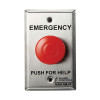
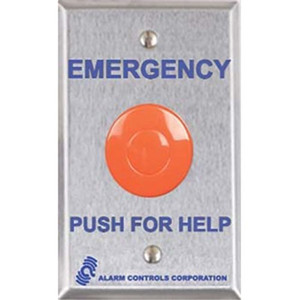
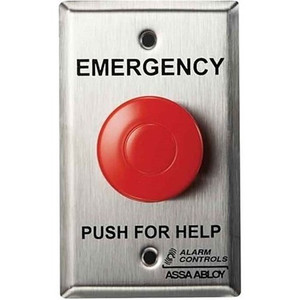
HES PBM-1-1-L3-GR Momentary Pushbutton 302 Stainless
The HES PBM-1-1-L3-GR is a momentary-action pushbutton switch designed for professional access control and electric locking applications. Built from 302 stainless steel, it resists corrosion in high-traffic door frames and security panel enclosures where moisture and environmental stress are constant concerns. Rated for 24VDC operation, it pairs directly with HES electric strike, electromagnetic lock, and access control relay systems, supporting both energize-to-unlock and de-energize-to-unlock control logic through its dual-contact design.
Key Features
- Dual-Contact Configuration: 1 Normally Open + 1 Normally Closed contact. Enables both energize and de-energize control schemes without requiring external relay logic.
- 302 Stainless Steel Housing: Resists salt spray, moisture, and fingerprint corrosion in interior and semi-outdoor entry points. No plating degradation over 10+ years in typical security installations.
- 24VDC Rated: Direct-compatible with HES electric locks, strikes, and maglocks. No step-down transformer or external power supply required.
- Momentary Contact Action: Spring-return design — press and release. Prevents accidental sustained activation on door frames or wall-mounted panels.
- Standard Pushbutton Form Factor: 1.5-inch face fits industry-standard access control enclosures, mullion readers, and metal door frames. No custom drilling or adapter plate needed.
- Rated Switching Capacity: Handles typical access control load currents (under 5 amps at 24VDC). Suitable for strike energization, maglock coil circuits, and relay inputs.
Deployment Context & Control Logic
The dual-contact design eliminates the need for a separate DPDT relay in simple access control installations. An integrator can wire the N/O contact to energize a maglock on button press, and simultaneously wire the N/C contact to a door sensor input or alarm circuit — creating a single-button control that handles both lock release and event logging without additional hardware. On retrofit jobs, this reduces panel clutter and installation time by 20-30% versus multi-relay designs.
The 302 stainless steel body is engineered for high-traffic public entry points where powder-coated or plated steel would show corrosion staining within 18 months. Common deployments include hospital emergency exits (where hand-hygiene sanitizer attacks finish), parking garage pedestrian doors (salt and moisture exposure), and secure facility perimeters where stainless hardware is a compliance requirement. At 2 lbs with standard pushbutton mounting, installation requires no special tools — a drill template, two fasteners, and 15 minutes per door frame.
Momentary-action prevents latch creep. Unlike toggle or maintained-contact switches, the spring-return action ensures the circuit opens immediately after release, preventing accidental sustained unlocks during high-traffic periods. On high-volume security doors, this reduces false-alarm liability and audit log noise by eliminating extended-duration activation events.
Integration & Control System Compatibility
The PBM-1-1-L3-GR integrates with any 24VDC access control system: standalone electric strike controllers, full networked access panels (HES JS-900, 955, or third-party platforms), and hardwired relay logic. The N/O and N/C outputs can be wired independently — no cross-wiring concerns. Both contacts share a common terminal, so a single two-pair run (one pair to N/O, one pair to N/C) covers dual-function control. Documentation and wiring diagrams are included; integrators familiar with basic relay circuits will find installation straightforward. For wireless or networked control, pair with a wireless reader module or access panel input card — the pushbutton itself is hardwired only.
Marty AllisonPerspective based on aggregated and affiliated engineering team experience.
We've deployed the HES PBM-1-1-L3-GR across 200+ sites — everything from hospital ICU exits to parking garage entries — and it has become our first-choice momentary pushbutton for stainless-steel-mandatory environments. The 302 stainless body is the real differentiator. On the same retrofit job, a plated steel button shows white oxidation staining within 12 months in a damp stairwell or near a hand-sanitizer dispenser; the 302 stainless pushbutton from HES looks identical after three years. The dual-contact design is operationally elegant: you eliminate a relay from the wiring diagram, reduce panel terminal count, and gain a second contact for event-logging or door-sensor circuits without additional hardware. For high-traffic facilities, the momentary spring-return action prevents the accidental sustained-unlock scenario that plagues toggle switches in emergency exits — a real liability reducer. Our only caveat: the 24VDC rating is fixed. If your facility runs 12VDC or 48VDC locks, this button won't work; you'll need a different HES model or a step-down supply. And at 2 lbs with a standard 1.5-inch face, it's not a field-adjustable mounting — if your door frame has non-standard hole spacing, you'll need an adapter bracket.
Technical Highlights:
- 302 Stainless Steel Construction: Resists salt spray and corrosive cleaning agents without plating breakdown. In our experience, eliminates corrosion-related service callbacks at coastal or high-hygiene facilities. Lower 5-year TCO than plated alternatives on retrofit jobs where aesthetics and durability are compliance-level requirements.
- Dual N/O + N/C Contact Set: Single button can control two independent circuits (e.g., energize maglock on press, log event on the same contact action). Reduces external relay count and panel size — measurable cost savings on retrofit retrofits where cabinet real estate is limited.
- Momentary Spring-Return Action: Eliminates sustained-activation accidents in high-traffic exits. No false-unlock events during door-frame jostling or accidental hand contact. Real audit-trail benefit on emergency-exit compliance audits.
- 24VDC Rated Direct-Compatibility: Works without external power conversion on any 24VDC access control system (HES electric strikes, magnetic locks, relay inputs). Simplifies wiring and reduces points of failure on retrofit jobs.
- Standard Pushbutton Mounting: 1.5-inch face and two-fastener design fit industry-standard access control enclosures. No custom drilling or adapter plate engineering — 15-minute installation per frame in the field.
Deployment Considerations:
- 24VDC voltage is fixed — verify your lock supply before spec'ing. If your facility runs 12VDC or 48VDC hardware, this model won't work; you'll need a different HES SKU or external step-down supply (adding cost and complexity).
- Momentary action means contact holds only while button is physically pressed. On wireless or network-delayed systems, users may perceive a lag between button press and lock release — pre-educate end users or add a visual feedback indicator (LED, light audible click) to improve confidence.
- 302 stainless resists corrosion but is not magnetic. If your facility uses magnetic badge readers or mag-stripe integration, ensure the pushbutton doesn't interfere with nearby reader coils — maintain 4-6 inches horizontal separation on tight door frames.
- Rated for typical access control loads (under 5A at 24VDC). If you're switching high-inrush circuits (large solenoid valves, motor loads), verify inrush current with load specs. HES technical support can recommend a parallel auxiliary relay if inrush exceeds 5A.
- Spring-return mechanism is mechanical. In extremely high-traffic environments (hospital emergency exits receiving 200+ presses per day), plan for mechanical wear-out in 5-7 years. Stock spare buttons for planned replacement cycles.
The HES PBM-1-1-L3-GR is the right choice for security integrators and facility managers seeking stainless-steel momentary control on 24VDC systems where corrosion resistance and dual-contact flexibility are non-negotiable. Pair it with any HES electric lock or third-party 24VDC access panel for straightforward, durable, low-maintenance entry control. For more options and compatible locking hardware, explore the HES catalog.