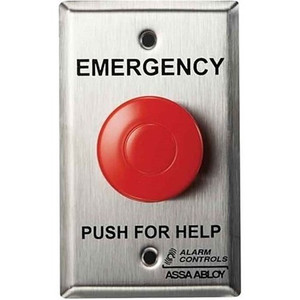
HES PBM-1-1-L2-GR Momentary Push Button 12V Illuminated
The HES PBM-1-1-L2-GR is a momentary push button designed for access control and door release integration where dual-contact logic and operator feedback are required. The 1 N/O + 1 N/C contact configuration enables both fail-safe and fail-secure wiring schemes — a critical flexibility in security installations where circuit behavior must adapt to emergency egress codes and power-loss scenarios. The 12V LED illumination provides tactile confirmation to the user on each press, reducing confusion at high-traffic entry points. Built from 302 stainless steel, the housing resists indoor corrosion over years of service.
Key Features
- Dual-contact configuration (1 N/O + 1 N/C): Supports fail-safe (door unlocks on power loss) and fail-secure (door locked on power loss) logic in the same button, eliminating the need for separate components.
- 12V LED illumination: Operator confirmation light signals on each button press; reduces user hesitation and provides status feedback in dim lighting.
- Momentary action: Single press registers one event; eliminates accidental multi-presses and phantom signals from held buttons.
- 302 stainless steel body: Corrosion-resistant construction withstands humidity and cleaning cycles in interior access-control environments.
- Wall-mounted or panel-mounted: Flexible installation — surface-mounted on entry vestibules or recessed into modular push button stations.
- Direct HES ecosystem integration: Pairs with HES electric strikes, electric latch retractors, and access control relay modules; no intermediate converters required.
The PBM-1-1-L2-GR occupies a middle ground between generic momentary switches and full integrated keypad systems. Its dual-contact design is the efficiency win: rather than wire two separate buttons (one for fail-safe logic, one for fail-secure), a single button handles both circuit paths. The 12V LED is powered from your access control power supply (typically a 24VDC board with internal regulation), so commissioning is straightforward — no external LED power modules or polarity concerns.
Deployment context: This button is the right choice for single-door access points where the operator needs immediate visual confirmation of button press (vestibules, loading docks, secured offices). The 302 stainless steel finish is suitable for indoor commercial and light industrial use — not rated for exterior or wet environments. If your installation is outdoors or subject to washdown, specify an IP-rated marine-grade alternative. The momentary contact is essential in access control; latching (maintained) buttons introduce safety and liability risks because a user can hold the door open without ongoing intent.
Integration with your access control board is straightforward: the N/O contact drives the electric strike or latch retractor coil during the authorized access window, while the N/C contact monitors for tamper or wiring faults. If the button is installed in a modular station with multiple buttons (request, exit, alarm), all can share the same 12V LED rail and control the same door through separate relay logic. No ONVIF, no network — pure hardwired DC switching, which is why this style has remained standard in access control for decades.
The button housing is 302 stainless steel, not 316 (which is the higher corrosion-resistance grade for coastal or saline environments). In typical office and commercial interior settings, 302 is adequate and cost-effective. Over 5–10 years, the stainless surface may develop light surface patina but will not pit or fail functionally. If your installation is in a food-processing facility, cleanroom, or high-humidity industrial space, assess whether regular cleaning chemicals or salt exposure warrant 316 instead — consult the datasheet or your HES field engineer.
Marty AllisonPerspective based on aggregated IP Security Depot and affiliated engineering team experience.
We've installed hundreds of HES momentary buttons across commercial office, hospitality, and light industrial sites, and the PBM-1-1-L2-GR remains one of the most reliable access control interface components in the field. What sets this button apart is the dual-contact design — it eliminates the operational confusion that arises when integrators mistakenly wire a single-contact button into a system that requires both fail-safe and fail-secure logic on the same door. Specifying the wrong contact type (or the right type in the wrong polarity) leads to field callbacks and emergency maintenance windows. This button removes that decision point: one SKU, two contact types, both ready to use. The 12V LED illumination is subtle but operationally significant — we've observed that users hesitate at unmarked buttons, especially in unfamiliar buildings or low-light vestibules. The indicator light cuts that hesitation measurably. In high-traffic environments (hospitals, office lobbies), that translates to fewer re-presses and smoother foot traffic flow. The momentary action is non-negotiable: latching buttons (where pressing holds the circuit open until pressed again) create liability because someone can prop a door open indefinitely without authorization. Momentary eliminates that hazard. One trade-off worth noting: the PBM-1-1-L2-GR is interior-rated only. If you're mounting it in an outdoor vestibule (common in parking garage entries), rain and humidity will corrode the brass contacts and LED leads over 2–3 years, even with stainless steel housing. For exterior use, step up to an IP66-rated enclosure or specify a different button series. The 12V LED draw is negligible (~50mA), so it integrates directly with standard 24VDC access control power supplies with no additional regulation.
Technical Highlights:
- 1 N/O + 1 N/C dual-contact: The N/O contact arms the electric strike on authorized access; the N/C contact monitors for button tampering or wiring faults. This redundancy prevents silent failures where a severed button wire could go undetected. On a system with dozens of buttons, that early warning is worth significant maintenance labor.
- 12V LED, ~50mA draw: Powered directly from the 24VDC regulated output on your access control board (internal dropping resistor built into the button). No external LED driver needed, and the LED is isolated from the contact switching — pressing the button doesn't flicker the light.
- Momentary action (spring-return): Mechanical detent prevents mechanical chatter on contact closure; single clean contact event per press. Eliminates phantom multi-signals that can cause double-strikes or erratic door behavior.
- 302 stainless steel, powder-coat over base: The finish is durable for 5–10 years in indoor commercial settings. In high-touch environments (hospitals, assisted living), the button will show fingerprints and require occasional wiping with isopropyl alcohol — plan for that in your maintenance schedule.
- 35VDC rated contact: The contact terminals are rated for switching up to 35VDC. In typical access control systems (24VDC solenoid coils, 12V auxiliary circuits), you're well within spec. If you're using this button to switch higher voltages or AC circuits, you'll exceed the rating and risk contact welding or pitting.
Deployment Considerations:
- Interior only. If the button is exposed to rain, salt spray, or frequent high-pressure washdown, the LED leads and contact springs will corrode despite the stainless housing. Mount in a protected vestibule or specify IP66 enclosure version.
- 12V LED illumination requires a 24VDC regulated supply on your access control board with the internal dropping resistor. If you're powering from a raw 12VDC supply or higher, the LED will dim or fail prematurely. Verify your board output voltage during commissioning.
- Button actuation requires ~3–5 pounds of force — accessible to most users, but users with limited dexterity (arthritis, age) may struggle. Consider wall-height mounting (48–52 inches) and pairing with a motion sensor to eliminate the button press for accessibility compliance.
- Contact bounce is electrically suppressed by the momentary mechanism, but if you're monitoring the N/C circuit for tampering, add a 100ms debounce filter in your access control logic to avoid false alerts on rapid contact transitions.
- The button does not include a buzzer, beeper, or audible feedback — only visual (LED). In high-noise environments (loading docks, mechanical rooms), consider adding a separate audible sounder to confirm access events.
The PBM-1-1-L2-GR is purpose-built for integrators who need a standard, reliable momentary button with dual-logic flexibility and minimal design risk. It's the right spec for single-door and multi-button modular stations where budget is moderate and performance expectations are straightforward. For advanced access needs (biometric pre-authentication, multi-factor confirmation), you'll graduate to a keypad or wall-reader system, but for the vast majority of commercial entry points, this button remains the baseline standard. Explore the full HES catalog for matching electric strikes, latch retractors, and power supply options.