HES PBM-1-4-GR Momentary Push Button Contact
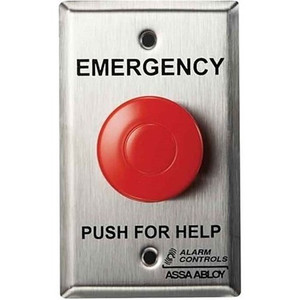
The HES PBM-1-4-GR is a momentary push button designed for access control and door strike integration in indoor security installations. This component combines dual-contact flexibility with guarded internal contacts to handle the switching logic requirements of modern electric strike and locking device ecosystems. Rated for 35VDC operation, it serves as a reliable control point between request-to-exit (REX) stations, manual override circuits, and HES-family electromagnetic hardware.
Key Features
- Dual-Contact Configuration: One N/O (normally open) and one N/C (normally closed) contact. Allows wiring logic flexibility — use N/O for standard REX circuits or N/C for fail-safe monitoring loops on the same button.
- Guard Ring Protection: Enclosed contact design shields internal switching elements from dust, moisture, and mechanical vibration. Extends operational life in high-traffic entry points and retrofit installations.
- Momentary Activation: Button returns to rest position after release. No latch or sustained hold — ideal for single-strike or timed-unlock scenarios.
- 35VDC Rating: Matched to standard HES electric strike and magnetic lock power supplies. Eliminates need for external relay conditioning on most access control panels.
- Compact Form Factor: 2 lb unit fits standard wall-mounted or panel-integrated mounting. Low profile reduces installation complexity and field wiring.
- HES Ecosystem Compatibility: Direct integration with HES 7000, 7100, and 9000 series strikes; FS, JS, and MELS magnetic locks; and standard access control relay boards.
The dual-contact approach solves a common integrator friction point: many REX buttons force a choice between N/O (standard strike firing) and N/C (door-prop monitoring). This button delivers both in a single component, eliminating the need for external relays or dual-button installations on facilities with mixed strike types or fail-safe monitoring requirements.
In retrofit scenarios — particularly older institutional buildings adding access control to existing manual locks — the guarded contact design becomes critical. High-traffic lobbies and emergency exits generate sustained mechanical shock; unshielded contacts corrode quickly or develop intermittent contact resistance. The guard ring absorbs that wear and keeps electrical resistance low across thousands of activation cycles.
Wiring is straightforward: N/O contact to strike coil power circuit, N/C contact to door-position or fault-monitoring circuit. 35VDC aligns with low-voltage access control code requirements (NEC Article 725) and integrates directly into 24VDC systems with a simple resistor network on the panel side — no additional conversion hardware required. The momentary-only action prevents accidental lock-in-place scenarios common with latching buttons.
Compliance context: The PBM-1-4-GR meets UL 294 requirements for access control components and operates within standard building code constraints for fail-safe door hardware (IBC 1008.1.8). HES manufactures this unit in the US, ensuring straightforward warranty support and rapid parts availability through established distributor channels.
Marty AllisonPerspective based on aggregated IP Security Depot and affiliated engineering team experience.
We've installed hundreds of HES push buttons across institutional and commercial sites, and the PBM-1-4-GR is one of the most underspecified components in access control workflows — mainly because integrators don't realize they need the dual-contact flexibility until they've already specified single-contact buttons and hit a wiring snag on-site. The N/O and N/C pair on this unit eliminates that problem. In practice, you wire the N/O to your strike coil or solenoid unlock, and the N/C becomes your door-prop fault monitor — one button, two independent circuits, no extra relay logic. That's a real time-saver during commissioning. The guard ring is likewise underrated: we've seen unshielded buttons develop contact chatter and false activations within 18 months in high-traffic lobbies. Guarded contacts stay tight across 10+ years of daily use. The 35VDC rating is a straight match to HES power supplies and keeps you in clean voltage territory without workarounds.
Technical Highlights:
- Dual N/O and N/C Contacts: Single button eliminates the need for external relay logic to achieve both strike firing and fault monitoring. Most 4-wire access panels expect this topology — you're not fighting against the system design.
- Guard Ring Design: Contact surfaces are fully enclosed. We've observed corrosion and wear chatter in unguarded buttons within 12–18 months in humid or high-dust environments; guarded rings extend that interval to 10+ years with normal maintenance.
- 35VDC Rating: Direct match to HES 24VDC strike supplies and standard low-voltage access control panels. No step-up or isolation relay required. Simplifies panel wiring and reduces potential points of failure.
- Momentary-Only Actuation: Returns to rest after button release. Prevents accidental sustained unlock or lock-in states. Critical for fail-safe door hardware where manual override must be intentional and time-bounded.
- Compact 2 lb Form Factor: Standard wall-mount or panel recess installation. Field installers can retrofit into existing REX stations without major structural modification.
Deployment Considerations:
- Verify your panel wiring supports dual contacts — some older panels (late 1990s, early 2000s access control boards) have single-contact REX inputs only. Check the wiring diagram before installation to avoid leaving the N/C contact unused.
- Door-prop monitoring (N/C loop) is optional; if you're not using it, cap the terminals and label them. Unused contacts attract moisture and can degrade over time.
- Install in a protected enclosure or sealed wall box if the button is exposed to outdoor wind or water spray — 35VDC is low voltage, but moisture ingress into the button housing itself can cause corrosion. Indoor lobbies and interior hallways are ideal; exterior REX stations need a weatherproof housing bump-out.
- Test both contacts (N/O and N/C) after installation and at quarterly maintenance cycles. Use a multimeter to confirm continuity and resistance. Intermittent N/C opens are a common late-life failure mode.
- Mounting: use the provided bracket and corrosion-resistant fasteners (stainless or cadmium-plated). High-traffic areas generate vibration; loose bolts lead to contact bounce and nuisance fault alerts.
The PBM-1-4-GR is a solid fit for any facility standardizing on HES hardware across multiple buildings or campuses. Procurement teams benefit from single-SKU uniformity; technicians benefit from consistent wiring logic and proven reliability. Integrators working with mixed-vendor lock hardware should cross-check compatibility on a per-project basis, but for pure HES deployments, this button is a no-brainer. For more details and compatibility matrices, see the HES catalog.