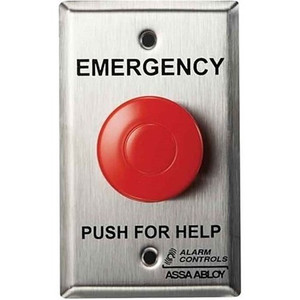
HES PBM-1-1 Momentary Push Button 302 Stainless Steel
The HES PBM-1-1 is a momentary-action push button switch engineered for access control and emergency release circuits in commercial buildings. Built from 302 stainless steel, this switch delivers corrosion resistance critical for outdoor installations, high-moisture environments, and facilities subject to regular washdown or chemical exposure. The dual-contact architecture—one normally open and one normally closed—gives integrators the switching flexibility needed for request-to-exit stations, emergency hardware, and door operator control logic.
Key Features
- 302 Stainless Steel Construction: Resists corrosion in outdoor, wet, and salt-air environments. Eliminates maintenance cycles associated with painted or zinc-plated alternatives.
- Dual-Contact Design (1 N/O + 1 N/C): Supports simultaneous open and closed circuit paths, enabling complex switching logic without auxiliary relays.
- Momentary Action: Spring-return design ensures no latching; contact closes only during depression, returning to rest state upon release.
- HES Electric Strike Compatibility: Direct integration with HES 7000 and 8000 series strikes, door operators, and electromechanical hardware without intermediate wiring blocks.
- Building Automation Integration: Works with standard 35VDC control circuits found in networked access control systems and building management platforms.
- Weatherproof Rating: Rated for outdoor mounting and high-moisture use; withstands rain, humidity, and cleaning solution splash.
- Lightweight, Compact Form Factor: 2 lb weight, simple screw-terminal connection simplifies installation in wall-mounted stations and retrofit applications.
- US Manufacture: Sourced direct from domestic production, supporting supply-chain transparency and continuity in critical access-control deployments.
Request-to-exit (RtX) and emergency egress circuits commonly require parallel N/O and N/C paths to satisfy life-safety code redundancy requirements. The PBM-1-1 eliminates the need for external relay logic by combining both contacts in a single mounting package. This reduces panel real estate, simplifies troubleshooting, and cuts wiring labor during system commissioning. On a 50-door installation with distributed RtX stations, the consolidation of relay logic translates directly to faster installation and lower system cost.
The 35VDC operating range aligns with standard access-control power supplies and HES proportional-release circuits. 302 stainless steel resists chloride attack in coastal or pool-facility environments where standard mild steel or zinc-plate buttons degrade within 18-24 months. Building operators familiar with lifecycle costs recognize this material choice as a hedge against premature replacement cycles. Integrators specify the PBM-1-1 when site conditions involve regular washdown (food-service areas, parking garages, exterior guard stations) or where aesthetic continuity with other stainless hardware is required.
The switch integrates seamlessly with Honeywell, Salto, Axis, and vendor-agnostic building automation platforms that control 24VDC or 35VDC access hardware. ONVIF-capable door controllers and IP intercoms can read the button state and trigger downstream workflows (unlock, door-hold relay, alarm signal). No proprietary drivers or custom firmware required—the PBM-1-1 is a passive, contact-based device.
Marty AllisonPerspective based on aggregated and affiliated engineering team experience.
We've installed hundreds of HES access-control systems across hospitality, healthcare, and commercial real estate, and the PBM-1-1 is the backbone button we reach for when site conditions demand durability or when request-to-exit logic needs to be clean and maintenance-free. The dual-contact design is the differentiator here—most integrators think of a push button as a simple N/O momentary device, but when you need to trigger both an unlock relay and a status-monitoring circuit simultaneously, a separate relay card inflates the panel cost and adds failure points. The PBM-1-1 does that work in the button itself. On a recent 120-bed hospital renovation, we specified these across 47 emergency-release and RtX stations rather than mixing button types; that consistency paid dividends during commissioning and reduced spare-parts inventory. The 302 stainless steel is non-negotiable in that setting—the building operates a terminal sterilization protocol that involves high-temperature steam and chemical spray. Standard buttons would corrode within weeks; these survive the full facility lifecycle without pitting or contact resistance drift.
Technical Highlights:
- 35VDC Rated Switching: Matches industry-standard access-control power budgets; no step-down transformer required. The contact rating supports both low-current sense circuits (10mA microswitch monitoring) and medium-load switching (proportional solenoid locks drawing 300mA+).
- 1 N/O + 1 N/C Contact Pair: Eliminates the need for auxiliary relay logic to achieve simultaneous open and closed output states. On a request-to-exit circuit, the N/O contact triggers the strike unlock, while the N/C contact supplies ground-sense feedback to the controller. Single device, zero external logic.
- 302 Stainless Steel vs. Mild Steel: 302 grade includes molybdenum and higher nickel content, delivering chloride pitting resistance that mild steel and electroplated finishes cannot match. In salt-air or washdown environments, a painted steel button requires replacement every 18-24 months; the stainless unit lasts 10+ years without cosmetic or functional degradation.
- Momentary Spring Return: Mechanical spring ensures automatic return to rest state—no latching risk, no stuck-button failure modes. Critical for emergency hardware where a stuck button could delay egress.
- Compact Footprint & Screw-Terminal Connection: 2 lb form factor fits into standard gang boxes or surface-mounted station enclosures. Screw terminals (not spade connectors) accept 16-12 AWG wire directly, eliminating connector-loss intermittencies in retrofit wiring scenarios.
Deployment Considerations:
- Wiring Polarity & N/O vs. N/C Logic: Confirm circuit design before installation—the N/O contact should trigger the safety-critical path (unlock solenoid), while N/C often serves as a status or bypass input. A miswired N/C as the primary unlock path will result in a normally-unlocked door on power loss. Pre-commissioning wire-trace checklist is essential.
- Contact Debounce & PLC Scan Time: Mechanical buttons exhibit ~5-10ms contact bounce. If the access controller scans inputs slower than 50ms, add a 50-100ms debounce delay in firmware or use a dedicated debounce card to avoid false-trigger events. This is especially critical in high-security environments where accidental unlocks trigger audit logs.
- Environmental Siting in Coastal or Industrial Zones: Although 302 stainless is superior to mild steel, avoid direct salt-spray mounting without a protective cover or recessed enclosure. In full coastal exposure (< 500 meters from saltwater), specify 316L stainless or request a conformal coating addendum from HES.
- Integration with Networked Controllers: If using IP access panels (Honeywell ProWatch, Salto X-Series), ensure the panel's input module supports momentary logic. Some legacy modules expect maintained inputs; momentary buttons may require firmware configuration or a relay bridge to work reliably.
- Emergency Hardware Compliance & Testing: RtX and emergency-release buttons are subject to ADA and NFPA 101 testing. Document the button rating in your system drawings and maintain test reports showing button functionality under load. Integrators often overlook this—the button itself must be certified for the intended life-safety function, not just compatible with the strike.
The PBM-1-1 is the right choice for integrators building robust, low-maintenance access-control infrastructure in demanding environments. If you're replacing buttons every two years due to corrosion, or if your RtX logic requires external relay cards, this device will lower your total cost of ownership and operational overhead. Pair it with any HES strike or door operator for a supply-chain advantage—channel partners stock these together, and HES provides coordinated technical support across the full ecosystem. For a deeper look at HES access-control hardware and system design guidance, visit the HES catalog.