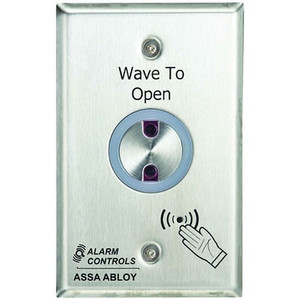
HES NTB-1 No Touch Exit Switch
The NTB-1 is a contactless exit switch designed for access control installations where touchless door release is required. Unlike traditional push-button exit devices, the NTB-1 eliminates a physical contact point — meaningful in high-traffic security zones, healthcare facilities, and environments where reducing surface contamination is a compliance or operational priority. It integrates with standard access control systems and electric locking hardware, supporting both permanent DC installation and temporary battery-backed deployments.
Key Features
- Contactless activation mechanism — eliminates the touch point entirely. In high-traffic egress corridors, this reduces wear on the device and removes a hygiene liability. Particularly valuable in healthcare, government, and food-service facilities where contact surfaces are audited.
- Flexible power options: 12 VDC, 24 VDC, or battery operation — choose permanent integration into your access control power distribution, or deploy battery-backed units in temporary installations or retrofit scenarios where pulling new DC runs is impractical. Battery backup also handles brief power loss without dropping door control.
- Compatible with standard access control systems — works with conventional access control panels and electric strike or electromagnetic lock hardware. No proprietary software or specialized readers required; integrates into existing door control logic.
- Retrofit-ready form factor — designed to replace traditional push-button exit switches in existing door frames, reducing installation labor and avoiding costly structural modifications to door frames or mullions.
- No scheduled maintenance or contact-point replacement — because there is no button to wear out or degrade, operational lifetime is extended and field service calls for stuck or broken buttons are eliminated.
- Reduced contamination in sensitive environments — hospitals, secure facilities, and food processing plants benefit from one fewer contact surface to sanitize or inspect.
Integration and Deployment
The NTB-1 pairs directly with access control panels that manage door locks and strikes. The contactless sensor triggers a relay or wired signal to the panel, which then energizes the locking device. On permanent installations, 12 VDC or 24 VDC is sourced from the same control loop or dedicated panel auxiliary supply. On temporary or mobile deployments—mobile security operations, temporary facility access, or retrofit jobs—battery operation (often AA or 9V, depending on configuration) provides weeks to months of service without external power, ideal for proof-of-concept trials or short-term installations.
Because the NTB-1 (often searched as NTB 1) is a contactless device, it is inherently more durable in environments where hand sanitizer, moisture, or salt spray would corrode or jam a mechanical button. This makes it particularly suited to healthcare, coastal facilities, and industrial environments where contact-based exit switches face accelerated corrosion or bacterial accumulation.
Frequently Asked Questions
Q: Can the NTB-1 be retrofitted into an existing door frame in place of a traditional exit switch?
A: Yes. The NTB-1 is designed for retrofit installations and will mount into the same cut-out or template as a conventional push-button exit switch. Consult the installation guide for mounting template and exact dimensions, but no new structural modifications are typically required.
Q: Does the NTB-1 work with both electric strikes and magnetic locks?
A: Yes. The NTB-1 triggers a relay signal compatible with standard access control panels. The panel then controls either electric strike locks or electromagnetic locks, depending on your hardware choice. The NTB-1 itself is agnostic to the lock type.
Q: How long does battery operation last?
A: Actual runtime depends on activation frequency and battery type (AA, 9V, or other). On light-traffic exits with battery power, expect weeks to a few months before replacement. Permanent DC-powered installations eliminate this concern entirely.
Q: Is the NTB-1 suitable for emergency egress compliance (ADA, NFPA, etc.)?
A: The NTB-1 provides hands-free activation, which can support egress requirements in facilities with accessibility mandates. However, emergency code compliance (ADA, NFPA, local fire code) depends on your overall egress system design, fail-safe behavior, and how the lock is configured. Consult your local AHJ and integrator during design to confirm the NTB-1 meets your jurisdiction's specific emergency egress rules.
Q: What is the expected lifespan of the NTB-1 compared to a mechanical exit button?
A: Because the NTB-1 is contactless and has no mechanical button to wear out or jam, operational life is typically longer than a push-button device. In high-traffic or harsh environments (moisture, salt spray, frequent sanitization), the advantage is even more pronounced.
Ted PerryPerspective based on aggregated IP Security Depot and affiliated engineering team experience.
The NTB-1 addresses a real problem on high-traffic access control jobs: mechanical exit buttons fail, jam, or become a liability in environments where hygiene and contamination control matter. The contactless design of the NTB-1 eliminates that failure mode entirely and, critically, removes a documented touch point — something auditors and compliance officers care about in healthcare and regulated facilities.
Technical Highlights:
- Multi-voltage DC support (12 VDC, 24 VDC): Most access control panels supply one or both voltage rails. Being able to pull power from either 12 or 24 VDC means you are not locked into a single power architecture — important when integrating the NTB-1 into an existing panel without requiring a separate power supply.
- Battery-backed option: On retrofit or temporary deployments, battery operation eliminates the need to run new power back to the control panel. This is a significant cost savings on a single exit or a short-term installation, and it also provides automatic failover if main panel power is briefly interrupted.
- No moving parts in the user interface: Contactless sensors (typically infrared or capacitive) have much longer MTBF than mechanical buttons. In environments with hand sanitizer, moisture, salt spray, or high-frequency sanitization cycles, this translates to dramatically fewer field service calls and replacement units.
Deployment Considerations:
- Sensor range and false activation risk: Contactless sensors on door exit devices typically have a small activation zone (a few inches). Verify the NTB-1's range during commissioning to ensure it does not false-trigger from passing traffic or adjacent activity. Adjust mounting or sensitivity if needed.
- Battery life on high-traffic exits: If the NTB-1 is battery-powered and the exit is busy (hundreds of activations per day), battery runtime will be shorter than published estimates. Calculate expected activations and confirm the maintenance schedule is acceptable before committing to battery-only operation on a critical egress route.
- Emergency egress and fail-safe configuration: The NTB-1 is a signal generator — it does not control the lock itself. Your access control panel must be configured for fail-safe behavior (unlock on power loss or sensor failure) if the exit is an emergency egress point. Verify this during design and commissioning; improper fail-safe configuration can create a life-safety risk.
The NTB-1 is the right choice for retrofit projects where you need to replace a worn mechanical button without rework, for healthcare and food-service facilities where contact-surface audits are routine, and for temporary or mobile deployments where battery operation keeps installation cost and labor low. If you are chasing maximum MTBF and eliminating touch-point contamination is a stated facility goal, the NTB-1 is worth the slight cost premium over a standard button.