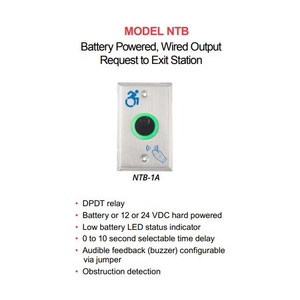
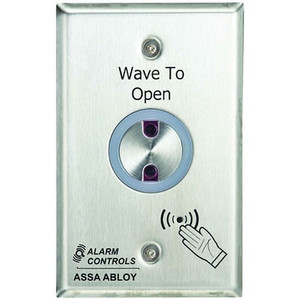
HES NTB-3 No Touch Exit Switch
The HES NTB-3 is a hands-free request-to-exit (REX) device engineered for modern access control deployments where contactless operation is a requirement, not an option. Unlike traditional push-button exit switches, the NTB-3 eliminates physical touch points while maintaining the reliability and compatibility that integrators expect from standard door control hardware. This matters in healthcare settings, high-traffic commercial buildings, and any facility where hygiene and infection control intersect with security workflow.
Key Features
- Contactless operation: Infrared sensor activation eliminates touch points entirely — particularly valuable in healthcare facilities, government buildings, and retail environments where pathogen transmission via shared hardware is a documented concern.
- Request-to-exit (REX) functionality: Standard REX signal output integrates directly with existing access control panels and door lock hardware — no panel reprogramming required on most systems.
- Dual power architecture: Battery mode supports retrofit installations where running additional low-voltage wiring would require extensive wall or conduit work; DC-powered mode suits high-volume or 24/7 facilities where battery replacement cycles become a maintenance burden.
- Compatible with standard locking hardware: Works with electric strikes, magnetic locks, and electromechanical latch hardware already installed in most commercial access control systems — reduces replacement scope and cost.
- Straightforward installation: Mounting footprint aligns with standard door frame layouts; sensor calibration and activation zone are simplified enough that integrators can deploy units without specialized commissioning equipment.
- Retrofit-focused design: Minimal electrical footprint and flexible power options make the NTB-3 practical for upgrading existing door stations without system-level redesign.
Integration and Compatibility
The NTB-3 functions as a direct replacement for conventional exit buttons in access control workflows. Output signals are compatible with standard access control panels — most systems recognize the REX contact closure without reconfiguration. Power flexibility is the standout here: battery mode allows deployment in locations where running hardwired DC power is impractical (retrofit retrofits, multi-tenant spaces, temporary deployments); DC-powered installations eliminate battery replacement overhead in facilities with frequent door traffic or 24/7 security operations.
Pair the NTB-3 with your existing access control hardware to upgrade entry/exit points with minimal disruption. For integrators managing large retrofit programs, the dual-power design often eliminates the need for custom wiring runs or panel expansion.
Deployment Scenarios
- Healthcare facilities and medical offices — contactless exit reduces cross-contamination risk in patient areas, infection control zones, and surgical suites.
- High-traffic commercial buildings and office complexes — maintains security integrity during peak arrival/departure periods without creating bottlenecks at single-touch exits.
- Retail environments with frequent door access — eliminates wear and maintenance issues on high-use exit buttons.
- Government and institutional buildings — meets modern hygiene standards and accessibility requirements without sacrificing control system logic.
- Retrofit and upgrade projects — battery operation minimizes installation cost where electrical infrastructure is limited.
The NTB-3 works equally well as a new-build specification or a mid-life retrofit to existing door hardware, making it a practical choice for integrators managing mixed portfolios of legacy and modern access control infrastructure.
Frequently Asked Questions
Q: Does the NTB-3 work with my existing access control panel?
A: Yes. The NTB-3 outputs a standard REX (request-to-exit) contact closure that is compatible with virtually all commercial access control panels. No panel reconfiguration or special modules are required — it functions as a drop-in replacement for a conventional exit button.
Q: What's the difference between battery and DC-powered modes?
A: Battery mode eliminates the need for additional wiring and is ideal for retrofit installations or locations where running low-voltage power is impractical. DC-powered mode connects directly to your access control system's 12V or 24V auxiliary power and eliminates battery replacement maintenance — better for high-traffic doors or 24/7 facilities.
Q: Can the NTB-3 be installed in retrofit applications?
A: Yes. The NTB-3 is designed for retrofit projects. Its compact footprint and flexible power options allow installation on existing door frames without requiring rewiring or system reconfiguration. Battery-powered mode is especially useful when additional low-voltage runs are impractical.
Q: What is the sensor activation range for the infrared sensor?
A: The NTB-3 activates via proximity/motion-sensing infrared — typical activation range is several inches from the device face. The exact range and sensitivity are optimized for standard doorway installation heights and traffic patterns.
Q: Is the NTB-3 suitable for outdoor installations?
A: The NTB-3 is designed for indoor access control applications. For covered outdoor areas (vestibules, alcoves), verify sensor performance under direct sunlight and weather exposure with the manufacturer before specifying.
Q: How often do batteries need replacement in battery-powered mode?
A: Battery life depends on activation frequency and ambient temperature. High-traffic locations may require more frequent replacement than low-use doors. For facilities with frequent exits, DC-powered mode eliminates this maintenance burden.
Ted PerryPerspective based on aggregated IP Security Depot and affiliated engineering team experience.
The HES NTB-3 solves a specific problem: how to upgrade existing access control infrastructure with contactless exit capability without wholesale replacement of door hardware or panel logic. The dual power model is what sets it apart — battery mode lets you deploy the NTB-3 in retrofit situations where adding new low-voltage wiring would consume budget and extend installation schedules. DC-powered operation handles high-traffic deployments where battery replacement becomes an operational nuisance.
Technical Highlights:
- Dual power architecture: Battery operation supports retrofit installations where running additional 12V/24V wiring would require wall chasing or conduit work; hardwired DC power mode eliminates battery maintenance cycles in facilities logging 500+ door operations per day.
- Standard REX output: Contact closure signal integrates directly with existing access control panels — no special modules, no reconfiguration required. This is the critical compatibility spec that keeps integration labor and cost down.
- Infrared sensor activation: No physical touch point means reduced wear, reduced maintenance on mechanical contacts, and zero contribution to pathogen transmission vectors — measurable benefit in healthcare, food service, and institutional environments.
Deployment Considerations:
- Battery life is traffic-dependent — verify expected replacement cycles with your facility's actual door-use patterns before assuming maintenance burden fits your schedule.
- Infrared sensors are susceptible to false triggers in direct sunlight and can be blocked by dirt or condensation on the lens — mounting height and protective overhang matter in retrofit installations.
- The NTB-3 is not a full system replacement; it is an exit-point upgrade that sits alongside your existing access control panel and locking hardware. Do not spec it as a standalone door control device.
If you're managing a large healthcare or retail retrofit where 50+ door exits need upgrade and running additional power infrastructure is not feasible, the NTB-3 battery-powered model will cut your labor and electrical scope by significant margins. For 24/7 high-traffic facilities (hospitals, data centers, secure warehouses), spec the DC-powered variant to eliminate battery logistics entirely.