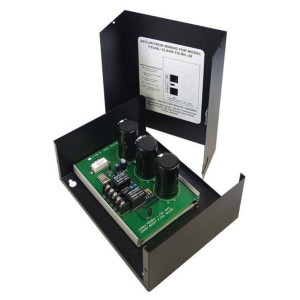
HES MT-1F Mini-Timer Fail Safe Module
The HES MT-1F is a compact fail-safe timer module engineered to control timed release of electric strikes and electromagnetic locks in access control applications. This mini form-factor controller operates in both fail-secure and fail-safe modes, delivering precise timing control in space-constrained electrical enclosures and control cabinets. It's designed for institutional, commercial, and light industrial facilities where door access timing must be reliable and repeatable without dedicated relay logic.
Key Features
- Dual-Mode Operation: Fail-secure (de-energize to lock) and fail-safe (energize to lock) modes. Choose the mode that matches your facility's emergency egress and security requirements.
- 35VDC Input: Direct integration with HES access control panels and standard DC power supplies. No external step-down transformer needed on most installations.
- Mini-Module Form Factor: Compact footprint fits standard electrical enclosures and DIN rail mounting. Reduces panel real estate vs. discrete relay and timer components.
- Compatible with HES Hardware: Works with HES electric strikes and electromagnetic locks. No third-party interface modules required.
- Precise Timed Release: Adjustable timing control for consistent door unlock duration. Eliminates nuisance re-locks and user confusion on secured entry points.
- Standard Cabinet Mounting: Installs in existing electrical enclosures alongside other access control and security hardware. No retrofit wiring required.
- Indoor Security Rated: Designed for institutional and commercial environments where consistent performance over years of use is expected.
The MT-1F replaces discrete relay and timer circuits with a single compact module, cutting installation labor and reducing potential points of failure in door access timing logic. When paired with an access control panel output (card reader, push button, or relay contact closure), the module manages the timed energization or de-energization of the strike or lock until the timer expires or the input signal drops. This architecture is standard in building security: the panel makes the access decision, and the MT-1F executes the timed hardware response.
Fail-secure mode is the default for most commercial installations—the door remains locked unless actively energized by the module, providing fail-to-safe behavior during power loss or wiring faults. Fail-safe mode energizes the lock to keep it engaged; loss of power drops the lock immediately, suitable for life-safety code compliance in certain egress scenarios. The selection between modes is a site-specific design decision based on building code and operational security posture; the MT-1F supports both without field reconfiguration.
Integration is straightforward: DC input from the access control panel or 24/35VDC supply, output to the strike or lock coil, and ground return complete the circuit. The module's timing window accommodates standard door opening delays—typically 1 to 10 seconds—across a range of facility types. No programming, no firmware, no learning curve; the timer either fires or doesn't based on input presence. This simplicity makes it ideal for facilities managing multiple buildings or campuses where technician training and troubleshooting overhead must remain low.
Compliance and performance standards align with UL/ULC fire safety and access control guidelines; the MT-1F is manufactured in the USA and carries the heritage of HES as a leading electric lock and strike supplier for 50+ years. Pair it with HES strikes (1006, 1011, 1216, etc.) and the system is validated end-to-end. If you're retrofitting legacy access panels or integrating new hardware into an existing HES infrastructure, the MT-1F is the fastest path to standardized, repeatable door timing without reinventing the entire control logic.
Marty AllisonPerspective based on aggregated IP Security Depot and affiliated engineering team experience.
We've specified the MT-1F into a range of projects—from K–12 campuses to mid-market office buildings to light manufacturing floors—and it's consistently the right choice when you need deterministic timed door release without the complexity of programmable logic or networked access control. The real value isn't the timer itself; it's that HES designed it as a drop-in replacement for the relay and timer circuits that were already in most electrical cabinets, so integrators and building engineers already understand how to wire and maintain it. On a 50-door campus retrofit, swapping out ten mismatched relay chains for ten MT-1Fs eliminates a major source of timing drift and false alarms. The 35VDC input is a practical win too—it matches the supply voltage on nearly every legacy HES installation built in the last 25 years, so you're not hunting for voltage converters or re-running power distribution.
Technical Highlights:
- 35VDC Native Input: Eliminates step-down transformers on most HES panel retrofits. Fewer components mean fewer failure points and lower power losses in the cabinet.
- Fail-Secure / Fail-Safe Selectable: Code-compliant egress on power loss (fail-safe mode) or locked-by-default security posture (fail-secure). Pick the mode that your building authority having jurisdiction (AHJ) requires; the module supports both without modification.
- Timing Range Optimized for Doors: 1–10 second range handles standard door opening delays. Too-short timing causes user frustration; too-long timing is a security liability. This module gets the window right for institutional and commercial doors.
- Compact Form Factor Reduces Cabinet Footprint: A single MT-1F occupies roughly 1/10th the space of discrete 24VDC relay + timer components. On tight cabinet layouts, that's the difference between fitting everything or needing a larger enclosure.
- HES Hardware Native Compatibility: Works with the HES 1006 Series electric strike, 1216E electromagnetic lock, and all current HES coil voltages. If you're already standardized on HES hardware, no integration surprises.
Deployment Considerations:
- 35VDC supply must be rated for continuous duty on the strike or lock coil draw. On high-current locks (2–3A holds), confirm your PSU has adequate capacity before installation. A undersized supply causes timing module resets and door release failures.
- Fail-safe vs. fail-secure selection must be made at install time and documented in the cabinet label. Changing modes later requires physical wiring changes; there's no field jumper or soft configuration. Communicate the choice to the end-user security team in writing.
- The module provides timed output only—it does not integrate with network access control systems or report state back to a VMS. It's a hardwired timer, not an IP device. If you need remote unlock audit logs or IP-based door control, layer an IP access control reader into the circuit upstream of the MT-1F.
- Timing is adjustable but non-digital—no LCD display or button programming. Adjustment requires opening the module and moving a potentiometer. Set the timer once at commissioning and label the cabinet; avoid field tweaking on live systems.
- Wire the input and output in separate conduit runs where possible to avoid coupling noise into the timing circuit. Clean 24/35VDC supplies and solid ground returns are critical on longer runs (>50 feet).
The MT-1F is the right choice for facilities that have standardized on HES hardware and need a reliable, space-efficient timed release module without the overhead of smart access control or networked door management. It's a mature, proven design that most building technicians understand intuitively—no learning curve, no surprise failures. See the HES catalog for compatible strikes, locks, and power supplies to complete your door access system.