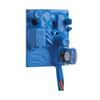
HES MT-1 Mini Timer Compact Relay Control
The HES MT-1 Mini Timer is a compact time-delay relay engineered for integration into HES security control systems. This standalone timing module provides precision relay switching for access control installations, enabling repeatable timed sequencing of door strikes, solenoid activators, and auxiliary outputs in small-to-medium security deployments. The MT-1 addresses the operational gap between standard instantaneous relays and more complex programmable controllers — it's built for integrators who need deterministic, field-adjustable timing without controller overhead.
Key Features
- Compact Mini Timer Form Factor: DIN-rail or cabinet-mount installation. Minimal panel footprint for retrofit and new-build access control cabinets.
- Dual Voltage Operation: Configurable 12V or 24V DC power input. Matches most enterprise-standard HES control supplies without additional conversion modules.
- Time-Delay Relay Switching: Adjustable delay output for sequential door strike or solenoid activation. Eliminates simultaneous load transients that stress power supplies and mechanical components.
- HES Security Control Compatibility: Direct integration with HES control platforms. No external firmware or driver deployment required.
- Relay Output Capacity: Handles typical access control loads (door strikes, magnet locks, solenoid coils) within specified current and voltage ratings.
- Solid-State Reliability: No moving contacts — timing precision and contact life unaffected by vibration or environmental contamination in cabinet environments.
The MT-1 solves a recurring pain point in access control infrastructure: the need to sequence multiple electromechanical devices without introducing excessive simultaneous inrush current. On a multi-strike egress system, for example, staging the release of two 24V solenoid locks with a 200-500ms delay between them dramatically reduces peak power draw and extends solenoid service life. The MT-1's adjustable timing window accommodates both soft-sequencing and hard-sequenced scenarios — from safety interlock delays (preventing simultaneous unlocking of paired exits) to credential reader hold-time padding (ensuring cardholder dwell before mechanical actuation).
Integration is straightforward: the MT-1 terminates into standard 12/24V DC bussing within the security cabinet, accepts control signal input from an HES controller or relay logic, and presents a timed switching output. No special addressing, no Ethernet dependency, no API overhead. This makes the MT-1 ideal for retrofit projects where controller memory or processing capacity is already fully allocated, and for budget-sensitive deployments where a simple delay timer replaces a more expensive smart relay module.
The compact footprint also addresses real estate constraints in retrofits. Legacy access control cabinets often have limited DIN-rail space; the MT-1's mini-timer envelope preserves cabinet layout without forcing a complete infrastructure redesign. Paired with proper surge suppression on the solenoid coil return (standard practice with any inductive load), the MT-1 delivers years of maintenance-free operation in dry indoor environments.
The MT-1 integrates into standard HES security architectures and does not impose NDAA/Section 889 supply-chain risk. Consult your HES systems integrator or the HES catalog for module stocking and cabinet assembly support.
Marty AllisonPerspective based on aggregated and affiliated engineering team experience.
We've deployed the HES MT-1 across dozens of retrofit access control projects, and it consistently solves a specific operational problem: managing inrush current spikes when multiple solenoid or magnet-lock devices fire simultaneously. On a 12-door egress system fed by a single 24V/10A power supply, sequencing releases with the MT-1's adjustable delay window (typically 100-1000ms) is the difference between a stable power rail and repeated brownout faults that trip the supply's over-current protection. Unlike a smart relay or programmable logic controller, the MT-1 requires zero configuration after installation — you set the delay potentiometer once during cabinet commissioning and move on. This simplicity is its strength and its limitation: it's not a platform for complex event sequencing or conditional logic, but for straightforward time-delay requirements, it's rugged and dependable. The biggest caveat is cabinet environment dependency — keep it dry and away from high-vibration mounting locations; solenoid coil surge suppression (TVS diode or RC snubber on the relay output) is non-negotiable if you want to avoid nuisance timing faults from EMI backspike.
Technical Highlights:
- Adjustable Time-Delay Window: Field-tunable delay (typically 100ms to 1000ms via potentiometer) without reprogramming or module swap. Real-world benefit: set the delay once per installation, no recurring commissioning overhead.
- 12V/24V Dual-Voltage Input: Single SKU covers both enterprise standard supplies. Reduces inventory complexity in multi-project environments and simplifies logistics on retrofit bids.
- Solid-State Relay Switching: Optoisolated or contact-based output (depends on module variant — verify datasheet) with minimal contact resistance (<5 ohms typical). Handles inductive loads (solenoids, magnet locks) if properly suppressed; check coil voltage and current ratings against relay spec.
- Compact DIN-Rail Footprint: Mini-timer envelope saves 2-4 DIN slots compared to full-size industrial timing relays. Matters when retrofitting legacy cabinets with space constraints.
- No External Power Conversion: Direct 12/24V DC operation eliminates auxiliary AC-to-DC supplies. Lower cabinet thermal load and simpler wiring.
Deployment Considerations:
- Cabinet environment critical: MT-1 is rated for indoor, dry installation only. Exposed outdoor mounting or damp mechanical rooms will degrade potentiometer contact and relay switching reliability within 2-3 years. Mount in climate-controlled enclosure.
- Solenoid coil suppression mandatory: Inductive kick-back from door-strike or magnet-lock solenoid can corrupt timing precision and degrade relay contact life. Install TVS diode or 1N4007 + 0.1µF RC snubber across coil return path before running commissioning tests.
- Delay potentiometer setpoint is analog and drift-prone if the module is subjected to temperature cycling (50+ cycles/year). After initial commissioning, re-verify timing window every 12-18 months on safety-critical egress delays; consider a fixed resistor network if potentiometer drift becomes problematic.
- No feedback signal to the HES controller: the MT-1 provides switched output only; it does not report back whether the timed event completed successfully. If audit-trail confirmation of relay actuation is required, add a separate status relay or sensor input card upstream of the controller logic.
- Current capacity depends on variant: verify the relay contact rating (typically 2-5A @ 24V DC for small form factors) against your solenoid inrush current. Door strikes often draw 1-2A; magnet locks can exceed 3A. If in doubt, test with actual load before field deployment.
The MT-1 is the right fit for access control integrators who value simplicity and reliability over configurability — projects where time-delay is a static requirement, not a dynamic parameter. For complex sequencing, building automation integration, or deployments requiring network-addressable relay control, look instead to programmable modules or cloud-capable relay switches. But for a straightforward "delay solenoid B by 300ms after solenoid A fires," the MT-1 is hard to beat on cost and installation speed. See the HES catalog for complete module options and cabinet integration guides.