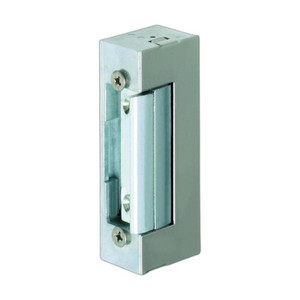
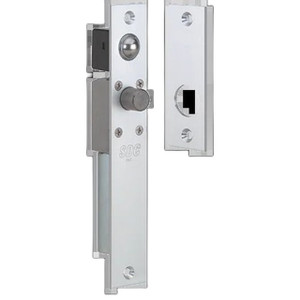
HES M32 Electric Strike 12/24VDC
The HES M32 is a dual-voltage electric strike designed for professional access control installations where power flexibility matters. By supporting both 12VDC and 24VDC operation, the M32 eliminates voltage compatibility issues across facilities with mixed power infrastructure — a genuine advantage in retrofit or multi-building deployments where standardizing on a single supply voltage is impractical or costly. This form factor fits standard door frame cutouts, reducing installation time and keeping framing modifications to a minimum.
Key Features
- Dual-voltage operation (12VDC or 24VDC): Select your operating voltage at installation — no need to stock two different models or source a custom power supply. This matters when integrating with legacy 12VDC credential readers or migrating to modern 24VDC infrastructure without replacing the strike itself. Field-selectable voltage means one SKU covers both scenarios.
- Electric strike form factor: Standard frame-mounted design fits conventional hollow-metal and wood door applications. No special frame modifications required, shortening deployment cycles and reducing carpenter callbacks. Mounts into the standard strike pocket in the door frame header or jamb.
- Direct voltage control: Wired control from access control panels or readers — no complex relay logic or intermediate modules needed. This simplifies wiring diagrams, reduces troubleshooting surface area, and lowers the risk of control-circuit faults that can disable egress.
- Durable electromagnetic locking mechanism: Built for sustained cyclic operation in commercial and industrial environments. The solenoid and armature are rated for high-frequency access cycles — meaningful when processing hundreds of credentials per day across busy entrances.
- Access control panel compatibility: Works directly with standard industrial access control panels, credential readers (card, keypad, biometric), and conventional electromagnetic locking system architectures. Connect to normally-closed relay outputs; no proprietary interfaces required.
- Low-voltage DC operation: Operates safely within 12VDC or 24VDC supply envelopes, reducing electrical hazard risk compared to line-voltage alternatives. Simplifies power distribution from cabinet-mounted supplies and eliminates the need for high-voltage conduit runs.
Integration & Compatibility
The M32 integrates with entry-level and mid-range access control architectures. Connect directly to normally-closed relay outputs on standard access control panels. Voltage selection is made via field wiring or internal jumper at installation — check the manufacturer datasheet for your specific panel's output voltage before ordering to avoid a return trip to the site. Works with door sensors, request-to-exit (REX) buttons, and multi-reader configurations managed through a single control panel. Verify your panel's output voltage matches your intended M32 setting before final commissioning.
Mounting & Installation
The M32 mounts into the standard electric strike pocket in the door frame header (top) or jamb (side), depending on your frame type and swing direction. Installation requires basic carpentry to position the strike body and route control wiring to the access panel. Clearance behind the frame must accommodate the solenoid and armature — typically 1.5 to 2 inches. Consult your door frame specification and the M32 installation guide to confirm fit before cutting.
When to Choose a Different Model
If your facility requires fail-safe operation (strike disengages on power loss for emergency egress), consider a purpose-built fail-safe electric strike instead — the M32 holds the door when powered. If you need surface-mounted or glass-door solutions, evaluate alternative HES strike geometries designed for those applications. For high-security environments requiring anti-tailgating or dual-credential verification, review integrated access control panel options that support advanced logic before selecting a strike alone.
Frequently Asked Questions
Q: Can I change the voltage after installation?
A: Yes, the M32 supports field voltage selection via jumper or wiring configuration. Consult the installation documentation to identify the voltage selector on your unit. No soldering or component changes required.
Q: Does the M32 work with my existing 12VDC access panel?
A: Yes. Configure the M32 for 12VDC operation and wire it to your panel's relay output. Verify the panel's output voltage and contact rating match the strike's control requirements before installation.
Q: What happens if power is lost?
A: The M32 is fail-secure — it locks the door when de-energized. If you require fail-safe (unlock on power loss), you need a different strike model designed for that logic.
Q: Can I use the M32 on a double-door or high-traffic entrance?
A: Yes, the M32 is rated for commercial-duty cyclic operation. For double-door deployments, install a strike on each leaf and coordinate them through your access control panel to ensure synchronized locking.
Q: Does the M32 fit my existing door frame?
A: The M32 uses standard electric strike dimensions — it fits conventional hollow-metal and wood frame cutouts. Verify your frame's strike pocket depth (typically 1.5–2 inches) and opening size against the installation guide before ordering.
Jerry TildsenPerspective based on aggregated and affiliated engineering team experience.
The HES M32 solves a real problem in retrofit access control work: voltage mismatch across legacy and modern infrastructure. Most integrators carry two SKUs (one 12VDC, one 24VDC) to cover the field. The M32 cuts that down to one, which saves inventory cost and eliminates the risk of ordering the wrong voltage to a remote site. The dual-voltage flexibility is genuine — you configure it at installation via jumper or wiring, and the solenoid handles both supply envelopes without modification.
Technical Highlights:
- Field-selectable 12VDC or 24VDC: No need for dual SKUs or custom power supplies. This flexibility matters in multi-building campuses or retrofits where consolidating power supply standards takes months. One strike covers both scenarios.
- Direct relay control with no intermediate logic: Wire the M32 to a normally-closed output on your access panel. No separate relay module, no additional wiring complexity, no extra failure points. If the control line fails, the door locks — fail-secure by design.
- Standard frame fit reduces installation time: The M32 mounting pocket is conventional, so most hollow-metal and wood frames accept it without modification. That saves carpenter time and site logistics on multi-door projects.
Deployment Considerations:
- Verify your panel's output voltage (12V or 24V) before ordering. Mis-matching voltage at installation is the most common on-site issue — check the spec sheet or use a meter.
- The M32 is fail-secure (locks when unpowered). If emergency egress requires fail-safe operation, this strike is the wrong choice — you need a fail-safe strike model instead.
- Allow 1.5–2 inches of clearance behind the frame for the solenoid and armature. Shallow frames or thick weather stripping can block the armature travel — confirm fit before framing cuts.
Deploy the M32 in standard commercial access control retrofits where voltage flexibility is a practical benefit — campus buildings, retail chains, or warehouse expansions where power infrastructure isn't yet unified. It's not exotic, but it's reliable, straightforward to integrate, and solves a specific logistics problem that mid-size integrators face every month.