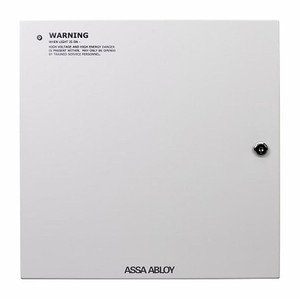
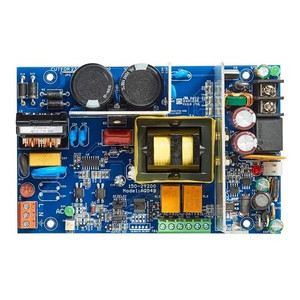
HES AQD1 1A Auxiliary Power Supply 12/24VDC
The HES AQD1 is a compact, standalone auxiliary power supply designed to distribute secondary power across access control installations. At 1-ampere output capacity, the AQD1 addresses a specific deployment need: powering auxiliary loads—door strikes, electromagnetic locks, card readers, and control modules—from a single, centralized point rather than stringing individual power runs to each endpoint. The integrated battery charger function makes it practical for backup scenarios where brief power loss could compromise access or safety systems.
Key Features
- 1-ampere output capacity: Sufficient for low-current auxiliary loads (door strikes, solenoids, LED indicators) in small to mid-scale access control deployments. Helps avoid the cost and cable complexity of individual power supplies per device.
- Dual voltage operation (12VDC / 24VDC): Accepts either voltage at the input and outputs the same to auxiliary devices. Eliminates the need for separate units when site power infrastructure already supplies 12V or 24V—simply jumper the unit accordingly. Confirm voltage before installation to avoid device damage.
- Integrated battery charger: Maintains float charge on backup batteries used for emergency door release or fail-safe operation during power loss. Reduces the need for a separate charging circuit.
- Fire alarm connection interface: Enables coordinated operation with building safety systems—allows door strikes or access control to respond to fire alarm signals (e.g., unlock on alarm for egress). Verify compatibility with your fire panel during design.
- Compact cabinet design: Mounts horizontally in standard 19-inch racks, electrical closets, or control room panels. Space-efficient footprint keeps the power distribution layer tidy in crowded installs.
- Compatible with HES lock systems: Integrates directly with HES electric strike and electromagnetic lock product lines, though it functions as a generic 12/24VDC auxiliary supply and will work with any compliant third-party devices within the 1A budget.
Integration & Compatibility
The AQD1 functions as a secondary power distribution point in larger access control architectures. Typical deployment: main power enters the unit, the AQD1 conditions and outputs it, then downstream auxiliary devices (strikes, locks, readers, relay modules) wire in parallel or via a terminal block. Fire alarm integration is hardware-based—connect the fire panel's dry contact or relay output to the designated alarm interface on the AQD1 per the datasheet pinout. Battery charger supports standard lead-acid or sealed lead-acid backup batteries; confirm amp-hour rating and float voltage requirements before connecting. Integrators should verify input voltage compatibility with site power infrastructure and confirm that the 1-ampere ceiling does not exceed the total amperage draw of all downstream devices during peak demand (e.g., simultaneous door unlock + reader power).
Deployment Considerations
The 1A limit is the critical constraint. In an installation with three door strikes (0.5A each) plus two card readers (0.2A each) plus indicator lights, you're at the ceiling or slightly over—surge capacity matters. If your site demands higher auxiliary current, consider a higher-amperage supply or split the load across multiple AQD1 units. The compact form factor and integrated charger make this well-suited for retrofit projects in limited-space environments and for new small-scale access control zones. Mount securely indoors in a climate-controlled enclosure; this is not a field-hardened outdoor device.
Frequently Asked Questions
Q: What is the maximum current draw the AQD1 can safely deliver?
A: The AQD1 is rated for 1-ampere output. Exceeding this will trigger thermal or overcurrent protection. Calculate the combined amperage of all downstream devices (strikes, locks, readers, solenoids) and confirm the total does not exceed 1A under simultaneous operation.
Q: Can I use the AQD1 with both 12VDC and 24VDC on the same installation?
A: The AQD1 operates at either 12VDC or 24VDC, not both simultaneously. Set the input and output voltage via jumper or terminal configuration before powering on. All downstream devices must match the selected voltage to avoid damage.
Q: Does the integrated battery charger support both lead-acid and lithium backup batteries?
A: The charger is designed for standard lead-acid and sealed lead-acid (gel/AGM) batteries. Lithium batteries require different float voltage and charging profiles; consult the datasheet and the battery manufacturer before connecting lithium backup systems.
Q: How do I wire the fire alarm interface to my fire panel?
A: The fire alarm connection is a dry contact input on the AQD1. Connect a relay output or supervised alarm circuit from your fire panel to the designated terminals on the AQD1. On alarm activation, the AQD1 applies power to a fire alarm output circuit, which can trigger door unlocks or other fail-safe actions. See the datasheet pinout and fire panel manual for correct wiring.
Q: What mounting options does the AQD1 support?
A: The AQD1 is compact and designed for cabinet or control room wall mounting. It includes a backplate suitable for din-rail or screw-down mounting. Do not mount outdoors or in uncontrolled environments with extreme temperature or humidity swings.
Q: Is there a warranty on the AQD1?
A: HES typically backs its products with a manufacturer's warranty; contact the vendor for specific terms, duration, and coverage details applicable to your region.
Ted PerryPerspective based on aggregated IP Security Depot and affiliated engineering team experience.
The HES AQD1 solves a common retrofit pain point: you've got a dozen small access control devices scattered across a building, each needing power, and individual 12/24VDC runs to every door strike or reader quickly become expensive cable and labor. The AQD1's 1-ampere output, integrated battery charger, and fire alarm interface consolidate that distribution into a single control point. It's not a heavy-hitter—don't try to power a 2A strike bank from it—but for small-to-mid-scale access control zones, it's pragmatic.
Technical Highlights:
- 1A continuous output at 12VDC or 24VDC: Enough for 2–4 standard door strikes, or a mix of strikes, readers, and solenoid valves, provided total draw stays under 1A. This is your design constraint—calculate real-world inrush current during simultaneous unlock scenarios.
- Integrated float charger: Maintains backup batteries without a separate charger circuit, simplifying cabinet wiring and reducing component count. Lead-acid and sealed-acid support is standard; confirm chemistry and voltage before connecting.
- Fire alarm dry-contact interface: Hardwired integration with building fire panels—no network dependency, no additional relay boards. On alarm trigger, fail-safe door unlock or strike power cut happens locally and reliably.
Deployment Considerations:
- The 1A ceiling is real. Add up every load—strikes draw 0.4–0.8A each, readers 0.1–0.3A, solenoid locks 0.5–1.0A. Simultaneous operation of all devices will exceed the unit's capacity. If your site needs more, stack multiple AQD1 units or move to a higher-amperage supply.
- Voltage selection (12 vs. 24) is fixed at installation via jumper or terminal block. Do not assume the unit auto-selects—you must verify and set it correctly before powering up, or you risk damaging downstream devices.
- Mount indoors in a climate-controlled cabinet. The AQD1 is not rated for outdoor or high-temperature environments; thermal shutdown will engage if case temperature rises significantly.
The AQD1 is a solid fit for retrofit access control upgrades in small office suites, secured equipment rooms, or multi-tenant buildings where you're consolidating power distribution and adding fail-safe/fire-integrated unlock logic to a single cabinet. It won't scale to enterprise campuses with dozens of doors, but for the 5–15 door range with modest auxiliary loads, it's cost-effective and wiring-clean.