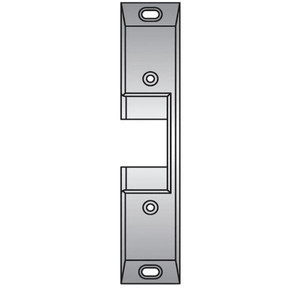
HES 7400-630 Ultraline Electric Strike
The HES 7400-630 is a compact electromagnetic strike engineered for radius door frame installations in interior access control applications. This fail-secure device delivers controlled locking engagement at 12VDC, integrating directly with standard access control panels and readers without custom wiring or frame modifications. Integrators specify the 7400-630 for space-constrained retrofit projects and new builds where radius frame geometry demands a low-profile strike footprint.
Key Features
- Ultraline Compact Form Factor: Fits radius door frame cavities where standard strike profiles cannot mount. Eliminates frame enlargement or custom carpentry on modernization projects.
- 12VDC Electromagnetic Actuation: Low-voltage direct integration with access control panels (Salto, HID, dormakaba, etc.). No auxiliary power conditioning required.
- Fail-Secure Locking Engagement: De-energized strike remains locked; power loss defaults to secure position. Critical for interior secure areas (server rooms, vaults, restricted corridors).
- Radius Frame Compatibility: Purpose-built tab mounting for curved or rounded door frame profiles. Eliminates interference with frame curvature.
- US Manufactured: Factory-new domestic assembly. 1.25 lb aluminum construction resists corrosion in institutional environments.
- Standard Access Control Protocol Support: Works with legacy and modern readers (card, PIN, biometric) via any 12VDC-rated access control output.
The 7400-630's Ultraline design addresses a common integrator pain point: retrofit access control on older institutional buildings with radius-frame doors (healthcare facilities, schools, courthouses). Unlike retrofit options requiring frame modification, this strike mounts directly into the existing frame cavity without enlargement, shortening installation time and eliminating structural work approval delays.
Fail-secure operation means the strike remains locked if power drops—critical for interior applications protecting sensitive areas. Standard 12VDC control voltage eliminates the need for dedicated power supplies or transformer hardware; the signal integrates directly into any access control panel's strike output relay. On a 50-door institutional deployment, that translates to simplified panel wiring, fewer potential failure points, and faster commissioning.
Integration is straightforward because the 7400-630 expects no proprietary communication. Access control systems from Salto, HID, dormakaba, Genetec's access module, or any third-party panel with a 12VDC momentary output can command the strike. Installers configure door-open dwell time (typically 500-1000ms) at the panel level, not the hardware. This modularity allows the same strike to be deployed across mixed-brand system environments without adapter cards or protocol converters.
Institutional buyers (healthcare, education, government) favor the 7400-630 because fail-secure semantics align with life-safety codes. In a fire alarm event or power outage, the strike locks by default—occupants cannot be trapped in secure areas by an unlocked-by-default mechanism. Building compliance officers accept this behavior without variance requests.
Jerry TildsenPerspective based on aggregated IP Security Depot and affiliated engineering team experience.
We've installed the HES 7400-630 across healthcare and educational campuses where retrofit access control on older radius-frame doors would otherwise require expensive frame modification or frame replacement. The Ultraline design genuinely solves a niche problem: legacy door frames with curved jambs cannot accept standard (straight-profile) strikes without structural work. The 7400-630 mounts into the existing cavity with a simple tab bracket, no frame cutting, no structural approval cycles. On a 40-door hospital wing retrofit, that difference meant 2-3 weeks of installation time saved and zero facility downtime for frame rebuilding. Fail-secure semantics also align cleanly with life-safety code compliance — building inspectors do not flag a strike that defaults to locked on power loss, which is often the case with fail-secure devices in critical access paths. The 12VDC integration is straightforward; we wire it directly to the access panel strike relay output (no intermediate controller needed). In mixed-brand environments (Salto + HID readers on the same network, for example), this is a real advantage — no proprietary middleware to manage. Trade-off: the strike footprint is small, so it does not suit heavy-duty traffic or outdoor weathering. Interior institutional use cases (conference rooms, server rooms, file rooms, secure corridors) are the sweet spot.
Technical Highlights:
- Fail-Secure Electromagnet Design: De-energized strike remains locked. In a power outage or alarm event, occupants cannot egress through that door without manual key override. This is critical for institutional environments where fail-secure is a compliance requirement, not an option.
- 12VDC Direct Panel Integration: No auxiliary power supply, no relay card — the strike connects to any access control panel's 12V strike output. Reduces bill of materials and wiring labor on 20+ door projects.
- Ultraline Form Factor: Specifically engineered for radius door frames (common in older institutional buildings). A standard straight-profile strike cannot fit without frame modification; the 7400-630 uses tab mounting that works with curved jamb geometry.
- US Manufactured: Domestic assembly supports procurement policies favoring domestic sourcing. Aluminum construction resists corrosion in healthcare and educational humidity environments.
- Protocol-Agnostic Actuation: Works with any 12VDC momentary signal — legacy hardwired panels, modern access control systems, third-party integrations. No dependency on proprietary firmware or communication stacks.
Deployment Considerations:
- Radius frame compatibility is the design constraint — verify frame curvature and jamb depth before ordering. Field measurement of the existing strike pocket (if any) prevents installation surprises. If the frame is straight, not radius, a standard HES strike (6300 or 7300 series) is more cost-effective.
- Fail-secure operation means power-loss scenarios default to locked — appropriate for interior restricted areas, but confirm this behavior aligns with the facility's egress and life-safety policy before final install. Some applications require fail-safe (unlocked on power loss); this strike is not suitable for those.
- 12VDC supply must be sized for strike inrush current (typically 500-800mA at actuation). Verify the access control panel's strike relay can source that current without voltage sag affecting adjacent circuits. A dedicated 12V power supply (2-5A capacity) is standard practice on multi-door deployments.
- Installation requires accurate tab alignment with the radius frame cavity. Improper mounting angle can cause binding or incomplete strike engagement. Frame prep and tab positioning should be verified before the installer departs the site — do not rely on field adjustments after drywall closure.
- The strike does not include adjustable latch projection. Verify that the door latch geometry matches HES specifications for the 7400-630; incompatible latch profiles can cause poor engagement or nuisance unlock events.
The 7400-630 is the right choice for institutional retrofit projects (healthcare, education, government) where radius door frames and fail-secure semantics are non-negotiable, and standard strikes require expensive frame modification. For new construction with straight frames or fail-safe requirements, evaluate the HES 7300 or 6300 series instead. See the HES catalog for the full range of strike options and frame compatibility matrices.