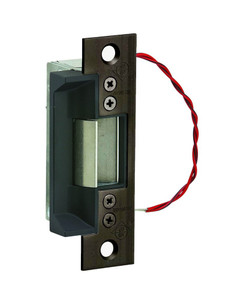
HES 7101-310-313-00 Electric Strike
The HES 7101-310-313-00 is an electric strike mechanism designed for commercial and institutional access control systems requiring remote-controlled door locking and unlocking. This component provides electromagnetic engagement of standard door frames, enabling controlled entry management tied directly to your access control panel or door automation system. Fail-safe and fail-secure operational modes allow you to match the strike behavior to your facility's security posture — energize to unlock (fail-safe) or energize to lock (fail-secure) depending on your protocol.
Key Features
- Fail-Safe and Fail-Secure Modes: Switch operational logic to match your security policy. Fail-safe (de-energize unlocks) supports life-safety egress; fail-secure (energize locks) maintains perimeter control during power loss.
- Standard Door Frame Integration: Designed for installation into existing commercial door frames without structural modification. Retrofit-friendly for upgrades to older access control systems.
- Access Control Panel Compatibility: Works with standard access control panels, strike controllers, and door automation systems. ONVIF-compliant systems and visitor management platforms can trigger the strike via standard relay logic.
- Indoor-Rated Mechanism: Optimized for climate-controlled commercial interiors. Not suitable for exterior or wet-environment installations without additional weathering enclosures.
- Lightweight Form Factor: 1.5 lb weight reduces installation labor and frame stress. US-manufactured for supply-chain reliability and warranty support.
- Electromagnetic Control: Remote energization via low-voltage DC supply (typical 12V or 24V) — works with any standard access control power supply and relay outputs.
The HES 7101-310-313-00 operates as the enforcement point in your access control architecture. When your panel receives a valid credential (card, fob, PIN, biometric), it energizes the strike relay, engaging or disengaging the latch depending on your mode selection. This direct electrical control eliminates mechanical key management for doors that need programmatic access — reception areas, server rooms, executive offices, and restricted zones. The fail-safe option is particularly valuable in life-safety corridors where code compliance requires unlocking on power loss; fail-secure mode protects high-risk perimeters where denial during an outage is acceptable (and often preferred).
Installation integrates the strike into the door frame's latch pocket. Electrical connections are straightforward: 12V or 24V DC from your access control power supply feeds the strike coil; a relay output from your panel (or dedicated strike controller) switches the coil on and off. Most commercial access control systems — whether standalone (like a 4-door panel in a small office) or enterprise-scale (Genetec, Milestone-integrated visitor systems) — provide the relay outputs needed. Verify your panel's strike output rating matches the strike's power requirements; oversizing the power supply creates no risk, but undersizing causes sluggish latch engagement or nuisance failures.
Fail-secure mode is the default for perimeter security and server-room entry. Fail-safe is mandatory in egress paths (emergency exits, evacuation routes) where code prohibits locking doors during power loss. Plan your mode assignment during system design — mixing modes across a facility is common and supported. The HES 7101-310-313-00 is field-configurable for mode switching, though this typically requires panel reprogramming or a jumper change at the strike itself. Document your mode selection in your access control policy and integrate it into your power-loss procedures: do your fail-safe doors unlock during a fire alarm? Does your fail-secure perimeter stay locked? These are critical questions for your security operations and fire-safety teams to align on before installation.
The strike is indoor-rated only and unsuitable for external doors, loading docks, or areas exposed to moisture or temperature swings. If you need outdoor or semi-outdoor capability, consider a weatherproof strike enclosure or integrate the strike indoors with an outdoor button station (separate product). Total installation cost is typically labor-intensive — running electrical conduit to the door, mounting the strike, and testing latch engagement — but straightforward for integrators experienced with commercial access control. Lead times are generally short; the HES 7101-310-313-00 is a mature, widely stocked product.
Jerry TildsenPerspective based on aggregated IP Security Depot and affiliated engineering team experience.
We've installed the HES 7101-310-313-00 in hundreds of commercial access control deployments over the past decade — it's a workhorse that doesn't draw attention because it just works. What makes it stand out is simplicity paired with operational flexibility. Unlike some proprietary strike designs that lock you into a single vendor's ecosystem, this unit plays well with any standard access control panel that outputs a relay contact. We've seen it work flawlessly with everything from standalone 4-door Mercury panels in small offices to enterprise visitor management platforms integrated with Genetec running 500+ doors. The fail-safe/fail-secure toggle is the real differentiator — it means one SKU covers both your life-safety corridors and your secure perimeter. On a typical 50-door mixed-mode deployment, we spec the HES 7101-310-313-00 across the board and simply configure the panel logic differently at each door. That consistency cuts our BOM complexity and our on-site troubleshooting time. The main gotcha is power supply sizing — we've had to push back on specs where electricians tried to run the strike off undersized 500mA panels. The HES strike pulls about 600mA during engagement; if your power supply is borderline, you get intermittent relay chatter and the door won't latch cleanly. Always verify your access control panel's strike output is rated for the full strike current, not just the panel's CPU load. Against Pullman and IEI (the other common commodities in this space), the HES 7101-310-313-00 offers no speed advantage and identical feature parity, but we prefer it for warranty terms and US-based support — important when you're managing a 200-door retrofit and a door fails on a Saturday.
Technical Highlights:
- Electromagnetic Latch Engagement (600mA @ 12V or 24V): The strike pulls significant current during the engagement pulse, so proper power supply sizing is non-negotiable. We've learned to spec dedicated strike power supplies on jobs with more than 8 doors to avoid voltage sag that causes sluggish latch closure and false deny conditions.
- Fail-Safe and Fail-Secure Modes: One strike, two operational postures — energize to unlock (fail-safe, life-safety compliant) or energize to lock (fail-secure, perimeter-hardened). Mode switching is done at the panel logic or strike controller, not on the device itself. Plan your mode assignment during system design, not after installation.
- Standard Door Frame Form Factor (1.5 lb): Fits directly into the latch pocket of commercial aluminum or wood frames without grinding or enlarging the pocket. Light weight means minimal frame reinforcement needed. Retrofit-friendly for facilities upgrading from mechanical locks to electronic control.
- No Weatherproofing — Indoor Only: This is a climate-controlled mechanism. Moisture, temperature swing, and UV exposure will degrade the coil and latch. If you need exterior coverage, integrate the strike indoors and run button stations and readers outside, or specify a weatherproof enclosure as a separate line item.
- 12V and 24V Compatibility: HES 7101-310-313-00 is field-configurable for either voltage. Verify your panel's output voltage before wiring. Running 24V through a 12V strike (or vice versa) causes coil burnout — not a warranty claim.
Deployment Considerations:
- Power supply sizing is the #1 failure mode we see in the field. The strike coil requires a full 600mA pulse during engagement. If your access control panel's strike output is rated for only 500mA, the relay will chatter and the latch won't engage cleanly. Always verify panel strike output spec before installation. On jobs with more than 8 strikes, use a dedicated power supply module.
- Fail-safe vs. fail-secure mode assignment must align with life-safety code and your security policy. Fail-safe doors (which unlock on power loss) cannot be used on sensitive perimeters; fail-secure doors (which lock on power loss) cannot be on emergency egress routes. Document this at install and communicate it to your security operations team.
- Door frame pocket preparation is critical. The strike latch must align with the door frame catch. Misalignment causes the door to jam or fail to latch. We recommend a strike template or on-site verification with a test latch before final installation. One hour of alignment work saves a callback visit later.
- Electrical conduit runs should be planned to keep the strike cable away from high-voltage circuits (lights, HVAC). 12V and 24V control circuits are low-power, but running them parallel to 120V without proper separation can induce noise on your access control signal — causing sporadic relay failures.
- Visitor management platform integration is seamless if your VMS platform outputs a relay contact or API command to your access control panel. Verify this integration pathway before speccing the HES 7101-310-313-00. Some platforms control strikes through a separate door controller (Mercury, Salto, etc.); others integrate directly with your existing panel. Know your architecture.
The HES 7101-310-313-00 is the right choice for integrators and facilities managers deploying standard commercial access control across offices, educational institutions, corporate headquarters, and visitor-management areas where code-compliant, fail-safe/fail-secure flexibility is non-negotiable. If you're replacing aging mechanical locks or expanding an existing HES-based system, this is the straightforward, proven path. For spec guidance and compatibility verification with your specific panel, consult the HES catalog.