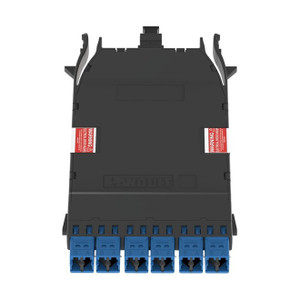
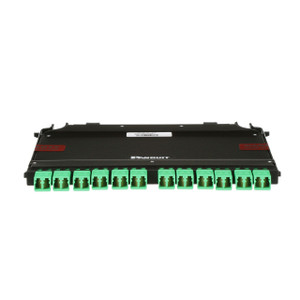
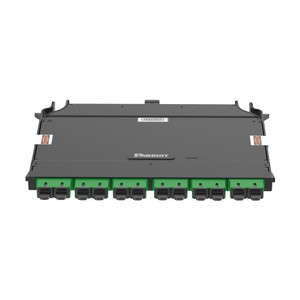
Panduit FHC9N-24-LAU HD Flex Fiber Cassette
The Panduit FHC9N-24-LAU HD Flex™ cassette bridges high-density MPO backbone trunks to individual LC duplex connections in a single-RU footprint, converting two 12-fiber MPO-12 male interfaces to twelve LC/APC duplex ports. Built for OS2 single-mode deployments, this cassette handles 24 fibers with universal polarity, eliminating the need to stock multiple polarity variants and reducing field errors during MAC operations. Standard insertion loss keeps link budgets predictable across 10G, 40G, and 100G applications. The polycarbonate housing fits all Panduit Flex™ enclosures and most third-party high-density chassis that follow the cassette form factor standard, making it a direct-fit solution for datacenter spine-leaf builds, enterprise fiber-to-desk distributions, and carrier-grade access aggregation.
Key Features
- Two MPO-12 male backbone interfaces to twelve LC/APC duplex distribution ports (24 fibers total)
- OS2 single-mode fiber rated for distances up to 10 km at 10G, 40 km at extended reach
- Universal polarity design works with Type A, B, or C trunk configurations
- Standard insertion loss specification (typically ≤0.5 dB per mated pair) for reliable link budget allocation
- Angle-polished connectors (APC) minimize back reflection to <-60 dB, mandatory for high-speed coherent optics
- HD Flex™ cassette form factor fits industry-standard 1-RU enclosures (288-fiber density per rack unit)
- Color-coded ports and laser-etched labeling for rapid circuit identification during adds/moves/changes
- Polycarbonate construction rated for 0–70°C operation in non-climate-controlled telecom spaces
- Factory-terminated and tested—arrives ready to install, no field splicing or polishing
- Ten-unit carton packaging for large datacenter rollouts with consistent lot performance
Datacenter and enterprise network operators deploying 40GBASE-LR4 or 100GBASE-LR4 optics face a common challenge: MPO trunk cables deliver high fiber count efficiently between buildings or floors, but distribution switches and servers still predominantly use duplex LC interfaces. The FHC9N-24-LAU solves this breakout requirement without requiring intermediate patch panels or fusion splicing in the field. Each cassette accepts two 12-fiber MPO trunk connectors on the rear and breaks them out to twelve individually accessible LC duplex ports on the front, maintaining polarity automatically through the internal ribbon-to-discrete-fiber transition. This architecture is especially valuable in leaf-switch deployments where a single 24-fiber MPO trunk from the spine can be split into twelve discrete 10G links without consuming excessive rack space or requiring technicians to manage polarity documentation—universal polarity means the cassette will mate correctly regardless of whether your trunk cables follow Method A, Method B, or Method C pinouts per TIA-604-5 Annex D.
The OS2 single-mode fiber specification is critical for installations where link distances exceed the 300-meter ceiling of OM4 multimode, or where future migration to 100G coherent optics is anticipated. OS2 fiber supports 10GBASE-LR and ER applications up to 40 kilometers, 40GBASE-LR4 up to 10 kilometers, and 100GBASE-LR4 across the same distance, all while maintaining the chromatic dispersion and attenuation characteristics required by IEEE 802.3 standards. The angle-polished connectors (APC, identified by the green boots standard to TIA-598-C) are engineered with an 8-degree endface angle that reflects any return light into the cladding rather than back toward the source—this reduces return loss to below -60 dB, a requirement for dense wavelength-division multiplexing (DWDM) systems and any coherent modulation scheme where even minor reflections can degrade bit-error rates. If you're running standard 10G optics today but plan to overlay DWDM or upgrade to 400G in the next refresh cycle, APC connectors are non-negotiable; trying to mix UPC and APC in the same infrastructure leads to measurable insertion loss at every transition point.
Installation efficiency translates directly to labor cost. A typical 288-fiber distribution frame using individual splice trays and duplex adapters requires 144 discrete LC connector terminations, each needing cleaving, polishing, inspection, and testing—figure 8–10 minutes per connector for a competent tech, or roughly 20 hours of labor per frame. The FHC9N-24-LAU arrives factory-terminated with all 24 fibers pre-polished, pre-tested, and enclosed in a hot-swappable module that installs in under 60 seconds: slide the cassette into the enclosure rails, mate the two rear MPO connectors, verify polarity with a visual fault locator, done. For a 288-fiber build, you're looking at twelve cassettes and roughly 15 minutes of total installation time, cutting field labor by 95% and eliminating the variability introduced by hand terminations. The polycarbonate housing includes integrated strain relief for the internal breakout, so there's no risk of over-bending the 900-micron tight-buffered legs during installation—a common failure mode in field-terminated breakout kits where installers rush the build and don't leave adequate service loops.
The HD Flex™ cassette form factor is designed for Panduit's own FAP™ and FMP™ enclosures, but it also fits the cassette slots in most Corning, CommScope, and Leviton high-density frames due to the de facto standardization of cassette dimensions across the industry. Each cassette occupies one-twelfth of a 1-RU enclosure, so a fully populated 1-RU tray holds twelve cassettes for a total of 288 fibers (144 duplex circuits) in a single rack unit—density that would require three or four RU using traditional splice trays. This vertical density is critical in colocation facilities where rack space is billed per-RU per-month; reducing your fiber distribution from 4-RU to 1-RU saves $300–$600 monthly in typical tier-3 markets. The cassettes are individually removable without disturbing adjacent modules, so MAC operations—adding a new circuit, troubleshooting a bad port, swapping a cassette to change polarity—can happen without taking down entire rows of production links. Just pull the suspect cassette, verify continuity with an OTDR or power meter, swap in a replacement, and you're back online in under two minutes.
Polarity management is where most fiber deployments encounter field failures, especially when mixing trunk types or when documentation lapses during after-hours emergency changes. Traditional polarity schemes (Method A, Method B, Method C per TIA-568.3-D) require matching specific trunk cable types to specific adapter or cassette configurations, and a mismatch means your transmit fiber lands on the far end's transmit port instead of receive—link stays dark, tech spends 45 minutes with a fiber scope trying to figure out what went wrong. The FHC9N-24-LAU uses universal polarity: internal to the cassette, Panduit has designed the fiber mapping so that it auto-corrects for polarity regardless of the trunk type you plug in. This doesn't violate any standards—it's simply a more forgiving internal pinout that handles all three methods without requiring you to order three different SKUs or maintain polarity documentation in your DCIM. For large environments where multiple contractors or shifts are pulling cables, universal polarity is the difference between a clean install and a midnight troubleshooting call.
The FHC9N-24-LAU is engineered for installations where link performance must meet or exceed TIA-568.3-D insertion loss limits and where APC connectors are specified for wavelength-sensitive deployments. It eliminates field termination labor, reduces rack space consumption by 70% compared to traditional splice trays, and accommodates any polarity scheme without requiring tech-level knowledge of TIA-604 pinouts. Typical deployment scenarios include datacenter top-of-rack to end-of-row aggregation (12 server uplinks per cassette), enterprise fiber-to-desk distribution (one cassette per floor serving twelve offices), carrier-grade fiber access nodes (central office MPO trunks broken out to individual subscriber ONTs), and medical or industrial campus networks where single-mode fiber is required for building-to-building spans exceeding 500 meters. Factory test reports included with each cassette provide insertion loss and return loss measurements across all 24 fibers, giving you documented proof of performance for customer acceptance testing or compliance audits per BICSI DCDC or TIA-942 standards.