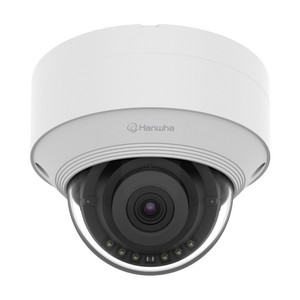
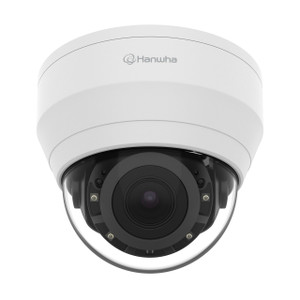
Hanwha QND-C8013R 5MP Indoor AI Dome Camera
The Hanwha QND-C8013R is a 5MP fixed-lens indoor dome designed for commercial facilities that need object detection and business analytics without premium optics or outdoor durability. Built around a 1/2.8-inch CMOS sensor and 3.0mm fixed lens, it delivers 100° horizontal coverage optimized for ceiling-mount deployments in retail floors, office lobbies, warehouse aisles, and access points. The combination of edge-based AI analytics, H.265 compression, and PoE power makes it a cost-effective choice for deployments where behavioral intelligence and operational metrics matter more than high-resolution facial or license-plate capture.
Key Features
- 5MP resolution (2592×1944) at 30fps: Captures enough detail for occupancy and traffic analysis in interior spaces. H.265 encoding cuts storage and bandwidth by roughly 40–50% versus H.264—a measurable win on 24/7 multi-camera systems where network and disk costs compound.
- 3.0mm fixed lens, 100° horizontal FOV: Prioritizes area coverage over long-range identification. Subjects within 5–15 meters are tracked reliably; beyond that, forensic detail drops off. Ideal for interior spaces where people and vehicles pass within arm's length of the camera.
- 120dB WDR (Wide Dynamic Range): Balances exposure when windows, bright signage, or mixed lighting create high-contrast scenes. Prevents blown-out highlights and crushed shadows—critical in retail or lobby environments where sunlight and artificial lighting coexist.
- 25-meter IR range with auto day/night switching: Built-in IR LEDs illuminate unlit storage areas, back rooms, and nighttime corridors without requiring separate lighting. The 25m range covers most interior ceiling-mount applications; if subjects are closer (warehouse aisles, small retail), IR saturation is less of a concern.
- On-camera AI analytics: Person and vehicle detection, line crossing, intrusion, loitering, people counting, queue management, heatmap, and vehicle counting. Processing happens at the edge—metadata (alerts, counts, heatmap coordinates) flows to your NVR or VMS without burdening backend compute. Reduces false-positive spam and enables real-time response to breach events or occupancy thresholds.
- PoE Class 3 (IEEE 802.3af, 8.1W typical): Runs on standard 802.3af PoE without power injectors or separate supplies. Safe to deploy alongside dozens of other PoE devices on a mid-range PoE switch—no capacity headaches.
- Built-in microphone and microSD slot: Captures two-way audio for intercom announcements or access control escalation. microSD card (up to local storage specs per evidence) provides edge-based recording failsafe if network goes down—keep critical footage even during connectivity loss.
- ONVIF compliance with HTTPS encryption: Integrates with standard network video recorders and VMS platforms without vendor lock-in. Encrypted communications protect credentials and video streams.
- Operating range -10°C to +45°C: Suitable for unheated storage, outdoor-adjacent lobbies (vestibules), or climate-controlled retail—but not outdoor-hardened. Skip this if you need all-weather durability; consider a higher IP-rated variant for exposed installations.
Integration & Compatibility
The QND-C8013R connects via standard RJ-45 10/100BASE-T Ethernet. ONVIF Profile S/T conformance ensures compatibility with major NVR platforms and VMS software. Pair it with a PoE-capable network switch and any ONVIF-compliant recording appliance—Milestone XProtect, Genetec, Hikvision iVMS, or open-source platforms like Frigate or Shinobi all support frame ingestion and analytics integration.
Mounting is ceiling-oriented; the compact dome form factor fits standard T-rail and drop-ceiling fixtures. Local microSD backup is independent of network architecture—no special storage configuration required.
When to Choose a Different Model
If subjects routinely stand more than 20 meters away, or if you need to read faces or license plates from across a parking lot, the fixed 3.0mm lens and 5MP pixel density won't deliver. Consider a higher-megapixel variant (such as an 8MP or 12MP model in the Hanwha surveillance line) or a varifocal lens option for adjustable coverage.
For outdoor-exposed applications, outdoor domes with IP66/IP67 ratings are mandatory; this model is indoor-only.
Frequently Asked Questions
Q: What's the maximum effective range for the AI person and vehicle detection?
A: On-camera detection reliably triggers on people and vehicles within approximately 10–15 meters under typical interior lighting. Beyond 25 meters, detection confidence drops. The 5MP resolution and 3.0mm lens trade long-range detail for wide-area coverage—suitable for lobby and retail floor monitoring, not long-distance outdoor surveillance.
Q: Can the QND-C8013R be wall-mounted instead of ceiling-mounted?
A: The dome form factor and compact design support wall mounting with appropriate brackets, though the 100° horizontal FOV is optimized for ceiling placement. Confirm your mounting orientation and confirm field-of-view coverage on-site before installation.
Q: Does the microSD card provide continuous local backup, or is it event-only?
A: microSD functionality supports both continuous and event-triggered recording, depending on your VMS or camera configuration. Consult the manufacturer documentation for your specific firmware version to confirm recording mode options.
Q: Is the QND-C8013R suitable for 24/7 operation in a heated warehouse?
A: Yes. The operating temperature range (-10°C to +45°C) covers heated indoor warehouses and climate-controlled facilities. Outdoor loading docks or unheated storage above 45°C may cause thermal stress—verify ambient conditions before deployment.
Q: What codec selection should I use to balance quality and storage?
A: H.265 is the default recommendation for 24/7 recording. It cuts storage cost roughly in half versus H.264 at comparable quality. H.264 remains available for legacy NVR compatibility. MJPEG is bandwidth-heavy and best reserved for short-clip or on-demand viewing.
Q: Does the camera support ONVIF motion detection, or only the on-board AI analytics?
A: The QND-C8013R provides both on-board AI analytics (person/vehicle detection, line crossing, loitering, etc.) and standard ONVIF motion detection. Choose the algorithm that fits your VMS workflow and incident response requirements.
Marty AllisonPerspective based on aggregated IP Security Depot and affiliated engineering team experience.
The QND-C8013R balances 5MP resolution, on-camera AI enrichment, and operational cost in a compact dome form factor. The 3.0mm fixed lens and 100° FOV prioritize area coverage over forensic identification—ideal for spaces where subjects remain within 5–15 meters (lobbies, retail aisles, warehouse bays). Edge-based AI processing (person/vehicle detection, line crossing, loitering, people counting) reduces backend compute load and storage overhead by filtering and contextualizing video at ingestion time. You get actionable metadata (alert events, occupancy counts, heatmaps) without bloating archive storage.
Technical Highlights:
- H.265 compression at 5MP, 30fps: Roughly 40–50% storage savings versus H.264. On a 24/7 multi-camera deployment (10+ cameras), that's a tangible infrastructure cost reduction. Bandwidth constrained? H.265 keeps pipe utilization reasonable.
- 8.1W PoE Class 3 draw: Safe to deploy 20+ units on a single managed PoE switch without budget overrun. No separate power supplies, no conduit clutter—just Ethernet and mounting.
- 25m IR with 120dB WDR: The IR covers most interior unlit scenarios (back stock, after-hours corridors). WDR preserves detail when mixed lighting hits—windows and fluorescent together—no washout or shadow crush.
- On-device analytics (person/vehicle detection, line crossing, loitering, queue management, people counting, heatmap): Runs at the edge. VMS receives pre-classified events and enriched metadata, not raw 30fps video streams. Cuts false-positive noise and enables real-time alert response without waiting for backend processing.
Deployment Considerations:
- Lens coverage is fixed: 100° horizontal is standard interior dome coverage. Before purchase, physically walk your retail floor, warehouse bay, or office corridor and confirm that field-of-view aligns with your coverage map. A fixed lens means no zoom adjustments post-install—get it right at commissioning.
- AI detection works best at detection distance, not identification: The QND-C8013R flags "person detected at coordinates X,Y at timestamp T." It does not reliably read a face or license plate from across the room. If forensic identification is mandatory, upgrade to a higher-megapixel or longer-focal-length variant.
- Indoor-only temperature envelope: -10°C to +45°C is suitable for climate-controlled retail, offices, and heated warehouses. Unheated loading docks or outdoor vestibules in winter or summer extremes may exceed limits—verify your facility thermal profile.
Best fit: retail operations and warehouse facilities where occupancy trends, queue depth, and area intrusion detection drive operational decisions. Pair with a standard ONVIF NVR and a managed PoE switch, and you have a scalable, cost-effective analytics platform without custom integrations or exotic firmware.