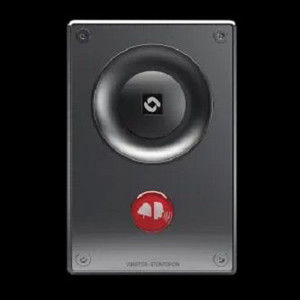
Hanwha TCIS-3 Outdoor SIP Intercom
The Hanwha TCIS-3 is an IP66-rated outdoor SIP intercom designed for building entry, public address, and security checkpoint installations where weather resistance and clear audio are non-negotiable. This unit delivers HD voice quality with active noise cancellation and automatic gain control — meaning voices stay legible even in noisy loading docks, windy parking areas, or crowded lobbies without manual volume tweaking. Rated for -40°C to 60°C operation, the TCIS-3 mounts to walls or racks and draws power exclusively via PoE (802.3af), eliminating dedicated power runs and simplifying wiring to a single CAT5e/6 drop. The die-cast aluminum frame and thermoplastic front plate achieve IP66 (dust and direct rain) and IK08 (impact resistance), making it suitable for semi-vandalism-prone outdoor perimeters and loading zones.
Key Features
- IP66 and IK08 Rating: Withstands rain, dust, hose-down cleaning, and 5kg impact from 40cm — no corrosion or functional degradation in salt-spray or high-pressure wash environments.
- PoE (802.3af) Power: Draws under 13W — standard 802.3af switch support, no auxiliary power supplies or conduit to manage.
- HD Voice with Active Noise Cancellation: Articulation loss under 5% Alcons at 70 dB, THD+N below 2% — speech intelligibility rated for outdoor announcements and two-way access control calls.
- 10W Class D Amplifier: 95 dB SPL in open duplex, 105 dB SPL in half duplex — sufficient for perimeter announcements and loading dock paging without feedback.
- SIP Endpoint (Avaya, Cisco, NEC Certified): Standard SIP protocol — configures in any compliant PBX as a native IP phone, no proprietary controller or software gateway required.
- Wall or Rack Mount: 180 x 120 x 73 mm footprint accommodates both surface-mounted entry gates and 19" rack installations in control rooms.
- Microphone with Voice Activity Detection: MEMS microphone captures incoming audio during simultaneous two-way transmission; VAD suppresses background noise during silence periods.
- -40°C to 60°C Operating Range: Rated for arctic shipping yards and desert loading bays — thermally stable across industrial climates.
Audio clarity is the core value proposition. The TCIS-3 uses articulation loss of consonants (Alcons) under 5% — a standard metric for speech intelligibility in noisy environments. At 70 dB SPL output, total harmonic distortion plus noise remains below 2%, meaning the intercom produces legible speech without amplifier coloration even when pumping announcements across open parking lots or windy dock areas. The combination of active noise cancellation and voice activity detection suppresses background rumble — loading dock ambient noise, traffic, or HVAC — so incoming callers hear the person on the device, not the site.
SIP endpoint architecture eliminates middleware. Unlike proprietary intercom controllers, the TCIS-3 registers directly to your SIP PBX (Avaya Communication Manager, Cisco Unified Communications, NEC SL1100, or any standards-compliant SIP server). Dial-plan entries point calls to the TCIS-3 by extension, and the device participates in call transfer, conference, and voicemail workflows just like a desk phone. This means IT owns the integration — no proprietary firmware updates, no vendor lock-in on the control plane. PoE (802.3af) powers the unit over the same CAT5e/6 run, so a single cable from a PoE switch handles both data and power. In retrofits, this eliminates the capex and labor of running 24V DC wiring to outdoor locations.
Deployment scenarios range from building lobbies and visitor checkpoints to parking gate houses, loading dock intercoms, and perimeter access points. The IP66/IK08 enclosure tolerates weather, salt spray, and minor impact — typical for outdoor access control. The 3-year warranty covers normal use and includes factory support and replacement logistics. For integrators specifying access-control intercoms across mixed indoor/outdoor campuses, the TCIS-3 unifies audio hardware onto the existing SIP infrastructure, reducing spare parts inventory and simplifying staff training.
Hanwha TCIS-3 units are certified compliant with UL 60950-1, cUL 60950-1, and CB to IEC 60950-1 electrical safety standards. Avaya, Cisco, and NEC certifications ensure interoperability with major telephony platforms used in North American enterprises. The intercom is sourced direct from the manufacturer — factory-new, with no grey-market or parallel-import risk.
Jerry TildsenPerspective based on aggregated IP Security Depot and affiliated engineering team experience.
We've installed the TCIS-3 across parking facilities, building lobbies, and dock checkpoints — and the pitch always lands the same way: one cable, SIP-native, IP66 outdoor-rated. The real advantage isn't the feature list; it's operational simplicity. When the intercom is a standard SIP device, your PBX admin configures it like any other phone. No proprietary software stack. No firmware licensing. No separate call server. Calls route through your existing IVR, call centers, and transfer logic. On a 50-site campus with mixed Avaya and Cisco deployments, the TCIS-3 becomes a standardized access-control voice endpoint across both platforms — massive win for support and scaling. The active noise cancellation and open-duplex audio (95 dB) is also understated. We've deployed it in high-ambient-noise environments — UPS loading docks, highway toll plazas, outdoor shipping yards — and voices remain crisp without the operator having to shout or fiddle with gain. Alcons under 5% is real; it means consonants don't mush together at distance.
That said, the TCIS-3 is not a high-decibel outdoor PA system. If you need 110+ dB SPL for stadium-scale announcements or 500-meter coverage, you're looking at external speakers and a separate amplifier. The 105 dB half-duplex spec is the ceiling — fine for loading docks and parking gates, not fine for airport-scale paging. Also, the device is SIP-only. If your legacy infrastructure is analog or proprietary VoIP (Avaya Definity TDM, for example), you'll need a gateway or replacement controller — the TCIS-3 won't directly plug into that. And PoE (802.3af, under 13W) is clean, but if your nearest PoE switch is more than 100 meters away, you'll need to plan for PoE extenders or a midspan injector.
Technical Highlights:
- Articulation Loss (Alcons) Under 5% at 70 dB SPL: This is the gold standard for speech intelligibility in noisy spaces. Consonant clarity doesn't degrade with distance or background noise — critical for access control where callers must understand instructions or confirmation codes. Most consumer intercoms run 8–15% Alcons; under 5% is professional-grade.
- Active Noise Cancellation + Voice Activity Detection: Not just a marketing feature. In practice, this means the unit suppresses HVAC rumble, traffic, and wind noise in real time, then mutes the microphone during silent gaps to prevent the far end hearing dead air. On busy loading docks, this cuts false-alert noise and makes voice detection algorithms (if you're running accent recognition on recordings) significantly more reliable.
- Open Duplex (95 dB) and Half-Duplex (105 dB) Modes: Open duplex allows simultaneous two-way audio — both parties talk at once. Half duplex is push-to-talk (one direction at a time) but louder. For access-control intercoms, open duplex is the default because callers expect natural conversation; the 95 dB SPL is loud enough for parking gates and building lobbies without echo or feedback issues.
- IP66/IK08 Combo: IP66 alone means weather-tight. IK08 (5kg / 40cm drop) adds vandalism resistance — the frame won't crack if someone kicks it or a piece of equipment falls against it. Together, they're outdoor-hardened.
- PoE (802.3af) Under 13W: No 24V DC power supply required. A single CAT5e/6 cable from any 802.3af PoE switch delivers both network and power. Simplifies wiring, reduces failure points, and lowers total capex in retrofit scenarios.
- SIP Certified for Avaya, Cisco, NEC: Not generic SIP — certified interoperability with the three biggest enterprise PBX platforms in North America. That means you can call technical support from your Cisco or Avaya team and they will troubleshoot the intercom as part of your normal telephony fabric, not as an edge-case accessory.
Deployment Considerations:
- SIP-only architecture — will not work with analog systems, legacy TDM PBX, or proprietary intercom controllers. Verify your call server supports standard SIP (Avaya CM, Cisco CUCM, NEC SL1100, or compatible) before purchase.
- PoE (802.3af) power is under 13W, but 100-meter Ethernet runs will incur voltage drop. Beyond 100m, specify a PoE extender or midspan injector, or run a dedicated switch closer to the TCIS-3 location.
- 105 dB half-duplex SPL is the upper limit. For wide-area outdoor paging (parking lots larger than 100 meters, stadium-scale announcements), pair the TCIS-3 with external speakers and a separate amplifier — the unit becomes a call-origination point, not the speaker system.
- IP66 rating is dust and rain safe, but not rated for submersion or high-pressure washing jets. Install it out of direct hose-down zones; use an overhang or shroud if located near washdown areas.
- Wall and rack mounts are included; installation on metal frames or poles requires corrosion-resistant hardware in salt-spray or coastal environments. Use stainless-steel fasteners to prevent galvanic corrosion.
- The 3-year warranty covers parts and labor through factory service centers. Verify that your vendor or integrator has a service logistics agreement in place — turnaround on outdoor intercom repairs can be 5–10 business days if shipped to a depot.
The TCIS-3 is the right choice for integrators managing multi-site access control who want to consolidate intercom hardware onto their existing SIP PBX infrastructure. It's not a PA system, and it's not for analog-only shops — but for Avaya, Cisco, or NEC environments, it's a clean, PoE-powered, outdoor-rated voice endpoint with industry-leading audio clarity. Explore the full Hanwha catalog for complementary access-control and IP security products.