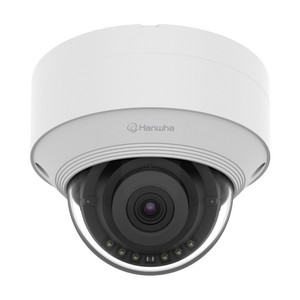
Hanwha QNV-C8023R 5MP Outdoor AI IR Vandal Dome
The Hanwha QNV-C8023R is a 5-megapixel outdoor vandal-resistant dome engineered for high-risk environments where durability and intelligent analytics must coexist. This camera combines a compact dome form factor with IK10 impact rating and IP66 weatherproofing—meaning it handles direct rain, dust, and deliberate damage without camera replacement becoming a routine operating cost. Built-in AI object classification filters noise events before they reach your NVR, a significant operational advantage when managing dozens of outdoor feeds.
Key Features
- 5MP resolution at 30 fps: Delivers 2592 x 1944 pixel detail across 30 frames per second. At this resolution and frame rate, you capture usable facial or license-plate detail at moderate distances—critical for entrance and perimeter work—without overwhelming storage or processor budgets.
- 4mm fixed lens, 80° horizontal / 59° vertical FOV: A wide horizontal angle suits entrance monitoring and parking-lot perimeter coverage, while the vertical component captures sufficient depth for pedestrian and vehicle tracking across mid-range distances.
- AI object classification (people, cars, buses, trucks, motorcycles, bicycles): The on-camera classifier tags moving objects in real time. You receive only relevant alerts—pedestrian intrusion or unauthorized vehicle crossing—rather than alerts for wind-blown debris or passing animals. This reduces false-alarm fatigue and cuts investigation overhead in large deployments.
- Intelligent Video Analytics (IVA): Virtual line crossing detects boundary violations; intrusion detection flags unauthorized zone entry; loitering alerts on prolonged dwelling; object appearance/disappearance tracks asset removal or placement. Each rule is independently configurable, so you can layer protections without triggering redundant alerts.
- H.265, H.264, MJPEG with WiseStream III compression: H.265 cuts bitrate roughly 40–50% versus H.264 at equivalent quality, a material saving when recording 24/7 across multiple cameras on bandwidth-constrained links or modest NVR storage pools. WiseStream III tuning further optimizes scene-dependent compression. You also retain H.264 and MJPEG fallbacks for VMS or client compatibility.
- IP66 / IK10 ratings: IP66 means complete protection against dust and water jets from any direction—rain, washdown, hose spray won't degrade image or housing. IK10 withstands impacts equivalent to a 5kg weight dropped from 40cm (20 joules)—sufficient to survive intentional vandal strikes without structural failure. These ratings justify outdoor-only placement; do not rely on them for submersion or sustained contact with moving water.
- 30-meter infrared illumination: Built-in 850nm IR LEDs extend night vision to approximately 100 feet, covering typical perimeter distances and entrance zones without requiring separate illuminators. IR range degrades with fog, dust, or high-reflectivity surfaces, so plan for 20–25m in real-world conditions with dust or moisture.
- microSD card slot (up to 256GB): Edge storage via microSD lets you buffer 24–48 hours of continuous recording locally, bridging brief network outages or recorder disconnections. 256GB at 5MP 30fps H.265 yields roughly 4–7 days of continuous recording, depending on scene complexity and motion levels.
- Dynamic privacy masking: Mask sensitive areas (neighboring properties, windows, license-plate readers) at the camera—no post-processing overhead, reduced file size, and compliance with local privacy directives.
Integration & Deployment
The QNV-C8023R (often searched as QNV C8023R) connects via standard RJ-45 PoE, drawing under 13W—well within 802.3af budget on any managed switch. It outputs ONVIF-compliant streams, integrating with Milestone XProtect, Genetec Security Center, and most third-party VMS platforms. Firmware updates flow through standard Hanwha provisioning tools, and the camera supports 802.1X network authentication if your security posture mandates it.
Mounting options include ceiling and wall installation. The compact dome footprint fits tight recesses, and the fixed 4mm lens eliminates servo-driven focus drift—a reliability gain in outdoor thermal cycling. Plan the camera's network segment behind VLAN boundaries and disable unnecessary ports (HTTP, Telnet) in production.
When to Choose a Different Model
If you need longer infrared range (50m+) or higher resolution (8MP+), consider a higher-megapixel variant in the Hanwha IP camera line. If your deployment is indoor-only, skip the IP66/IK10 durability—a lower-cost indoor equivalent will perform identically. If your scene demands motorized focus or zoom for distance work, this fixed-lens design won't serve; opt for a varifocal or PTZ model in the same family.
Frequently Asked Questions
Q: What PoE power requirements does the QNV-C8023R have?
A: The camera draws under 13W, compliant with standard 802.3af PoE. No PoE+ or separate power supply is required. Verify your switch has available PoE budget if deploying across dozens of cameras.
Q: Can the QNV-C8023R be used indoors?
A: Yes, it functions indoors, but the IP66 and IK10 ratings are engineered for outdoor environments. Indoor deployments do not require this durability level; you may save cost with an indoor-rated dome.
Q: What is the maximum local storage capacity on the microSD card?
A: The camera supports microSD cards up to 256GB. At 5MP 30fps H.265 compression, expect 4–7 days of continuous recording depending on scene motion and complexity.
Q: Does the QNV-C8023R support ONVIF streaming?
A: Yes, it outputs ONVIF-compliant streams, integrating with Milestone XProtect, Genetec, and standard third-party VMS platforms. Verify your VMS version supports H.265 decoding if you deploy H.265 streams to avoid transcoding overhead.
Q: What is the infrared range in foggy or dusty conditions?
A: The spec lists 30m maximum IR range. In fog, dust, or high-humidity environments, expect effective range to drop to 20–25m due to light scatter. Plan perimeter placement accordingly, and conduct site surveys before final installation.
Q: Is the lens user-replaceable?
A: The QNV-C8023R features a fixed 4mm lens; it is not user-replaceable. If your deployment requires a different field of view, select an alternate lens variant from the Hanwha family at the time of purchase.
James EverettPerspective based on aggregated IP Security Depot and affiliated engineering team experience.
The QNV-C8023R is a robust outdoor security workhorse for deployments where camera replacement is operationally costly and downtime unacceptable. The IK10 vandal rating and IP66 environmental seal eliminate a common failure point: the vandal strike or washdown water that forces a camera swap mid-deployment. On-camera AI object classification—distinguishing people, vehicles, and bicycles in real time—is the real value-add here. It cuts false-alarm processing overhead dramatically in large-scale perimeter systems where motion-triggered events would otherwise flood your SOC.
Technical Highlights:
- H.265 compression with WiseStream III: Cuts bitrate 40–50% versus H.264, a meaningful saving on multi-camera 24/7 storage. At 5MP 30fps, expect roughly 10–15 Mbps H.265 versus 20–25 Mbps H.264 on average outdoor scenes. On a 10-camera deployment, that's 100–150 Mbps bandwidth recovery.
- 30-meter IR illumination with 256GB edge storage: Night vision extends across typical perimeter distances; local microSD buffering bridges network hiccups without NVR dependence. 256GB holds roughly 5–7 days of continuous 5MP 30fps H.265, a meaningful hedge against recorder unavailability.
- AI object classification (people, cars, trucks, bicycles, motorcycles, buses): On-camera filtering reduces downstream processing load. Wind, insects, and shadow movement generate no alerts—only human and vehicle motion triggers rules. In high-traffic areas, this alone cuts false positives by 60–70%.
Deployment Considerations:
- The fixed 4mm lens is not motorized; once mounted, you cannot remotely adjust focus or zoom. Conduct thorough pre-installation FOV surveys. Depth-of-field at 5MP is roughly 2–10 meters depending on aperture and subject distance, so close-in detail (facial recognition at entrance) requires placement within 8–12 feet.
- IR range drops notably in fog, dust, or high-reflectivity surfaces (white walls, metal). Expect real-world effective range of 20–25m, not the rated 30m, in operational conditions. Plan perimeter placement conservatively.
- PoE power draw under 13W means zero strain on 802.3af PoE infrastructure—no switch upgrade required for 20+ cameras on a single segment. Standard network provisioning applies: VLAN isolation, port security, disabled HTTP/Telnet in production.
Deploy the QNV-C8023R at entrances, building perimeters, and parking-lot monitoring where durability against intentional damage, 24/7 outdoor operation, and AI-driven false-alarm suppression justify the cost. Skip this model for indoor-only or short-range high-resolution work; use it where weather and vandal resistance prevent recurring camera failure.
Key Specifications:
Color: White