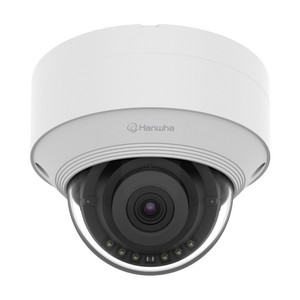
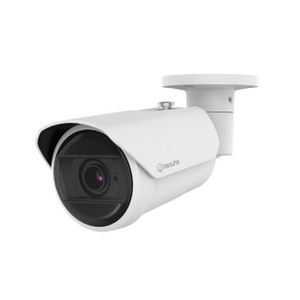
Hanwha QNO-C8013R 5MP Outdoor AI IR Bullet Camera
The Hanwha QNO-C8013R is a 5MP outdoor bullet-style IP camera engineered for intelligent perimeter security in demanding environments. This camera combines on-board AI object classification, robust weatherproofing, and low-light performance into a single PoE device, making it practical for unattended installations where network bandwidth and storage cost matter.
Key Features & Deployment Benefits
- 5MP resolution (2592 × 1944 pixels) at 30fps: Delivers enough detail to identify people and vehicles from 25–40 feet under daylight conditions. Useful for parking lots, access gates, and warehouse perimeter zones where forensic identification is part of the security baseline.
- Fixed 3.6mm lens with 100° horizontal field of view: Strikes a practical middle ground — wide enough to cover a parking space or loading dock entrance without requiring pan-tilt, yet tight enough to retain meaningful facial and license-plate detail. Simpler to aim and maintain than a varifocal.
- AI object classification (people, vehicles, cars, buses, trucks, motorcycles, bicycles): Runs on the camera itself, not on a backend AI service. This means you can create intrusion or line-crossing alerts without streaming video to a cloud or central analytics appliance. Reduces false alarms by distinguishing vehicle types, which cuts alert fatigue on large deployments.
- H.265, H.264, and MJPEG codec support with WiseStream III compression: H.265 cuts file size roughly in half compared to H.264 at equivalent quality — a material factor when recording 24/7 on a 256GB SD card or NVR. WiseStream III further optimizes bit rate during low-motion scenes (parking lot at 2 AM) without visible quality loss. Switch codecs on the fly depending on network conditions or storage constraints.
- 120dB Wide Dynamic Range (WDR) and WiseNR II noise reduction: WDR handles backlit scenarios (person entering a garage bay with bright exterior behind them) where you'd otherwise lose detail in shadow areas. WiseNR II applies intelligent noise filtering in low-light, preserving edge sharpness where standard smoothing algorithms blur important detail. Together, these extend usable coverage from sunset through predawn hours without relying solely on IR.
- IR LED night vision up to 25m (82 ft): Adequate for mid-range outdoor monitoring. At 25m, expect person-sized targets in the frame with reasonable contrast; fine for detection, marginal for detailed facial work. Infrared falls off with distance, so factor layout when planning camera placement.
- IP66-rated weatherproof housing with IK10 vandal resistance: IP66 means direct rain and spray won't intrude — appropriate for open-air installations. IK10 resists hammer and crowbar attack to a meaningful degree, reducing risk of smash-and-grab lens damage in accessible outdoor locations. Not intended for full submersion (that requires IP67 or higher).
- Intelligent Video Analytics (IVA) with configurable detection zones: Allows you to draw intrusion perimeters, loitering thresholds, and line-crossing rules directly in the camera UI or via management software. Alerts trigger locally; you're not counting on a network link to a VMS to detect trespass. Practical for remote or disconnected sites.
- Edge storage via SD card slot (up to 256GB): Provides local recording buffer when your NVR is down for maintenance or the network link fails. A 256GB card at H.265 quality typically holds 3–5 days of 24/7 single-camera footage, depending on scene motion. Reduces single-point-of-failure risk on critical perimeter zones.
- PoE power (802.3af) with -30°C to +55°C operating range: Draws under 13W, so standard 802.3af PoE will power it — no separate PSU required. Temperature range covers most North American outdoor deployments; extreme cold (below -30°C) or desert heat (above +55°C) may degrade IR performance or require ventilation.
- Selectable audio input (mic in / line in) and USB interface: Enables two-way talk-back in security scenarios or local voice annotation. USB simplifies setup and firmware updates without network dependency.
Integration & Compatibility
The QNO-C8013R supports ONVIF Profile S compliance, making it compatible with mainstream network video recorders and open-platform management systems. Triple codec support (H.265, H.264, MJPEG) ensures you won't hit bitrate bottlenecks even on older switches or constrained WAN links. Edge-based analytics mean you can deploy the camera without requiring surveillance management software on the backend — useful for modular, site-by-site installations where centralized VMS complexity isn't justified.
When to Choose a Different Model
If your deployment requires 360° coverage or tracking movement across a wide area, a PTZ or panoramic variant will serve better. If facial detail at 60+ feet is non-negotiable, consider a higher-megapixel variant in the Hanwha IP camera lineup. For indoor-only warehouse environments with stable lighting, a fixed-dome or turret without IR may be more cost-effective.
Ideal Deployment Scenarios
- Parking lot perimeter and vehicle access gates
- Building entry and loading dock surveillance
- Industrial facility and warehouse exterior monitoring
- Traffic observation and intersection recording
- Outdoor intrusion detection with zone-based rules
Frequently Asked Questions
Q: What's the maximum IR range on the QNO-C8013R?
A: The camera delivers IR illumination up to 25 meters (82 feet). At that distance, expect a person-sized target visible in the frame with reasonable contrast suitable for detection. IR effectiveness decreases with distance and is affected by fog, rain, and reflective surfaces.
Q: Does the QNO-C8013R support ONVIF?
A: Yes. The camera complies with ONVIF Profile S, allowing integration with most mainstream network video recorders and open-platform management systems without proprietary software.
Q: Can I use the QNO-C8013R in high-contrast backlit environments?
A: Yes. The 120dB Wide Dynamic Range (WDR) is designed specifically for high-contrast scenes where a bright background (exterior daylight) competes with shadowed foreground (a person entering a garage). WDR recovers detail in both bright and dark areas simultaneously.
Q: How much power does the QNO-C8013R draw, and will standard PoE power it?
A: The camera draws under 13 watts and is powered by standard 802.3af PoE. No separate power supply is required, and it won't strain a typical PoE switch's power budget.
Q: Can I record locally on the QNO-C8013R if my network goes down?
A: Yes. The camera includes an SD card slot supporting up to 256GB. You can configure local recording as a backup buffer; at H.265 quality, a 256GB card typically holds 3–5 days of 24/7 footage depending on scene complexity.
Q: What's the field of view with the 3.6mm lens?
A: The fixed 3.6mm lens provides a 100° horizontal field of view. This is wide enough for mid-range perimeter coverage (a parking space, loading dock, or building entrance) without requiring pan-tilt adjustment.
James EverettPerspective based on aggregated IP Security Depot and affiliated engineering team experience.
The QNO-C8013R represents Hanwha's pragmatic approach to edge-based surveillance: put intelligence on the camera, keep the network link lightweight, and let WiseStream III handle bandwidth constraint without sacrificing image quality. The dual strength here is embedded AI object classification — distinguishing vehicles by type, people from shadows — combined with proven low-light and WDR performance that lets you recover detail in conditions where cheaper fixed-profile cameras fade to noise.
Technical Highlights:
- H.265 codec with WiseStream III: Cuts bitrate 40–60% versus H.264 depending on scene complexity. On a 256GB SD card, that translates to 3–5 days of 24/7 retention instead of 1–2 days — material when you're justifying edge storage cost on a large fleet.
- 120dB WDR + WiseNR II: The combination handles legitimate high-contrast scenarios (backlit entry points, reflective surfaces, bright sky) without washing out shadow detail, and reduces chroma noise in low-light without over-smoothing edges. Real-world difference: usable footage from 5 AM through 10 PM without relying solely on IR.
- Fixed 3.6mm lens with 100° FOV: Deliberate optical choice: avoids the cost and alignment headache of varifocals, yet delivers enough horizontal coverage for a single parking bay or loading dock entrance with room for approach detail. Not wide-angle (would blur plates), not narrow (would require multiple cameras).
- On-camera IVA with zone-based rules: Intrusion, loitering, line-crossing alerts fire locally. You're not streaming raw video to a backend AI appliance or relying on cloud connectivity to detect trespass. Practical for remote sites or disconnected perimeters.
Deployment Considerations:
- IR falloff at distance: 25m is nominal range; at that distance, expect person detection but not detailed facial recognition. Fog, rain, and nighttime dew reduce effective range further. If your deployment requires license-plate detail at 30+ meters in low light, consider tighter lens or higher megapixel variant.
- IP66, not IP67: Direct spray and heavy rain are fine; full submersion (roof gutter, flood-prone area) is not. Similarly, IK10 vandal rating resists hammer strikes but won't survive direct firearm impact or deliberate shotgun damage.
- SD card retention planning: A 256GB card holds roughly 3–5 days of H.265 footage. For 24/7 retention beyond that window, you still need an NVR or cloud archive. SD card is a contingency buffer, not a primary store.
Position the QNO-C8013R (often searched as QNO C8013R) for mid-range outdoor perimeter work where intelligent motion classification and codec efficiency matter more than extreme zoom or submersion-rated durability. Parking lot access gates, warehouse loading docks, and industrial facility entries are the sweet spot — fixed coverage, stable mounting points, and enough light variation to justify WDR and low-light processing.
Key Specifications:
Color: White