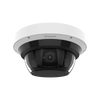
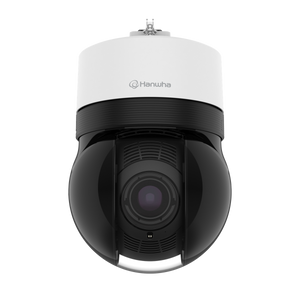
Hanwha PNM-C16083RQZ 4MP Quad-Sensor Outdoor AI IR PTZ Camera
The Hanwha PNM-C16083RQZ is a multi-sensor surveillance camera built for environments where a single optical axis isn't enough. Four independent 4MP sensors, each with its own motorized 3.2–10.2mm varifocal lens and full pan-tilt-rotate-zoom (PTRZ) control, deliver simultaneous coverage across four directional zones. This quad-sensor design eliminates the mechanical blind spots and slew-rate delays inherent in single-sensor PTZ systems—each lens adjusts independently, so you can monitor an intersection, perimeter fence, and parking lot at the same time without rotating a single mechanical platform.
Key Features
- Quad 4MP sensors with independent PTRZ: Four parallel 4MP image streams, each with motorized varifocal lenses and full pan-tilt-rotate-zoom control. Eliminates the coverage gaps and rotational delays of conventional single-sensor PTZ cameras.
- Motorized varifocal lenses (3.2–10.2mm): Field-adjustable focal length on all four sensors means you can tighten or widen coverage post-deployment without repositioning the camera body or opening the housing. Saves time during integration and reduces callbacks.
- 120dB wide dynamic range (WDR): Balances bright and dark areas in a single frame—critical at loading docks where afternoon sun and indoor shadows coexist, or on warehouse floors with reflective surfaces and deep recesses. Prevents washout and detail loss.
- H.265 compression with WiseStream II: H.265 cuts encoded bitrate roughly 40–60% compared to H.264 on the same scene complexity. On a 24/7 multi-sensor system, that translates to measurable storage savings and lower network bandwidth demand per stream.
- 30fps full-resolution video: All four 4MP streams deliver 30fps simultaneously, supporting smooth motion in high-traffic areas and reducing motion blur during evidence review.
- IR illumination with AI auto-shutter: Built-in 850nm IR with AI-based exposure control prevents overexposure of nearby objects when IR fires, maintaining detail across the illuminated zone while managing backscatter.
- AI-powered analytics: Motion detection, virtual area monitoring, defocus detection, and tampering alarms run on-device, reducing false positives and alerting operators only to actionable events. Optional sound classification via external I/O box extends sensing beyond video.
- WiseNR II noise reduction and hallway view: Grain suppression in low-light scenes; hallway view support optimizes framing for narrow corridors or linear monitoring zones.
- IP66 weatherproof, IK10 vandal-resistant, NEMA 4X stainless steel: Direct rain and hose-down rated. Impact-resistant to 20J. Salt-spray corrosion protection for coastal or chemical-wash environments.
- TPM 2.0 with FIPS 140-2 Level 2 certification: Cryptographic module on-device prevents unauthorized firmware modification and secures stored credentials. Meets federal security baseline for critical infrastructure.
- Triple codec support (H.265, H.264, MJPEG): Flexibility to choose compression per stream based on VMS capability or bandwidth constraints without replacing hardware.
Integration & Compatibility
The PNM-C16083RQZ integrates via standard ONVIF Profile S and is compatible with IP camera management platforms supporting multi-stream RTSP ingestion. Quad-sensor cameras impose higher backend processing load than single-sensor models—confirm your NVR or recording appliance can handle four simultaneous 4MP streams at 30fps before deployment. Power draw peaks around 40W; verify your PoE switch has sufficient budget per port and total chassis power.
When to Choose a Different Model
If perimeter coverage can be satisfied by sequential PTZ panning (where zones are monitored one at a time), a single-sensor Hanwha PTZ variant with 40x or 50x zoom may be more cost-efficient. If only one fixed directional view is required, consider a fixed-lens Wisenet P series outdoor camera to reduce complexity and power draw. Quad-sensor value emerges in deployments requiring simultaneous multi-zone coverage: traffic intersections, utility substations, airport perimeter fence runs, or warehouse loading docks where blind rotation is operationally unacceptable.
Frequently Asked Questions
Q: Does the PNM-C16083RQZ support remote focus and zoom adjustment?
A: Yes. All four motorized varifocal lenses can be adjusted remotely via the camera's web interface or ONVIF-compatible VMS. Pan, tilt, and rotation are also network-controllable per sensor.
Q: What is the IR range on the PNM-C16083RQZ?
A: Infrared illumination range depends on reflectance and lens focal length; the datasheet specifies performance at key focal lengths. Check the product PDF for precise range tables at 3.2mm, 6.4mm, and 10.2mm.
Q: Can I record all four 4MP streams simultaneously on a standard NVR?
A: Yes, but confirm the NVR supports at least four concurrent 4MP streams at 30fps. High-end 8-channel and 16-channel recorders handle this; entry-level 4-channel models may not. Total throughput is roughly 480 Mbps uncompressed per camera before H.265 compression is applied.
Q: Is the PNM-C16083RQZ NDAA Section 889 compliant?
A: Hanwha is a South Korean manufacturer. Check the procurement classification or statement of origin required by your compliance officer; some federal contracts may restrict or flag non-US equipment regardless of technical merit.
Q: What is the warranty on the PNM-C16083RQZ?
A: Warranty terms vary by region and channel. Contact the OEM or specialty distributor for warranty duration and coverage specifics.
Q: Does the camera support two-way audio?
A: The PNM-C16083RQZ supports optional audio input and output via external connectors; onboard speaker and microphone are not built-in. Refer to the IO specifications in the product datasheet for audio interface details.
James EverettPerspective based on aggregated IP Security Depot and affiliated engineering team experience.
The quad-sensor architecture of the PNM-C16083RQZ is the core differentiator. Single-sensor PTZ cameras rotate to cover multiple zones sequentially; the PNM-C16083RQZ monitors four zones in parallel. Each of the four 4MP sensors carries its own motorized 3.2–10.2mm varifocal lens and independent PTRZ control—meaning you can zoom in on an access gate while simultaneously tracking motion across a loading dock and monitoring a perimeter fence. On paper, that's a lot of processing; in practice, it eliminates the coverage gaps and mechanical latency that plague conventional PTZ deployments at high-traffic intersections or utility substations.
Technical Highlights:
- 120dB WDR across all four streams: Balances exposure in extreme contrast scenarios—parking lots with sunlit pavement and dark building shadows, or warehouse aisles with reflective concrete and under-eave recesses. Without 120dB WDR, you either blow out the bright zone or lose detail in shadow; with it, you preserve evidence across both.
- H.265 codec with WiseStream II: 40–60% bitrate reduction versus H.264 translates directly to storage efficiency at scale. On a quad-sensor system recording 24/7, that's a measurable operational cost—less storage needed per day, lower network congestion, and reduced transcoding burden on archive servers.
- TPM 2.0 + FIPS 140-2 Level 2: On-device cryptographic attestation prevents firmware tampering and protects credential storage. Critical for systems monitoring government facilities, utilities, or financial infrastructure where firmware integrity audits are mandatory.
- AI-powered defocus and tampering detection: Alerts you to lens obscuration or misalignment without human review, reducing false negatives and protecting against passive lens obstructions (dust, spider webs, deliberate covering).
Deployment Considerations:
- Backend infrastructure must handle four concurrent 4MP streams; entry-level 4-channel NVRs often cannot. Confirm decoder and storage before procurement.
- Quad-sensor power draw (~40W peak) exceeds single-sensor alternatives; verify PoE supply headroom and port availability on your distribution switch.
- Field adjustment of four independent varifocal lenses is convenient but requires integrator familiarity with PTRZ configuration. Misalignment of one sensor relative to the others is visually obvious and takes time to correct.
Deploy the PNM-C16083RQZ at transportation hubs, utility perimeter fences, and warehouse loading zones where simultaneous multi-directional monitoring is non-negotiable. The quad-sensor design and WDR capability shine in high-contrast outdoor environments where evidence integrity is the primary metric.