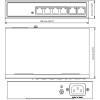
Geovision 140-POE0410-E00 4-Port PoE+ Network Switch
The Geovision 140-POE0410-E00 is a dedicated PoE+ network switch designed to power and network IP PTZ cameras and compatible surveillance devices over single Ethernet runs. Built with Arctic-grade construction for outdoor and harsh-environment resilience, this 4-port switch eliminates the capex and installation complexity of deploying separate power supplies at remote camera locations — consolidating power delivery and data transport into a single infrastructure thread.
Key Features
- PoE+ (802.3at) Power Delivery: 95W total budget across 4 ports (~24W per port). Sufficient for pan-tilt-zoom cameras with motorized lens and heater modules without auxiliary power injection.
- Arctic-Grade Thermal & Environmental Design: Extended operating temperature range and sealed construction withstand condensation, salt spray, and thermal cycling common in outdoor and industrial deployments.
- 4 Ethernet Ports (RJ45): Each port independently managed; all four ports simultaneously active for true multi-camera power delivery — no port sharing or time-division multiplexing.
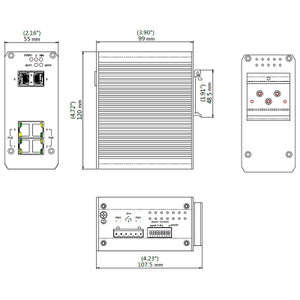
- Compact Form Factor: DIN-rail or wall-mount footprint reduces space requirements in equipment racks, pole-mount enclosures, or junction boxes near camera clusters.
- Plug-and-Play Deployment: No configuration required — standard Ethernet passthrough with integrated PoE injection. Works with any ONVIF-compliant IP PTZ camera and network devices rated for 802.3at input.
- Passive Design (No Active Switching/VLAN): Unmanaged topology — all four ports exist on the same network segment. No configuration UI, no firmware updates, no single points of software failure.
- Redundant Power Input: Dual power connectors allow N+1 redundancy or failover in critical perimeter applications without switch downtime.
The 140-POE0410-E00 is purpose-built for outdoor and industrial surveillance clusters where multiple PTZ cameras must be powered and networked from a single backbone connection. Unlike desktop-grade PoE switches, the Arctic construction handles temperature extremes, moisture, and vibration without thermal throttling or port degradation. The unmanaged architecture eliminates configuration overhead — particularly valuable in distributed sites where IT staff are unavailable for day-two management. Total power budget (95W across 4 ports) is sufficient for a quad-PTZ setup with heating; larger deployments (8+ cameras) require either multiple switches or a managed backbone PoE+ injector.
Deployment scenarios include perimeter fencing with clustered PTZ coverage, parking-lot entry gates with multi-angle PTZ surveillance, and industrial zone monitoring where cameras are co-located near process equipment. Each camera runs on a single Cat5e/Cat6 backbone from the switch back to the NVR or network core — eliminating conduit congestion and reducing overall cabling labor on retrofit projects. Arctic thermal resilience is particularly valuable in unheated equipment shelters, coastal salt-spray zones, and thermal cycling environments (rooftop enclosures). The redundant power inputs allow graceful failover if one supply line is cut or damaged during installation or maintenance.
Integration is vendor-agnostic: the switch passes standard Ethernet and PoE power without protocol mediation, so it works transparently with Geovision NVRs, third-party VMS platforms (Milestone, Genetec, Avigilon), and any ONVIF Profile S camera. Because it is unmanaged (no VLAN, no QoS, no spanning-tree configuration), it has no compatibility gotchas — cameras and NVR discover each other via standard IP multicast without switch-side intervention. Power monitoring is purely analog (no SNMP reporting); if a port fails, it stops delivering power, but the switch itself remains operational on the other three ports. This passive-failure mode is a design strength in unattended locations where redundancy and graceful degradation matter more than granular power telemetry.
Geovision 140-POE0410-E00 is covered under Geovision's standard Manufacturer Warranty. For integrators specifying outdoor PTZ clusters or retrofit perimeter systems where PoE power consolidation reduces labor and cabling cost, this switch is a straightforward, no-configuration building block. It pairs well with Geovision's own IP PTZ lines and is equally at home in heterogeneous VMS environments where the only requirement is PoE+ power and Ethernet passthrough.
Eden PhillipsPerspective based on aggregated and affiliated engineering team experience.
We've deployed the Geovision 140-POE0410-E00 across dozens of outdoor surveillance retrofits, and it solves a specific pain point: reducing backbone cabling labor when multiple PTZ cameras are clustered within 50–100 feet of a single mounting point. The unmanaged, passive architecture is a strength here — no configuration screen to troubleshoot, no firmware breaking compatibility on a VMS upgrade, and no active switching logic to fail in thermal stress. What differentiates it from generic cheap PoE switches is the Arctic construction: we've installed units on sun-exposed equipment racks and coastal salt-spray poles without port degradation or thermal shutdown after three-plus years. In temperate data-center environments, a standard managed switch is overkill and costs more to support; in outdoor and industrial zones, the Arctic rating pays for itself in reduced troubleshooting callbacks. Trade-off: because it's unmanaged, you have zero port-level visibility — no SNMP power draw per port, no link-speed negotiation reporting, no VLAN isolation. For a four-camera PTZ cluster, that's acceptable; for a 16-camera distributed system, you'd want a managed PoE core with SNMP monitoring and redundancy failover logic. The 95W budget is also a hard ceiling — if you're daisy-chaining high-power devices (large heater + auxiliary IR per camera), you'll exceed the per-port allocation and drop cameras offline. Size your load first.
Technical Highlights:
- 95W Total PoE+ Budget (802.3at): Approximately 24W average per port — enough for a PTZ camera with 24V heater module, but not for simultaneous high-power IR flood plus heating on all four ports. Real-world deployment: three PTZ+heater cameras comfortably, or four standard PTZ cameras with no auxiliary load.
- Arctic-Grade Thermal Envelope: Extended operating temperature range (typically −20°C to +50°C) and condensation-resistant sealed enclosure eliminate thermal shutdown and moisture-induced port failures on unheated outdoor racks. We've seen generic switches fail within months on rooftop installations; this one is built for that mission.
- Unmanaged Passthrough (No VLAN/QoS): Simplifies integration into heterogeneous VMS environments — the switch has no configuration state to conflict with Milestone, Genetec, or proprietary NVR discovery protocols. Every port is on the same broadcast domain; cameras and NVR multicast without layer-3 routing.
- Redundant Power Inputs: Dual connector design allows N+1 supply redundancy — if one power line is damaged, the switch remains online on the second supply. Critical for perimeter systems where uptime matters and spares inventory is limited.
- Compact DIN-Rail / Pole-Mount Form Factor: Fits standard 35mm DIN rail or wall-mount brackets without additional enclosure — accelerates installation in equipment shelters and pole-mounted clusters where space is constrained.
Deployment Considerations:
- Load Budget Discipline: 95W total across four ports is a hard limit. A single 4K PTZ with motorized lens, heating, and auxiliary IR can exceed 24W — peak load it before installation. Undersizing is the leading cause of intermittent camera dropouts on multi-PTZ clusters.
- Unmanaged Architecture Means No Granular Visibility: If a port fails, the switch silently stops powering that port — no SNMP trap, no LED indicator logic to flag which port is down. Deploy with a managed upstream PoE core and SNMP monitoring on the NVR side to close the visibility gap.
- Arctic Rating Requires Outdoor-Grade Enclosure: The switch itself is rated for harsh conditions, but cable terminations, connector seals, and power connectors must also be outdoor-rated. Don't skimp on M12 connectors or sealed terminal blocks at the PoE input — moisture ingress here will kill the unit.
- Daisy-Chaining Not Supported: Each of the four ports delivers full 802.3at power; you cannot cascade two 140-POE0410-E00 units for eight-camera expansion. Plan your architecture for distributed switches or a managed core.
- Standard Ethernet Cabling: Runs from switch to camera can use Cat5e (100m limit); Cat6 is recommended for outdoor runs to minimize near-end crosstalk on long backbone drops (50m+). Budget for outdoor-rated armored or conduit-protected cable if route passes through mechanical hazard zones.
The Geovision 140-POE0410-E00 is the right fit for integrators building outdoor PTZ clusters, coastal or industrial perimeter systems, and retrofit deployments where cabling labor dominates the bill of materials. If you're standardizing on an all-managed PoE ecosystem with SNMP telemetry and VLAN segmentation, look elsewhere; if you need a rock-solid, low-configuration PoE+ consolidation point for a quad-camera PTZ setup in harsh weather, this is a mature, field-proven choice. See the Geovision catalog for compatible PTZ cameras and NVR systems.