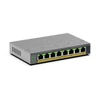
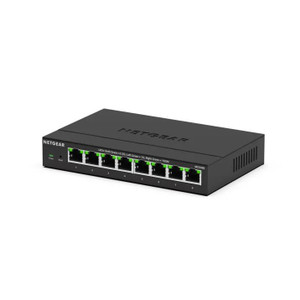
NETGEAR GS108EPP-100NAS 8-Port Gigabit PoE+ Switch
The NETGEAR GS108EPP-100NAS is an unmanaged Gigabit Ethernet switch purpose-built for deploying networked cameras, wireless access points, and IoT endpoints across small-to-medium installations. All eight ports supply 802.3at PoE+ power simultaneously, eliminating the capital and real-estate overhead of separate midspan injectors or wall-mount power supplies. Unmanaged operation — no web interface, no CLI, no firmware updates — means you plug it in and route traffic instantly. Industrial-temperature design supports cabinet mounting in climate-controlled or semi-outdoor enclosures, making it suitable for both security control rooms and edge cabinet deployments.
Key Features
- 8 Gigabit Ethernet Ports: 1 Gbps per port, all autosensing (10/100/1000 Mbps). Supports cameras and access points on standard RJ-45 wiring with no special cabling.
- 802.3at PoE+ on All Ports: Full 30W per port simultaneously across all eight ports. Powers PTZ cameras, IR dome units, and dual-radio wireless APs without auxiliary power injectors.
- Unmanaged Architecture: No configuration interface, no VLAN or QoS tuning, no management traffic. Zero learning curve — suitable for field integrators without network engineering staff.
- Industrial Operating Temperature: Rated for extended ambient range, enabling reliable operation in unheated cabinets, utility closets, and semi-outdoor wall-mount enclosures.
- Plastic Enclosure with Wall/Ceiling Mount Options: Lightweight, DIN-rail and surface-mount compatible. Reduces installation labor vs. rack-mount alternatives on small deployments.
- 5-Year Manufacturer Warranty: Standard coverage across the product lifecycle, protecting against defects in manufacture and component failure.
- Automatic Power Management: Internal AC power input with auto-power-on recovery. No manual intervention required after site power restoration.
- Plug-and-Play Deployment: Connects directly to existing network backbone (uplink switch or router) and begins forwarding traffic within seconds of power application.
Typical Deployment Scenarios
The GS108EPP-100NAS is optimized for distributed camera clusters and access-point rings where a single switch location consolidates both Ethernet backhaul and PoE sourcing. A typical use case: a 6-camera perimeter cluster fed through a single cabinet drop (one uplink to the core switch) with all local camera power derived from the GS108EPP. Each camera draws 10–25W; the switch's power budget accommodates 6–8 cameras without load shedding. For larger deployments (12+ cameras), cascade multiple GS108EPP units on the same uplink, or upgrade to a managed PoE+ switch that supports advanced scheduling and port-level power limiting.
Access point clusters benefit similarly: two-radio 802.11ac access points typically consume 20–30W each. A six-port AP ring plus two camera uplinks leaves headroom for growth. The unmanaged nature means no VLAN configuration is required — all ports are on a single broadcast domain, simplifying provisioning in environments without dedicated network staff. VLAN segmentation, if needed, must occur upstream at the core switch.
Power Budget and Load Planning
The unit's total PoE power output is manufacturer-specified and must be verified against connected device datasheets. Typical camera power draw ranges from 6W (fixed HD cameras with passive IR) to 45W (30x optical zoom PTZ with integrated heater). High-power devices like motorized zoom cameras or heated PTZ domes may require PoE++ (802.3bt) support — the GS108EPP supports 802.3at (PoE+) exclusively. If your deployment requires mixed PoE+ and PoE++ devices, consult a managed switch with mixed-standard support or deploy separate PoE injectors for PoE++ loads. Always sum expected device wattages before installation; exceeding the switch's total power budget will cause brownout conditions and intermittent device reboots.
Network bandwidth per port is 1 Gbps full-duplex, sufficient for HD and 2K IP cameras running at 2–8 Mbps, and for wireless access point backhaul (typical clients consume 5–15 Mbps aggregate). 4K camera streams (8–20 Mbps) remain compatible, but avoid oversubscribing a single switch with more than 4–5 simultaneous 4K streams if QoS or traffic shaping is required — unmanaged switches offer no rate-limiting, so congestion is handled by frame drops.
Integration and Backward Compatibility
The GS108EPP is transparent to all upstream network equipment: NVRs, VMS platforms, access control systems, and DHCP servers. No special configuration is needed — attach the uplink port to your existing network, and cameras connected to the switch ports automatically receive IP addresses (if your DHCP server is reachable) or self-assign link-local addresses. Since the switch is unmanaged, ONVIF device discovery works seamlessly across all ports without VLAN or subnet isolation concerns.
Physical Installation and Mounting
The plastic enclosure is compact and lightweight, with mounting brackets supporting DIN-rail, wall-surface, and ceiling-mount configurations. For cabinet deployment, verify adequate ventilation around the unit (passive convective cooling). The industrial temperature rating allows operation in unheated utility closets during winter months — confirm local ambient conditions against the datasheet before outdoor or semi-outdoor mounting. All eight port LEDs indicate link and activity status; no separate management port is required.
Compliance and Support
The GS108EPP carries standard RoHS and CE compliance for commercial networking equipment. NETGEAR supplies a 5-year manufacturer warranty covering defects in materials and workmanship. Technical support is available through standard NETGEAR channels; no advanced RMA or field-replacement options are included, so budget for potential downtime if a unit fails — for mission-critical deployments, consider deploying redundant switches or stocking a spare unit.
Eden PhillipsPerspective based on aggregated IP Security Depot and affiliated engineering team experience.
We've deployed the NETGEAR GS108EPP across dozens of distributed surveillance clusters and wireless infrastructure refresh projects. The value proposition is straightforward: it eliminates the capex and real-estate footprint of separate PoE midspan injectors. On a typical 6-camera perimeter ring, consolidating Ethernet switching and power delivery into one unmanaged device cuts installation labor by 15–20% compared to managing a separate PoE injector. The industrial temperature rating is the differentiator that makes semi-outdoor cabinet deployments viable — we've run these units in unheated utility closets during winter months without thermal issues. Candid limitations: this is strictly a PoE+ device (802.3at), so PTZ cameras with integrated heaters or dual-band APs drawing >30W require auxiliary power or a different switch. The unmanaged architecture means zero traffic visibility or rate-limiting — on a congested uplink, there's no built-in mechanism to shed low-priority streams. For small deployments (6–8 devices), that's rarely an issue. For facilities with 12+ cameras, migrate to a managed PoE+ switch or deploy multiple GS108EPP units cascaded upstream. The sweet spot is a single-cabinet camera cluster or a distributed ring of access points where the switch sits close to the devices and the uplink is provisioned conservatively.
Technical Highlights:
- 802.3at PoE+ on All 8 Ports: 30W per port, simultaneous delivery across all ports. Eliminates the cost and wiring complexity of external power supplies for HD cameras and standard wireless APs. Verify device power draw before design — any single device exceeding 30W requires PoE++ or auxiliary power.
- Gigabit Ethernet (1 Gbps per port): Sufficient for HD and 2K IP streams (2–8 Mbps per camera). Acceptable for 4K at lower frame rates; avoid oversubscribing with more than 4–5 simultaneous 4K streams without upstream QoS management.
- Unmanaged Operation: No configuration overhead, no firmware updates, no web interface access logs to worry about. Plug-and-play integration into existing networks. Trade-off: no VLAN isolation, no rate-limiting, no per-port power scheduling.
- Industrial Temperature Rated: Extends usable deployment envelope to unheated or semi-outdoor cabinets. Verified operation in 0–40°C ambient range supports winter-season utility closet and loading-dock installations.
- Plastic Enclosure with DIN-Rail and Wall-Mount Support: Lightweight and compact. Reduces cabinet space consumption vs. rack-mount managed switches. Passive cooling (no active fans) means silent operation and zero maintenance.
Deployment Considerations:
- Validate total PoE power budget against all connected devices before installation. A single high-power PTZ camera or dual-radio AP can consume 35–45W and risk brownout across other ports. Have device datasheets in hand at design time.
- The switch is unmanaged — no VLAN tagging, no QoS, no traffic prioritization. All ports are on a single broadcast domain. If subnet isolation is needed, implement VLANs upstream at the core switch or NVR.
- Position the switch close to the camera cluster to minimize cable runs and reduce cabling labor. The compact form factor allows cabinet, wall, or ceiling mounting; confirm adequate passive ventilation and verify ambient temperature matches the industrial operating range.
- Uplink port to the core switch or NVR should be provisioned for the aggregate camera traffic plus management traffic (NTP, syslog, alarm feeds). A single Gigabit uplink handles 6–8 cameras comfortably; beyond that, evaluate network capacity or cascade multiple GS108EPP units.
- This is a PoE+ (802.3at) device exclusively. PoE++ devices requiring 60W+ (large PTZ with integrated heating/cooling) will not function; plan a separate power supply or upgraded switch for those endpoints.
The NETGEAR GS108EPP is the right choice for integrators building small distributed camera clusters or access-point rings where consolidation, low cost, and zero configuration complexity are priorities. For larger, mission-critical facilities requiring power scheduling, VLAN isolation, or mixed PoE standard support, evaluate a managed PoE+ or PoE++ switch. Explore the full NETGEAR catalog for managed switch alternatives and complementary networking infrastructure.