
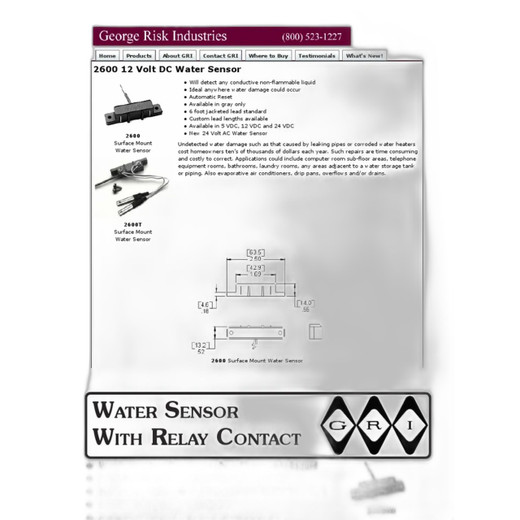



Product images are provided for reference and may not represent the exact model, configuration, or included
components.
Overview
SKU:
2600
Condition:
New
Availability:
Usually ships in 24 hours
Warranty
Manufacturer Warranty
GRI 2600 Water Sensor with Relay
GRI 2600 Water Sensor with Relay Overview The GRI 2600 is a water sensor designed to detect the presence of moisture and trigger relay-based alarm or…

GRI 2600 Water Sensor with Relay
$33.99
Your recommended setup
Review items below — quantities update pricing automatically.
Item
Qty
Status
Price
Optional Add-Ons recommended
Services optional
Bundle Summary
Bundle Subtotal:
$0.00
Optional Add-Ons:
$0.00
Services:
$0.00
Total:
$0.00
Overview
SKU:
2600
Condition:
New
Availability:
Usually ships in 24 hours
Warranty
Manufacturer Warranty
Description

GRI 2600 Water Sensor with Relay
Overview
The GRI 2600 is a water sensor designed to detect the presence of moisture and trigger relay-based alarm or shutdown responses in facility protection and building automation systems. The device combines moisture-sensing technology with integrated relay switching, making it suitable for deployment in server rooms, mechanical spaces, data centers, and other environments where water intrusion poses operational or infrastructure risk. The 2600 integrates directly into existing alarm and control systems without requiring complex gateway architecture.
Key Features
- Integrated relay output for direct alarm triggering or equipment shutdown
- Moisture-detection sensing element for early flood warning
- Normally open (NO) relay contact configuration for fail-safe operation
- Low-voltage operation compatible with standard alarm and control wiring
- Compact form factor suitable for wall mounting or direct placement in risk areas
- No external power supply required for basic detection operation
- Suitable for integration with legacy and modern alarm systems
- Field-replaceable sensing probe for extended service life
Technical Operation
The GRI 2600 functions as a passive detection device that monitors for moisture presence using a conductive sensing element. When water or conductive liquid bridges the sensor probe, the internal relay closes, triggering connected alarm circuits, visual indicators, or automated shutdown sequences. The relay contact rating supports standard alarm-class loads without requiring intermediate relays for most applications. Installation requires basic two-conductor wiring to alarm control panels or relay modules. The sensor operates across standard facility temperature and humidity ranges without calibration.
Integration & Compatibility
The 2600 integrates with any alarm control system that accepts normally open relay inputs, including legacy hardwired systems and modern networked alarm panels. The device is compatible with both 12V and 24V alarm system architectures through standard relay contact closure. No proprietary software, IP connectivity, or external power modules are required. The sensor can be daisy-chained with other detection devices on a single alarm zone circuit, making multi-point flood detection economical for large facilities. Installers should verify relay contact rating matches downstream alarm loads prior to deployment.
Typical Applications
Common deployment locations include server and network equipment rooms, HVAC mechanical spaces, basement and crawl space monitoring, pipe run areas, cooling system sumps, and utility closets. The 2600 is frequently used in conjunction with building management systems to trigger water shutoff valves, equipment alarms, or facility-wide notifications upon detection. Organizations deploying multiple sensors across large facilities benefit from the 2600's simple relay interface and installation cost efficiency.
Eden Phillips
I've specified the GRI 2600 water sensor in multiple data center retrofit projects where adding IP-based environmental monitoring was not feasible due to legacy panel architecture. The 2600 delivers reliable moisture detection through a simple relay interface that integrates seamlessly with hardwired alarm systems without requiring panel upgrades or IP gateway equipment. It's particularly effective for rapid deployment in existing facilities.
Technical Highlights:
- Relay-based detection: Direct normally open contact closure eliminates the need for intermediate signal conditioning or external power supplies in most alarm system architectures
- Passive sensing element: No calibration, battery replacement, or periodic maintenance required under normal operating conditions
- Field-replaceable probe: Extends device life by allowing sensor element replacement without full system removal
Deployment Considerations:
- Verify that the alarm panel or control module supports NO relay inputs at the planned voltage level before installation
- Position the sensing probe in the lowest point of the monitored area to detect water flow earliest in a flood event
- Test the relay closure and alarm response during system commissioning to confirm proper circuit integration
For facilities still operating traditional hardwired alarm systems, the 2600 remains a cost-effective and reliable choice for water detection without requiring system modernization. Installers appreciate the simple two-wire connection and lack of proprietary commissioning steps.
Specifications
Product Type:
Water sensor with relay
Communication:
Relay contact closure
Voltage:
12V/24V alarm system compatible
Have Questions?
Ask an Expert.
RELATED PRODUCTS
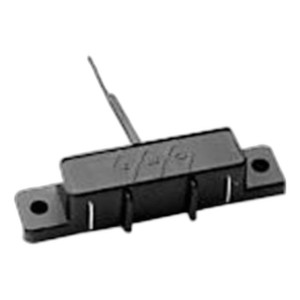


System Design, Deployment & Technical Support
Support services and planning resources for commercial surveillance, access control, and infrastructure deployments.
Fixed scope • Fixed price
System Design Assistance
- Get help validating product compatibility
- Coverage requirements
- Storage planning and deployment architecture before you buy.
Deployment & Configuration Support
- Access fixed-scope support for rollout planning
- User setup guidance
- Migration and system standardization across single-site or multi-site deployments
Guides, Tools & Calculators
- PoE requirements
- Storage retention
- Camera selection and deployment methodology