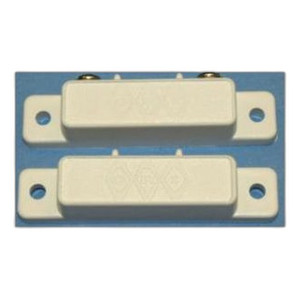
GRI 2800 Surface Mount Water Contact Sensor
The GRI 2800 is a surface-mounted water contact sensor engineered for early detection of water intrusion in critical facility environments. Unlike passive flood detection, this sensor triggers an immediate alert the moment it makes contact with standing water or moisture — meaning you catch leaks before they propagate through server racks, uninterruptible power supplies, or networked equipment. Direct contact detection is fast and simple: no threshold calibration, no false positives from humidity drift.
Key Features
- Direct water contact activation: The sensor responds only to actual liquid presence, not ambient humidity or condensation. This eliminates false alarms that plague humidity-based detection and keeps your monitoring team focused on real events.
- Surface-mount form factor: Installation requires no drilling, trenching, or invasive modifications — position the sensor on the floor near equipment, along cable trays, or in known drainage paths. This makes retrofit deployment feasible in existing facilities where downtime is costly.
- Standard monitoring system integration: The 2800 outputs a dry contact closure signal compatible with legacy security panels, modern VMS platforms, and building management systems. You integrate it into your existing alerting workflow without purchasing proprietary gateways or specialized monitoring hardware.
- Suitable for both new and retrofit installations: Whether you're building a new data center or adding leak detection to a warehouse, the 2800 deploys quickly without requiring facility modifications or disruption to active operations.
- Wide deployment scope: Effective in server rooms, equipment cabinets, basements, mechanical spaces, and any area where water intrusion represents a financial or operational risk.
Integration & Compatibility
The GRI 2800 integrates with standard commercial security and facility management monitoring platforms via dry contact output. No specialized protocol or proprietary software is required — the sensor works with conventional alarm panel inputs, relay-triggered notifications, and building automation systems that support contact-closure devices. This compatibility means you can add water detection to existing security infrastructure without architectural rework.
When to Choose a Different Approach
If you need continuous monitoring of moisture levels rather than binary wet/dry detection, consider a humidity or moisture-level sensor instead. If you require submersion detection or need the sensor to function submerged, verify that a contact-based approach is appropriate for your environment — some high-humidity spaces benefit from capacitive or optical water sensors that don't rely on direct liquid contact. For large-scale, multi-zone leak detection across an entire building, evaluate whether a networked sensor platform with centralized logging might reduce operational overhead compared to managing individual contact closures.
Ted PerryPerspective based on aggregated IP Security Depot and affiliated engineering team experience.
I'm Ted Perry, and while I typically focus on storage and retention systems, water detection is something I take seriously — because one leak can destroy weeks of recorded footage and the hardware hosting it. The GRI 2800 is straightforward: it closes a contact when water touches the sensor plate, triggering an immediate alert through your existing alarm panel or VMS. I've seen these deployed under raised floors in server rooms and along the base of NVR rack enclosures where HVAC condensate lines run overhead.
What makes this practical is the dry contact output — no proprietary gateway, no IP address to manage, just wire it into a zone on your security panel like any other sensor. One consideration: this is binary detection, not graduated moisture sensing. It tells you water is present, not that humidity is climbing or a slow seep is starting. For NVR environments where you need advance warning before liquid reaches equipment, pair this with environmental monitors that track humidity trends upstream.