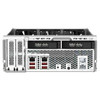
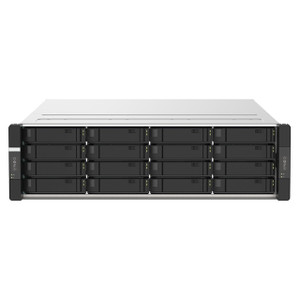
QNAP TNS-H1083X-E2234-8G NAS Node for GM-1000 High-Availability Systems
Overview
The QNAP TNS-H1083X-E2234-8G is a replaceable 10-bay NAS node designed for the GM-1000 high-availability storage system. Powered by an Intel Xeon E-2236 6-core/12-thread processor running up to 4.8 GHz, this node is built for environments where compute headroom, I/O density, and hot-swap serviceability matter — enterprise file services, surveillance storage clusters, and data-intensive edge deployments where a single point of failure is not acceptable. Because the node is field-replaceable within the GM-1000 chassis, you can service or upgrade the compute module without taking the entire storage array offline.
Key Features
- Intel Xeon E-2236, 6-Core / 12-Thread at up to 4.8 GHz: The Xeon E-2236 brings ECC memory support and server-class compute to a NAS node form factor. At up to 4.8 GHz boost, it handles concurrent workloads — simultaneous transcoding, snapshot processing, and active user sessions — without throttling under sustained load. If your previous NAS struggled during backup windows while users were still active, this architecture eliminates that bottleneck.
- 64-Bit x86 Architecture with AES-NI Encryption Engine: Hardware-accelerated AES-NI means full-volume or folder-level encryption runs with negligible CPU overhead. You get compliance-grade data protection — relevant for healthcare, legal, and financial data stores — without the 20–40% throughput penalty software encryption imposes on lesser hardware.
- 2x M.2 SSD Slots: Onboard M.2 slots let you provision SSD caching directly on the node, accelerating random I/O against spinning-disk RAID volumes. For mixed workloads with hot datasets — surveillance index files, database journals, frequently accessed project files — this tiered caching reduces latency without requiring a dedicated all-flash array.
- 2x PCIe Expansion Slots: Two PCIe slots give you genuine expansion flexibility. Add a 10GbE or 25GbE NIC for backbone connectivity, a fiber channel HBA for SAN integration, or additional NVMe storage — decisions you can defer until the deployment's actual I/O requirements are clear, rather than being forced to spec them at purchase time.
- 2x 2.5GbE LAN Ports: Dual 2.5GbE ports are included onboard, covering standard SMB and branch-office network topologies without requiring an add-in card. Port aggregation or failover bonding across both ports raises effective throughput for clients on a well-provisioned 2.5G switch fabric.
- 4x USB Ports: Four USB ports support direct-attach backup targets, UPS management interfaces, and peripheral connectivity — useful for air-gapped backup rotations or local management access without relying on network availability.
- Smart Cooling Design: The node integrates smart cooling management, relevant in dense chassis deployments where thermal regulation across multiple bays directly affects drive longevity and sustained CPU performance under continuous write loads.
- Replaceable Node Architecture: The defining deployment advantage of the TNS-H1083X-E2234-8G is its replaceability within the GM-1000 system. When a compute node reaches end-of-life or requires maintenance, the storage array stays online — a hard requirement for environments running 24/7 surveillance retention or always-on file services.
Integration and Compatibility
The TNS-H1083X-E2234-8G is designed specifically as a NAS node within the QNAP GM-1000 high-availability system architecture. It is not a standalone NAS — it requires the GM-1000 chassis and operates as the compute layer within that system. The dual PCIe slots support network expansion cards for higher-speed backbone integration, and the M.2 slots work within QNAP's QTS or QuTS hero operating system for SSD cache configuration. Buyers evaluating the broader QNAP NAS storage line should confirm GM-1000 chassis compatibility before ordering. For deployments pairing high-density storage with IP camera systems or network video recorders, the Xeon E-2236's processing capacity supports concurrent surveillance stream indexing and retention workloads at scale. Reference the storage capacity planning guide for retention calculations aligned to camera count and resolution.
Frequently Asked Questions
Q: Is the TNS-H1083X-E2234-8G a standalone NAS or does it require additional hardware?
A: The TNS-H1083X-E2234-8G is a NAS node designed specifically for the QNAP GM-1000 high-availability system. It is not a standalone unit — it operates as the replaceable compute module within the GM-1000 chassis. The GM-1000 chassis must be purchased separately.
Q: What processor does the TNS-H1083X-E2234-8G use, and why does it matter for NAS workloads?
A: It uses an Intel Xeon E-2236 6-core/12-thread processor running up to 4.8 GHz. The Xeon E-series includes ECC memory support and hardware AES-NI encryption acceleration — both relevant for enterprise data integrity and compliance-driven storage environments running encryption at volume.
Q: How many PCIe expansion slots does the TNS-H1083X-E2234-8G provide?
A: Two PCIe expansion slots are available, enabling add-in cards such as 10GbE/25GbE NICs, fiber channel HBAs, or additional NVMe storage expansion depending on deployment requirements.
Q: Can the TNS-H1083X-E2234-8G be replaced without taking the storage array offline?
A: Yes — the node is designed to be field-replaceable within the GM-1000 system, which is the core architectural advantage of the GM-1000 platform. The storage array can remain operational during node service or replacement.
Q: Does the TNS-H1083X-E2234-8G support hardware encryption?
A: Yes. The Intel Xeon E-2236 includes an AES-NI hardware encryption engine, enabling full-volume and folder-level encryption with minimal impact on storage throughput compared to software-based encryption.
Q: What network connectivity is built into the TNS-H1083X-E2234-8G?
A: The node includes two onboard 2.5GbE LAN ports. Additional higher-speed networking (10GbE, 25GbE) can be added via the two available PCIe expansion slots.
The TNS-H1083X-E2234-8G is the compute node at the heart of QNAP's GM-1000 high-availability architecture — and the 6-core/12-thread Xeon E-2236 running up to 4.8 GHz is what makes it viable for production workloads rather than just light file serving. That processor headroom matters specifically when you're running encryption, snapshot diffs, and active user I/O simultaneously, which is exactly the load profile in a well-utilized enterprise storage cluster.
Technical Highlights:
- AES-NI Hardware Encryption: Encryption at rest without measurable throughput degradation — the Xeon E-2236's AES-NI offloads cipher operations from general compute cores, keeping encrypted volumes performing close to unencrypted baseline.
- Dual PCIe Expansion: Two PCIe slots mean you're not locked into 2.5GbE as your ceiling — drop in a 10GbE or 25GbE NIC when the backbone warrants it, without replacing the node.
- Dual M.2 SSD Caching: Onboard M.2 slots for SSD tiering allow you to absorb random write spikes from active surveillance indexes or database journals without over-provisioning the spinning-disk RAID pool.
Deployment Considerations:
- Confirm GM-1000 chassis compatibility before ordering — the TNS-H1083X-E2234-8G (also searched as TNS H1083X E2234 8G) is a node module, not a complete NAS system. Ordering it without the GM-1000 chassis leaves you with compute and no enclosure.
- The dual 2.5GbE onboard ports will saturate quickly in multi-user or high-camera-count deployments — budget for a 10GbE add-in card via PCIe if your switch fabric supports it.
This node is the right specification for a GM-1000 deployment in a mid-to-large enterprise surveillance or file services environment where the compute layer needs to keep pace with 24/7 write loads, encryption requirements, and phased NIC upgrades — all without scheduling downtime for node swaps.