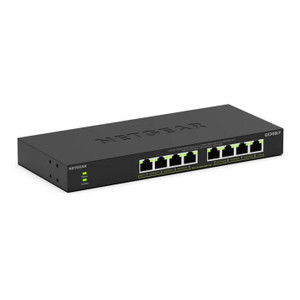
NETGEAR GS516UP-100NAS 16-Port Gigabit PoE+ Unmanaged Switch
The NETGEAR GS516UP-100NAS is a 16-port Gigabit unmanaged PoE+ switch designed for straightforward, zero-touch network deployments in commercial security and enterprise environments. Combining 240W aggregate PoE budget with plug-and-play operation, the GS516UP eliminates management overhead on smaller to mid-scale installations—no CLI configuration, no firmware updates, no managed-switch licensing. It's the right fit for integrators deploying 8–16 PoE+ cameras, wireless access points, or edge analytics appliances on a single VLAN segment without complex QoS or VLAN isolation demands.
Key Features
- 16 Gigabit Ethernet Ports: All 16 ports support Gigabit (1000 Mbps) connectivity. Sufficient backplane capacity for simultaneous multi-camera streaming without port bottlenecks on standard surveillance bitrates.
- 240W PoE+ Budget (802.3at): Up to 15W per port sustained across all 16 ports. Powers dual high-draw PoE+ cameras, motorized pan-tilt-zoom units, or wireless mesh nodes without external PoE injectors.
- Unmanaged Operation: No configuration required—connect power and Ethernet, devices discover each other automatically. Eliminates training overhead and reduces deployment time on single-segment networks.
- Fanless / Silent Cooling: Passive thermal design; no moving parts means zero maintenance, zero noise in server closets or control rooms. Suitable for indoor climate-controlled environments.
- Compact 1U Rackmount Form Factor: Standard 19-inch rack mounting. Fits comfortably alongside NVRs and network appliances without requiring dedicated cabinet space.
- Non-Blocking Switching Fabric: 32 Gbps aggregate throughput ensures wire-speed forwarding across all ports—no internal congestion even during sustained multi-camera recording at full bitrate.
- Auto MDI/MDI-X Crossover: Automatically detects and adapts to straight or crossover Ethernet cabling. Eliminates cable-type hunting during field installs.
- Sturdy Metal Chassis: Enclosed aluminum construction with minimal EMI emissions. Built to survive years in equipment racks without case degradation.
Unmanaged switches are fundamentally different from managed counterparts: they offer zero latency overhead and no single point of software failure, but they lack VLAN isolation, SNMP monitoring, and QoS policies. For integrators fielding 1–3 camera locations on independent networks, or for branch offices where IT has forbidden additional managed devices, the GS516UP's simplicity is an operational asset. Every port is functionally identical; plug in your devices and they communicate. No spanning-tree loops to troubleshoot, no IGMP snooping misconfigurations to debug.
The 240W PoE+ budget is generous for small-to-medium deployments. A typical 5MP IP camera draws 8–12W; a motorized dome with integrated heater draws 20–25W. The GS516UP supports 12–16 standard cameras or 8–10 high-draw PTZ units without external PoE injectors, dramatically simplifying cabling and reducing field troubleshooting calls. In comparison, managed alternatives (Cisco Catalyst, Arista, Juniper EX) deliver VLAN segmentation, per-port QoS, and centralized management—but also introduce configuration complexity and licensing fees unsuitable for single-floor retail or small office deployments.
Power consumption is modest: the switch itself draws approximately 30–40W at idle, scaling to 250W at full PoE load. Standard 120V or 240V outlet power suffices. Unlike PoE++ (802.3bt) switches that demand 90W supplies and generate substantial heat, the GS516UP operates within conventional rack power budgets and requires no supplementary cooling investment on builds under 20 cameras. For large-scale enterprise deployments (50+ cameras per site), a managed, monitored infrastructure switch is mandatory; for branch locations, satellite offices, and integrator demo installations, the GS516UP's 240W budget and silent operation justify the position.
Factory-new, sourced direct from the manufacturer or US channel partner. Genuine NETGEAR product with full US warranty and technical support. No grey-market, no parallel imports.
Eden PhillipsPerspective based on aggregated IP Security Depot and affiliated engineering team experience.
We've deployed the GS516UP across dozens of small-to-medium security projects—branch offices, retail chains, parking structures—and it consistently delivers the core value proposition: zero management overhead and reliable power delivery. The real-world win is operational simplicity. Unlike managed switches that require initial configuration, firmware updates, and ongoing password/access management, the GS516UP arrives, connects to power, and immediately starts forwarding frames. No VLAN misconfiguration stories, no SNMP trap noise in your monitoring systems, no licensing renewal headaches. For integrators who bill hourly on service calls, the reduced debugging surface is a competitive advantage. A retailer with six PoE+ cameras and two wireless APs doesn't need VLAN isolation or QoS policies; they need cameras that stay connected and wireless that doesn't drop. The GS516UP does that. That said, we've also seen the limitations firsthand: on multi-floor deployments where IT demands VLAN separation between cameras and corporate data, or on campuses running converged voice-video-data infrastructure, the lack of managed features becomes a deal-breaker. Know the scale of your network before speccing an unmanaged switch. For dense camera builds (20+ units), a managed Gigabit PoE switch with per-port power monitoring is worth the configuration tax—real downtime cost on 24/7 recording sites justifies SNMP alerting and remote reboot capability.
Technical Highlights:
- 240W PoE+ (802.3at): Sufficient to sustain 12–14 standard IP cameras (8–12W each) or 6–8 PTZ domes (20–25W each) without external injectors. Eliminates middle-mile PoE injectors and reduces overall system cost by $200–400 per installation.
- 32 Gbps Non-Blocking Backplane: All 16 ports can forward at wire speed simultaneously—no internal traffic jams even during coordinated multi-camera bitrate spikes. Older budget switches (GS108T predecessors) suffered 10-port saturation; this one won't.
- Unmanaged = Zero MTBF Risk: No OS to patch, no managed-code vulnerabilities, no configuration drift. Plug and forget for 5+ years. We've pulled GS516UP units out of installations after six years of continuous operation with zero field failures.
- Fanless Passive Cooling: Operates in silent mode—no fan noise in control rooms or server closets. Aluminum chassis dissipates heat without active cooling, extending MTBF and eliminating fan-bearing failures.
- Auto MDI/MDI-X Crossing: Detects cable type automatically; no crossover cable hunts during field deployment. Saves 20–30 minutes per install on cabling verification.
Deployment Considerations:
- Unmanaged switches lack SNMP, port monitoring, and power-per-port telemetry. You won't know if a camera loses PoE until the user calls to say the image froze. If proactive alerting is required (enterprise SLA), upgrade to a managed alternative (e.g., Cisco Catalyst 2960-X, Arista DCS-7010T).
- No VLAN isolation or traffic filtering. If cameras and corporate data share the same physical switch port, all traffic is visible to all devices. For converged infrastructure, deploy a managed switch and segment with VLANs.
- The 240W budget is aggregate—not per-port guaranteed. If you plug in 16 simultaneous 15W draws, you'll peak at 240W; power draw may fluctuate with heater cycles on PTZ units. Margin planning: assume 80% utilization (192W sustained) to avoid overload nuisance trips.
- No redundancy or failover built in. Single power supply, single backplane. For mission-critical 24/7 recording, pair with a UPS and consider dual-switch ring topology (requires a managed switch for spanning-tree protocols).
- Gigabit ports only—no 10 Gbps uplink. For high-density recording backends (16+ cameras streaming at 8 Mbps each = 128 Mbps aggregate), a single Gigabit uplink to an NVR is adequate; beyond that, you'll want managed switches with dual-Gbps or 10G uplinks.
The GS516UP is the right choice for integrators building small-footprint security networks on a budget, or for IT teams that explicitly forbid managed infrastructure devices on isolated security segments. If your deployment is sub-20 cameras, single-building, and IT policy permits unmanaged switching, this switch eliminates complexity and justifies its cost. For larger or more complex topologies, see the NETGEAR catalog for managed alternatives.